

Goya's First Warning
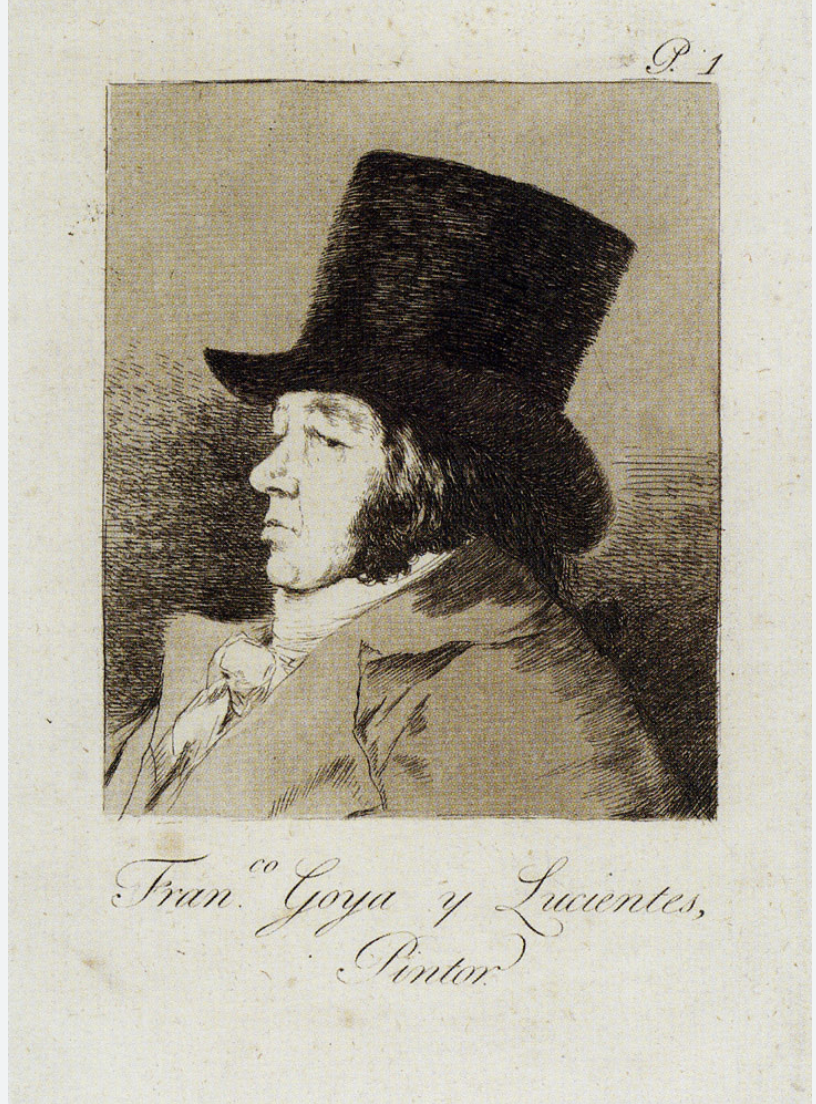
Goya's First Warning
Technical Data
Title: Francisco Goya y Lucientes, pintor
Spanish Title: Francisco Goya y Lucientes, pintor
Artist: Francisco de Goya y Lucientes
Date: 1799
Series: Los Caprichos, Plate 1 of 80
Medium: Etching and aquatint with drypoint and burin
Dimensions: 21.8 × 15.2 cm (8.6 × 6 in.)
Current Location: Museo Nacional del Prado, Madrid
Before witches take flight, before donkeys become scholars, before reason falls asleep and monsters emerge from the darkness, Goya asks us to stop before a single, silent image. The opening plate of Los Caprichos is neither satirical nor grotesque. It is a portrait of the artist himself.
At first sight, the choice appears almost unexpected. An eighteenth-century gentleman, wearing a fashionable top hat, is shown in profile against a plain background. There is no dramatic gesture, no symbolic object and no obvious clue to the extraordinary sequence of images that will follow. Yet this apparent simplicity conceals one of the most deliberate decisions of the entire series.
Every great work begins by establishing its narrator. Novelists do so with words; Goya does so with an image. Rather than writing a preface, he places himself at the entrance to his own visual journey. The inscription beneath the portrait—Francisco Goya y Lucientes, Pintor—is more than an identification. It is a declaration of authorship. Before challenging the prejudices, hypocrisies and superstitions of his age, Goya first reveals the person who assumes responsibility for what is about to be said.
This decision was not without risk. Published in 1799, Los Caprichos exposed the follies of Spanish society with a boldness that few artists had attempted. Although the satire was expressed through fantasy, allegory and humour, its targets were unmistakable. Vanity, ignorance, greed, false learning and social pretence appear throughout the series. By placing his own likeness on the first page, Goya does not hide behind anonymity. He signs the work not at its conclusion but at its beginning, accepting from the outset the consequences of his vision.
The portrait itself reinforces this sense of quiet resolve. Goya does not face the viewer directly. Seen in profile, his attention seems fixed on something beyond the limits of the image, inviting us to follow his gaze rather than admire his appearance. The expression is calm, thoughtful and restrained. There is no trace of self-glorification. Instead, the artist appears as an observer preparing to lead us into a world where appearances are repeatedly stripped away.
The first plate therefore serves as a threshold. Crossing it means accepting Goya's invitation to look beyond convention and to confront uncomfortable truths about human behaviour. Everything that follows—the absurd marriages, the corrupt clergy, the foolish aristocrats, the witches and the monsters—will be filtered through the eyes of the man introduced here. His portrait is not an interruption before the real story begins; it is the key that unlocks it.
For this reason, Plate 1 is far more than an elegant self-portrait. It is an act of artistic accountability. Before exposing the illusions of an entire society, Goya exposes himself. Only then does he invite us to enter one of the most penetrating visual explorations of human nature ever created.
Juan de Barrientos