

The Sleep of Reason Produces Monsters
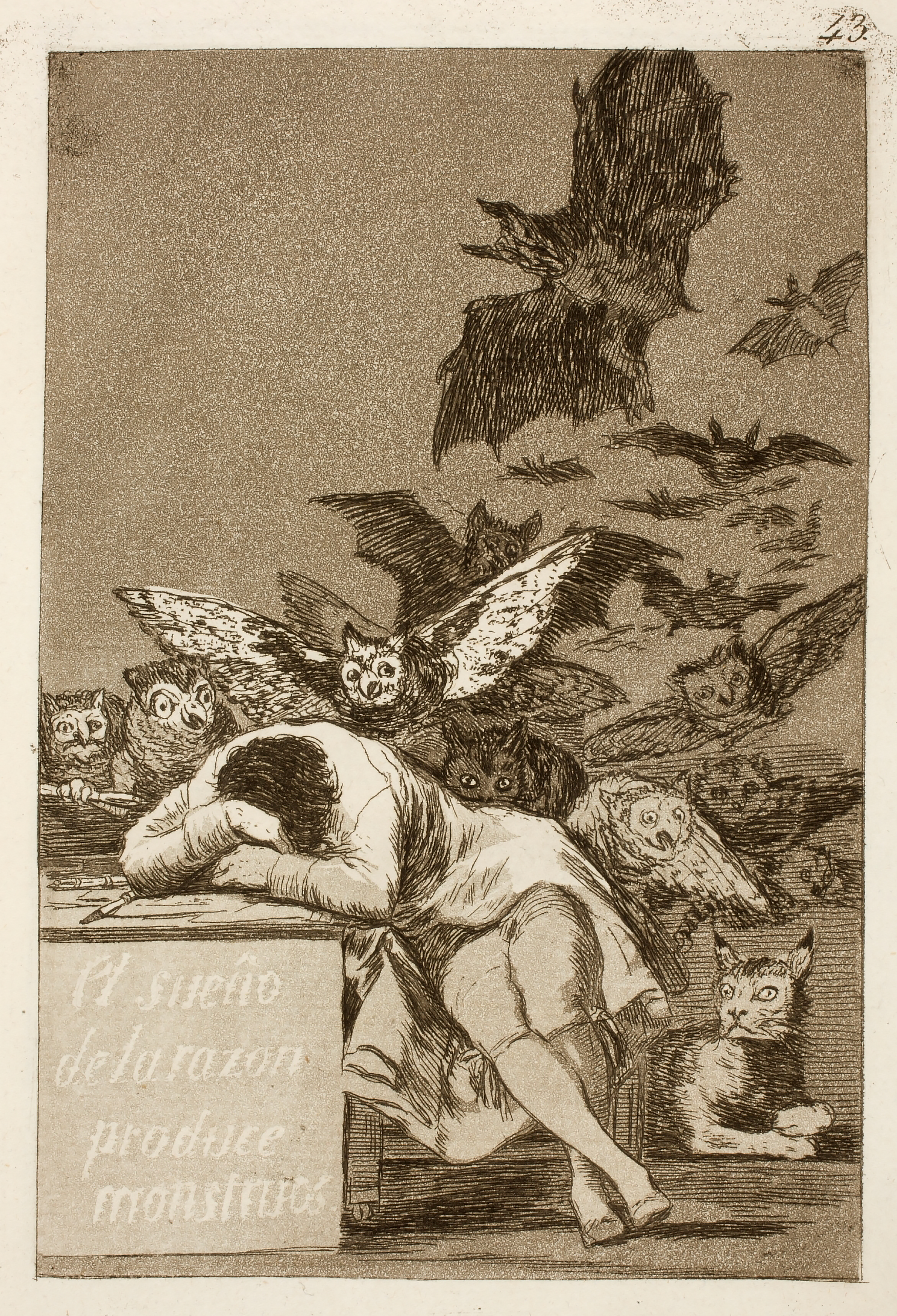
Title: The Sleep of Reason Produces Monsters (El sueño de la razón produce monstruos)
Series: Los Caprichos, No. 43
Date: 1799
Technique: Etching, aquatint, drypoint and burnisher on laid paper
Plate: 21.4 × 15.2 cm (8.4 × 6.0 in)
The Sleep of Reason Produces Monsters
A man appears to have fallen asleep over his work., his head resting heavily on folded arms, while the darkness behind him comes alive with owls, bats and a silent lynx. The composition is quiet, almost still, it immediately creates a sense of unease.
The sleeping figure occupies the centre of the image, but our attention is quickly drawn beyond him. Shapes begin to emerge from the darkness. Some are clearly recognisable, others dissolve into shadow before the eye can fully grasp them. The longer we look, the less certain we become about where the visible world ends and the imagined one begins.
Light plays a crucial role. The foreground remains illuminated, allowing us to see the man's body and the surface on which he rests. Behind him, however, the background becomes an undefined space from which the nocturnal creatures silently advance. Goya offers no clear boundary between reality and dream. Instead, he invites both to coexist within the same image.
At this stage, it is worth resisting the temptation to search immediately for symbolic meanings. Before asking what the owls, bats or lynx represent, the engraving asks us to experience something more immediate: the unsettling sensation that reason has briefly withdrawn, leaving the imagination free to occupy the scene. The creatures belong to the world of the sleeper's nightmare, where imagination has taken visible form.
The first encounter with this print therefore raises more questions than answers. Is the man merely exhausted, or has he surrendered something more profound than consciousness? Are the creatures threatening him, inspiring him, or simply waiting for him to awaken? Goya offers no explanation. He asks us first to observe, to remain with the image, and to recognise that uncertainty itself is part of its extraordinary power.
The Sleep of Reason Produces Monsters is the forty-third plate of Los Caprichos, published by Francisco Goya in 1799. Executed using etching and aquatint with touches of drypoint, the print demonstrates Goya's remarkable ability to combine precise line with broad tonal effects. The aquatint is particularly important here, allowing darkness itself to become an active element of the composition rather than a simple background.
The engraving is carefully balanced. The sleeping figure occupies the lower centre of the image, creating a stable triangular mass that anchors the composition. Behind him, however, order begins to dissolve. Owls emerge from the shadows with wide, luminous eyes, bats sweep through the air in restless movement, while a lynx remains motionless, watching in silence. Together they create a visual rhythm that contrasts sharply with the stillness of the sleeping man.
The creatures are not arranged randomly. Their gradual emergence from the darkness creates the impression that they are advancing towards the figure without ever fully entering his physical space. Goya deliberately avoids clear spatial definition. The background possesses no architectural structure, no identifiable landscape and no visible horizon. Instead, it functions as an indeterminate realm where imagination and reality overlap.
Light reinforces this ambiguity. Rather than illuminating the entire scene, it isolates the sleeper and the surface before him, while leaving the surrounding space unresolved. The eye moves repeatedly between certainty and uncertainty, between what is clearly seen and what remains only partially revealed. This careful manipulation of light and shadow owes much to Goya's experience as a painter, yet the restraint of black and white gives the composition an intensity unique to printmaking.
The inscription beneath the image, El sueño de la razón produce monstruos, serves not merely as a title but as an integral part of the composition. Its placement invites the viewer to read only after observing, encouraging a dialogue between text and image rather than allowing one to explain the other. Goya's own preparatory note deepens this relationship: "Fantasy abandoned by reason produces impossible monsters; united with reason, she is the mother of the arts and the origin of marvels." Far from condemning imagination, the artist presents reason and imagination as complementary forces whose balance lies at the heart of artistic creation.
Juan de Barrientos