

Los Caprichos
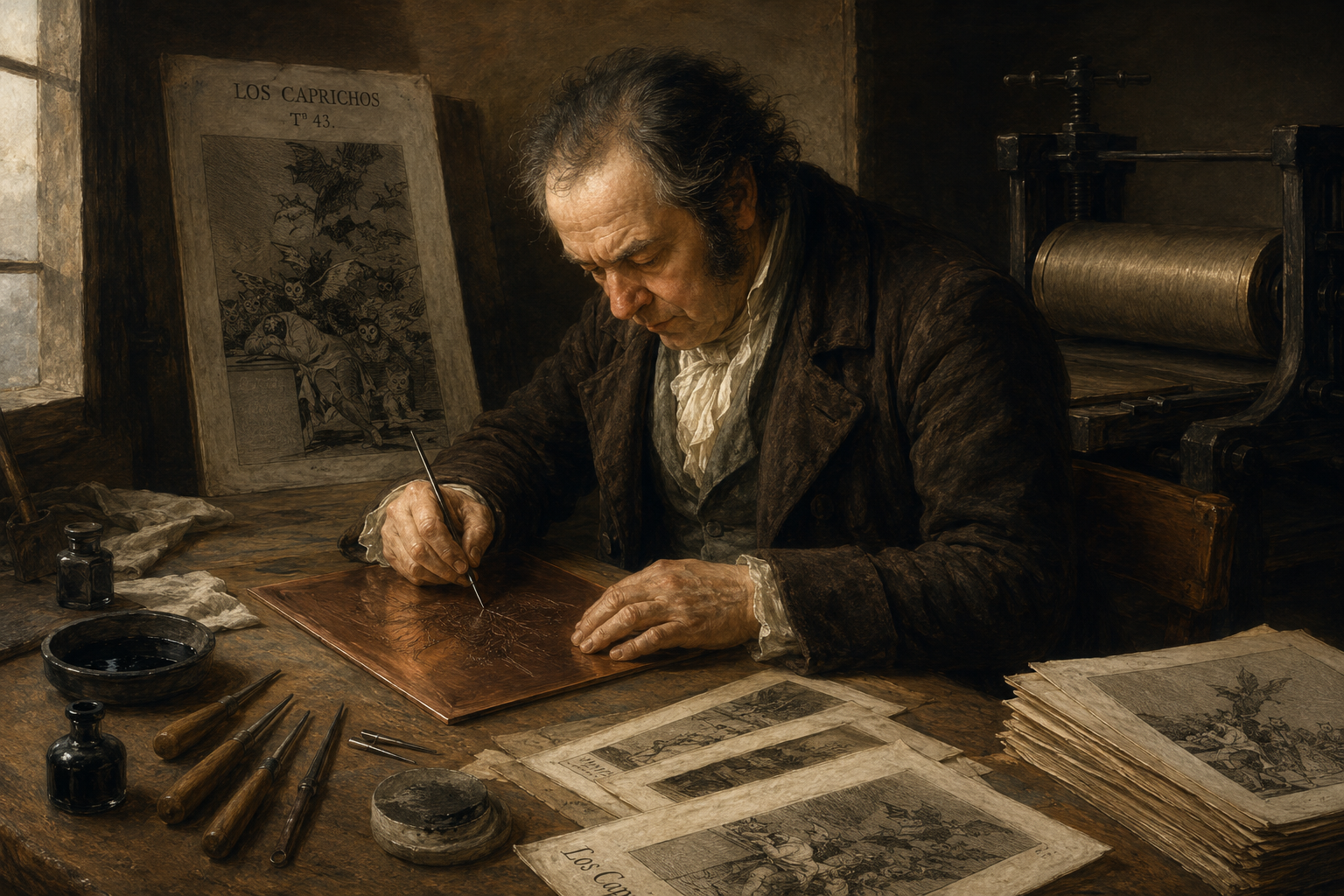
Los Caprichos
Artist: Francisco de Goya y Lucientes (1746–1828)
Date: Conceived 1797–1798; first published in 1799
Medium: Etching, aquatint, drypoint and burin on paper
Number of Prints: 80
First Edition: 1799
Publisher: Francisco de Goya
Printing Technique: Intaglio printing from copper plates using a rolling press
Current Collections: Complete sets are preserved in major museums including the Museo del Prado, Madrid; the British Museum, London; and the Metropolitan Museum of Art, New York.
Subject: A satirical and deeply personal exploration of Spanish society and universal human behaviour.
Significance: Widely regarded as one of the greatest print series in the history of Western art.
Unlike most artists of his time, Francisco de Goya was not content to express himself only through painting. During the final years of the eighteenth century, he turned increasingly to printmaking, discovering in the copper plate a freedom that even the largest canvas could not always provide. The result was Los Caprichos, a series of eighty prints first published in 1799 that transformed the possibilities of graphic art and revealed a side of Goya that was more personal, more critical and, at times, profoundly unsettling.
The series emerged during a decisive period in the artist's life. Goya had already achieved remarkable success as a portrait painter and had become Painter to the King, yet his growing reputation did not shield him from personal hardship. Around 1792 he suffered the mysterious illness that left him permanently deaf. The silence that followed did not diminish his creativity; instead, it appears to have sharpened his powers of observation.
At first glance, Los Caprichos may appear to be simple black-and-white illustrations. In reality, each print is the result of a remarkably sophisticated process that combines artistic vision with technical mastery. Goya mastered etching, aquatint, drypoint and burin to create a new expressive language for printmaking.
The figures that inhabit Los Caprichos are unforgettable. Although deeply rooted in eighteenth-century Spain, the series ultimately explores enduring aspects of human nature. More than two centuries later, these eighty prints remain strikingly contemporary because Goya was not recording a passing moment in history, but exploring enduring truths about the human condition.