

The Bravura Brushstroke
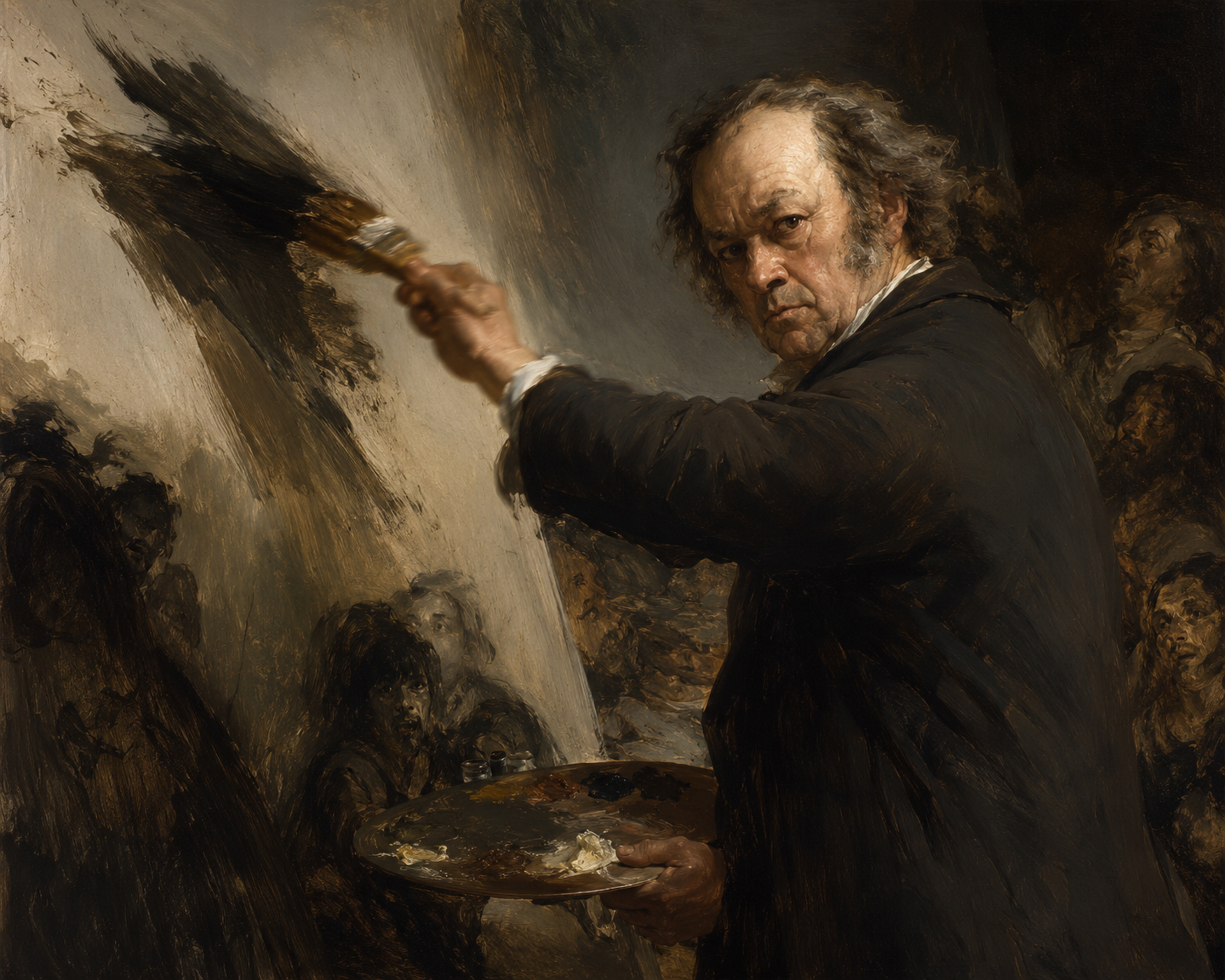
Do the Black Paintings seem unfinished? Faces dissolve into broad patches of shadow, clothing is suggested with only a handful of strokes, and entire passages appear almost careless when viewed from a close distance. Yet this impression disappears the moment the viewer steps back. Suddenly the figures emerge with astonishing clarity, their presence becoming more convincing precisely because Goya has resisted the temptation to describe every detail.
This is one of the greatest lessons these paintings offer. Goya was not abandoning technique; he was abandoning unnecessary information. By the time he covered the walls of the Quinta del Sordo, he had spent more than forty years proving that he could satisfy every expectation of academic painting. He knew how to render velvet, lace, polished armour and luminous flesh with extraordinary precision. The freedom of the Black Paintings was therefore not the result of declining ability, but of complete mastery.
Painters have long used the Italian word bravura to describe passages executed with exceptional confidence and authority. A bravura brushstroke is not simply a rapid stroke. It is a mark placed with such certainty that hesitation disappears. One movement of the brush replaces dozens of smaller corrections. The stroke carries both the description of the form and the personality of the artist who painted it.
Standing before these murals in the Prado, one begins to understand that Goya was no longer interested in perfect illusion. His brush no longer sought to conceal itself beneath a polished surface. Instead, it became visible, energetic and unapologetically direct. The paint itself became part of the visual language. Every broad sweep of black, every broken highlight and every abrupt transition from light to shadow remind us that we are looking not only at an image, but at the physical trace of a human hand moving across a wall.
This transformation marks a profound shift in the history of painting. Rather than asking how faithfully art could imitate reality, Goya began asking how directly it could communicate thought, fear, memory and emotion. The brushstroke ceased to be merely a technical instrument. It became the painter's own voice.
When visitors stand before the Black Paintings today, they often have the curious impression of encountering a way of painting that seems astonishingly fresh, even to twenty-first-century eyes. Yet their true originality lies elsewhere. Goya transformed the brushstroke itself into the principal vehicle of expression, allowing the physical act of painting to communicate as powerfully as the subject depicted.
Nearly a century before Expressionism emerged as an organised artistic movement, Goya was already employing many of the principles that would later define it. Form yields to emotion, anatomy bends to psychological truth, and visible brushwork becomes an essential part of the image rather than something to be concealed. The viewer responds not only to the faces and gestures of the figures, but also to the energy with which the paint has been laid upon the wall.
This achievement becomes even more remarkable when placed within the context of Goya's own career. The painter who had once produced brilliantly finished portraits for kings, aristocrats and ministers deliberately abandoned polished surfaces in favour of immediacy. Such a transformation was possible only because he had already mastered every convention of academic painting. Freedom did not replace discipline; it grew out of it.
The Black Paintings therefore represent far more than the final works of an ageing master. They reveal an artist who discovered that the brush could record thought itself. Every sweeping stroke, every broken edge and every abrupt transition between light and shadow preserves the instant of its creation, allowing us to follow the movement of Goya's hand across the wall almost two centuries later.
Perhaps this is their greatest legacy. The Black Paintings remind us that the highest purpose of painting is not always to imitate the visible world with increasing precision. Sometimes a single fearless brushstroke reveals more about the human condition than a thousand meticulously finished details. In Goya's hands, bravura became something more profound than technical virtuosity. It became a language of truth.
Juan de Barrientos