

The Black Paintings Palette
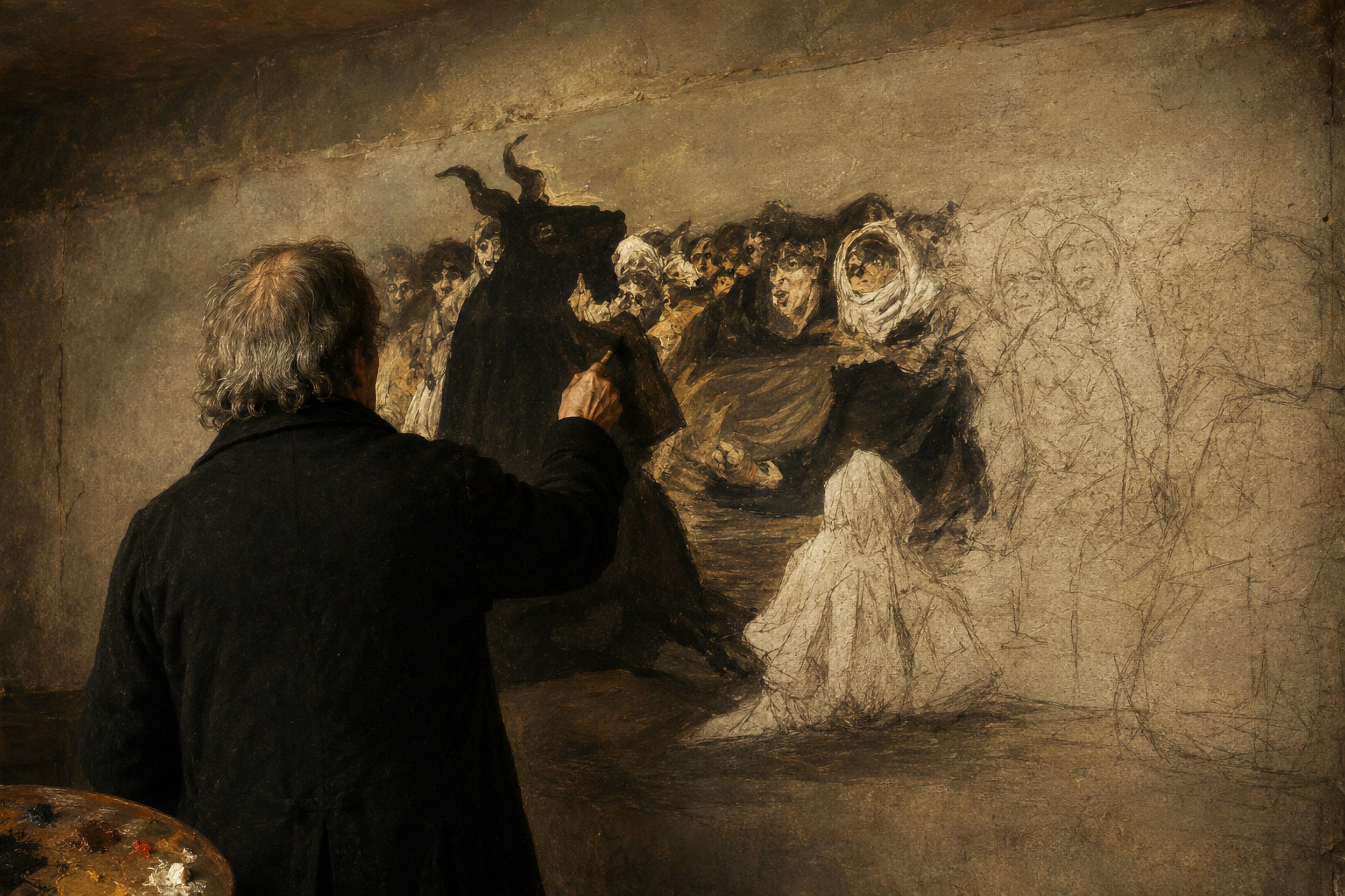
In his Black paintings, Goya did not , of course, simply paint with black; he deliberately reduced his palette to a remarkably small group of pigments, relying on their interaction rather than on the brilliance of colour itself.
The technical analyses carried out by the Museo del Prado and other conservation laboratories show that the paintings were built around a limited but highly effective selection of materials. Lead white remained indispensable, not merely for highlights but as a structural component throughout the compositions. Bone black and ivory black provided the deep shadows for which the series is famous, while yellow ochre, red ochre, raw umber and burnt umber supplied the warm earth tones that replace the brighter colours of his earlier career. Prussian blue appears sparingly, generally in the skies and in cool grey mixtures, while vermilion and occasional red lakes survive only as discreet accents rather than dominant hues.
What is striking is not simply the absence of vivid colours, but the complete change in their function. Earlier in his career, Goya employed a richer range of pigments for royal portraits, tapestry cartoons and religious commissions, where colour described fabrics, landscapes and light. In the Black Paintings, colour is no longer descriptive. It becomes structural. Every pigment is expected to perform several tasks simultaneously: creating volume, controlling temperature, establishing atmosphere and directing the viewer's eye.
The paintings are dominated by a carefully balanced dialogue between blacks, whites and earth pigments. Even when Prussian blue is introduced, it rarely appears as an obvious blue. Mixed with lead white, blacks and earth colours, it cools the shadows and gives the skies a heavy, almost oppressive atmosphere rather than a naturalistic appearance.
This reduction was not a consequence of poverty or lack of materials. By the second decade of the nineteenth century, Goya had access to professional colour merchants who supplied prepared pigments, drying oils and varnishes, allowing artists to obtain materials of consistent quality. The decision to work with such a restrained palette was therefore an artistic choice rather than a practical limitation. Like a composer who abandons the full orchestra in favour of a string quartet, Goya discovered that expressive power often increases when the available means are reduced.
The Black Paintings demonstrate that one of the most influential bodies of work in European art was created with remarkably few pigments. Rather than seeking chromatic richness, Goya pursued emotional intensity, proving that profound psychological expression could emerge from the simplest of palettes.
The extraordinary atmosphere of the Black Paintings does not arise from the use of black pigment alone. It is the result of carefully balanced mixtures in which every colour modifies the character of the others. Goya understood that darkness is never a single colour. It is constructed through subtle variations of temperature, transparency and value.
Lead white was perhaps the most important pigment in this process. Although invisible as a dominant colour in many passages, it is present throughout the paintings, mixed into blacks, blues and earth pigments to control opacity and luminosity. Rather than applying white only as a highlight, Goya used it to shape forms from within, allowing figures to emerge gradually from the surrounding darkness. The light seems to breathe through the paint instead of resting upon its surface.
The blacks themselves were equally complex. Bone black and ivory black provided dense, velvety shadows, yet Goya rarely used them alone. Mixed with raw or burnt umber they produced warm, earthy passages, while the addition of lead white created an astonishing range of silvery greys. These greys are among the most characteristic colours of the series. They give flesh its spectral appearance, dissolve distant forms into the background and transform ordinary space into something psychologically uncertain.
When using Prussian blue, it is used only sparingly, yet its influence is considerable. Rather than painting brilliant blue skies, Goya seems to have employed it to cool his mixtures and introduce a subtle atmospheric depth. Pure Prussian blue has a distinctly greenish cast, particularly when compared with ultramarine. From a painter's perspective, the most logical way to neutralise that tendency is through the restrained addition of a warm red such as vermilion, together with earth pigments. The resulting mixtures lose their obvious blueness and become deep, complex greys that retain a quiet sense of colour without ever calling attention to themselves.
This explains why the skies of the Black Paintings feel so unusual. They are neither blue nor black. They are built from delicate relationships between cool and warm pigments, where blue exists more as temperature than as colour. The atmosphere becomes oppressive not because Goya covered the surface with black paint, but because he removed almost every trace of chromatic brilliance.
The same principle governs the entire series. Earth pigments replace decorative colour; whites illuminate from within; blacks establish structure; blue cools the air; small touches of red restore chromatic balance. Every pigment performs multiple functions, and none exists in isolation. Goya had reduced his palette to its essentials, yet within those few colours he discovered an almost limitless range of emotional expression.
The restricted palette of the Black Paintings reveals a profound shift in Goya's understanding of painting itself. Throughout much of European art, colour had traditionally served to imitate the visible world. Rich fabrics required brilliant reds, landscapes demanded vivid greens, and clear skies called for luminous blues. Goya gradually abandoned that tradition. In the final years of his life, colour ceased to describe appearances and became a vehicle for emotion.
This transformation is striking because it was achieved through subtraction rather than addition. Instead of searching for new pigments or more brilliant colours, Goya reduced his materials to a small number of blacks, whites, earth pigments and a few carefully controlled accents. The limitation was deliberate. Every colour that remained had to justify its presence. Nothing is ornamental; nothing exists simply because it is beautiful.
The result is a pictorial language in which atmosphere takes precedence over description. Flesh is no longer convincingly alive but ghostly. Skies are no longer meteorological observations but emotional spaces. Light no longer illuminates the world objectively; it emerges from the paint itself, revealing faces and gestures before allowing them to dissolve once again into shadow. The viewer is not invited to admire colour but to experience uncertainty, tension and silence.
When studying the Black Paintings today, one of their most striking qualities is the extraordinary economy of means. Working with a palette that appears remarkably restrained, Goya achieved an exceptional richness of tonal relationships. Warm and cool greys, earthy browns, subdued reds and carefully controlled blues are orchestrated with such precision that the paintings never feel limited or monochromatic. Their expressive power lies not in the variety of pigments, but in Goya's extraordinary ability to combine a small number of colours into an infinite range of visual and emotional effects.
This economy of means would resonate with many later artists. Without belonging to any modern movement, Goya demonstrated that expressive force could arise from simplified colour, visible brushwork and the material presence of paint itself. His concern was not optical perfection but emotional truth. In that sense, the Black Paintings stand at the threshold of modern painting, pointing towards artistic languages that would only fully emerge decades later.
Nearly two centuries after they were painted, the palette of the Black Paintings remains a lesson in restraint. Goya proved that the deepest human emotions do not require an abundance of colour. Sometimes, a handful of carefully chosen pigments is enough to reveal an entire world of fear, solitude, imagination and hope.
Juan de Barrientos