

The Holy Office Procession
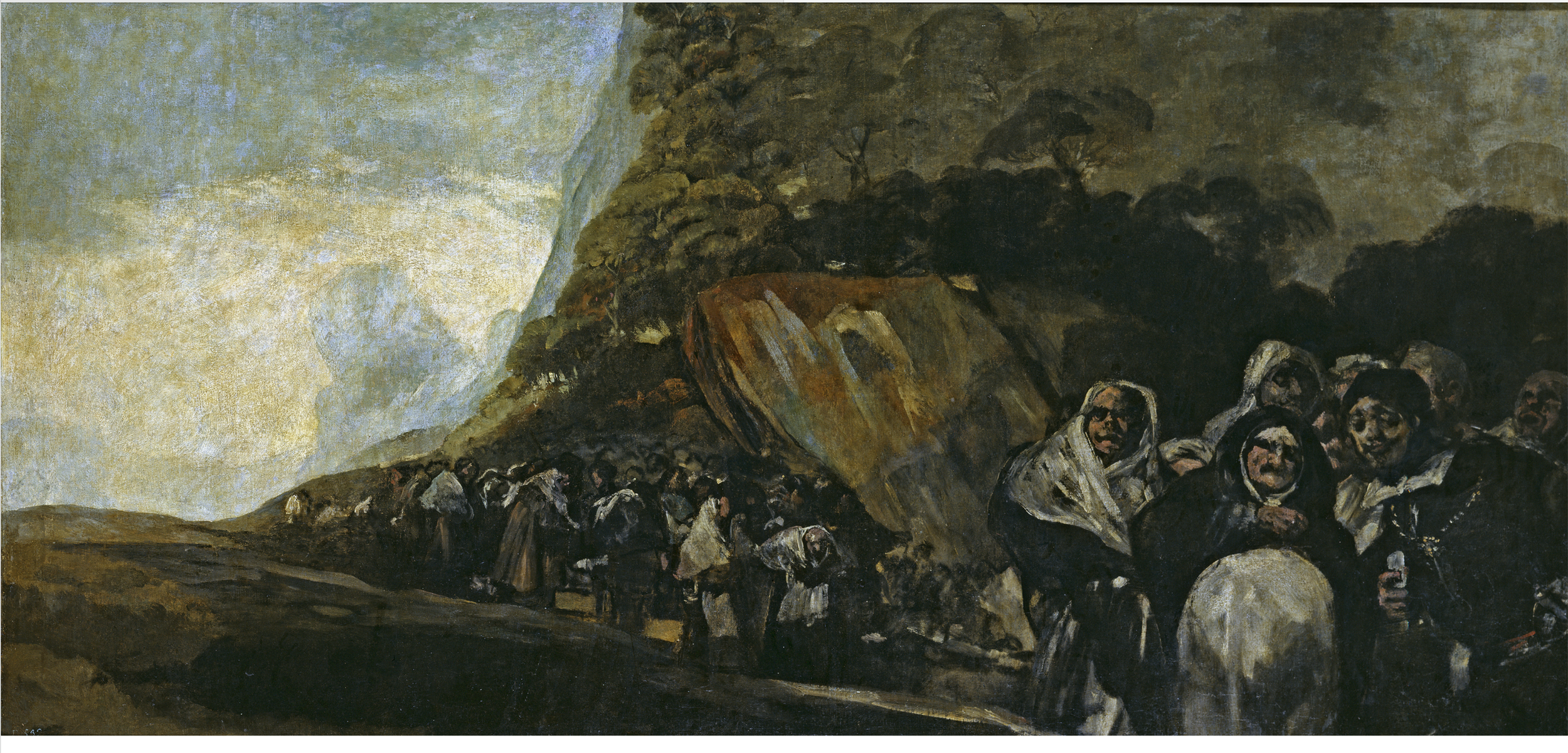
Title:The Holy Office Procession(traditionally also known asPilgrimage to the Fountain of San Isidro)*
Artist: Francisco de Goya
Date: c. 1819–1823
Series: Black Paintings
Medium: Oil mural transferred to canvas
Dimensions: 140 × 438 cm (55.1 × 172.4 in)
Current Location: Museo del Prado, Madrid, Spain
Original Location: Dining room, ground floor, Quinta del Sordo
Support: Originally painted directly onto plaster; transferred to canvas by Salvador Martínez Cubells between 1874 and 1878.
Style: Romanticism; late period; Black Paintings.
Subject: A mysterious religious procession traditionally identified either with the Holy Office or with a pilgrimage to the Fountain of San Isidro.
Significance: One of the most enigmatic of Goya's Black Paintings. Rather than illustrating a clearly identifiable historical event, the work deliberately blurs the boundaries between religious devotion, institutional authority, popular belief, and collective psychology. Its ambiguous title and unresolved imagery continue to invite new interpretations.
Inventory Number: P000762
One has the impression that this painting has too often been interpreted through its traditional title rather than through the image itself. Much of the existing literature begins by assuming that the subject is the Holy Office, allowing the title to shape the interpretation before the painting has been carefully observed. Goya, however, offers no such certainty. Like many of his Black Paintings, this work resists immediate explanation and demands that we look before reaching conclusions. If we set aside the inherited title and return to the painting itself, different questions begin to emerge. Who is the dark-clad figure who dominates the foreground? Why does he wear that enigmatic expression? Who is the hooded woman beside him? And why has Goya brought these two figures together? Perhaps the painting has been asking different questions all along.
The composition immediately directs our attention toward the man standing in the foreground. He is not isolated from the crowd, yet Goya gives him an unmistakable visual authority. His dark clothing occupies a large portion of the canvas, while the broad white collar creates one of the strongest contrasts in the painting. He alone seems to possess a distinct personality. His expression is neither solemn nor overtly joyful. Instead, it carries a subtle, almost knowing smile, suggesting a confidence that sharply distinguishes him from the anonymous faces surrounding him. Whether this expression conveys irony, satisfaction, or quiet amusement is impossible to determine, but it is surely intentional. Goya was one of Europe's greatest portraitists, and facial expression was never accidental in his work.
Equally striking is the object held in his right hand. Its form has never been convincingly identified, yet it resembles a small box rather than a ceremonial staff or religious attribute. It is my impression that it is a snuff box, an elegant accessory widely used among educated and affluent men in late eighteenth- and early nineteenth-century Spain. If this interpretation is correct, the object subtly shifts our understanding of the figure. Rather than emphasizing religious devotion, it introduces a distinctly worldly element, hinting at refinement, habit, or even social status. Although this identification cannot be confirmed, the object clearly contributes to the character's individuality, distinguishing him from the surrounding crowd.
Standing beside him is a hooded female figure who appears, at first sight, to be a nun or another religious woman. What immediately attracts the eye, however, is the pronounced fullness of her abdomen. To my reading, Goya intentionally suggests pregnancy. The form is too emphatic to be dismissed as a casual fold of heavy clothing. This interpretation cannot be demonstrated with certainty, but it deserves to be taken seriously because of its profound implications. If Goya deliberately placed what appears to be a pregnant religious woman beside the painting's dominant figure, then we are no longer looking at a simple pilgrimage or an illustration of the Holy Office. We are confronted with a far more disturbing image, one that invites questions about institutional authority, appearances, hypocrisy, and the tension between public virtue and private reality. It is precisely because the painting refuses to answer these questions that they become impossible to ignore.
Only after these two figures do we begin to notice the crowd itself. Faces emerge from the darkness one after another, some weary, others vacant, others almost grotesque. They seem less like individual portraits than fragments of humanity carried along by a common movement. Yet even as the procession expands into the background, our attention repeatedly returns to the pair in the foreground. It is here, perhaps, that Goya has placed the true mystery of the painting—not in its title, nor in the procession itself, but in the silent relationship between two figures whose identities remain unresolved and whose presence invites us to look more carefully before attempting to explain what we see.
Having examined the painting without the guidance of its traditional title, we may now return to the question that has shaped its interpretation for nearly two centuries. Is this truly a procession of the Holy Office, or are we looking at a pilgrimage to the Fountain of San Isidro? The difficulty lies in the fact that neither title originated with Goya. Both were assigned after his death, and each directs the viewer toward a different reading before the painting itself has had the opportunity to speak.
If the work represents a pilgrimage, the crowd may be understood as ordinary devotees participating in one of Madrid's most popular religious traditions. Pilgrimages to the Fountain of San Isidro brought together people from every social class, combining sincere acts of devotion with festivity, popular customs, and, at times, a degree of superstition that concerned many Enlightenment thinkers. Goya knew these gatherings well, having painted them decades earlier in works filled with light, movement, and celebration. Here, however, everything has changed. The joy has vanished. The pilgrims advance through darkness, their expressions drained of celebration, transformed into something solemn, unsettling, and difficult to define.
The presence of the prominent dark-clad figure complicates the picture still further. Many scholars have identified him as an inquisitor or another official connected with the Holy Office, an interpretation that undoubtedly influenced one of the painting's traditional titles. Yet Goya provides no definitive evidence. There is no tribunal, no trial, no public punishment, and no explicit reference to the rituals of the Inquisition. If the figure does represent institutional authority, he does so through suggestion rather than declaration. His enigmatic smile, elegant bearing, and possible snuff box make him appear less like a religious ascetic than a man entirely at ease within the world he inhabits.
The woman beside him deepens this uncertainty. Her white hood distinguishes her from many of the surrounding figures, while her reserved expression contrasts sharply with the confidence of her companion. Whether she is intended to represent a nun, a pilgrim, or simply another anonymous participant cannot be established with certainty. Their proximity nevertheless appears deliberate. Goya repeatedly arranges his compositions through visual relationships rather than explicit narratives, encouraging viewers to ask why particular figures have been brought together. In this case, the contrast between the composed authority of the man and the quiet reserve of the woman becomes one of the painting's most compelling visual dialogues.
This deliberate ambiguity may well be the point. Goya does not force us to choose between pilgrimage and Holy Office, faith and authority, devotion and superstition. Instead, he allows these possibilities to coexist within the same image. Rather than illustrating a specific historical event, the painting becomes an exploration of the uncertain territory where belief, power, and human behaviour intersect. It is precisely because the answers remain incomplete that the painting continues to resist definitive interpretation more than two centuries after it was created.
Once we move beyond the question of whether the painting represents the Holy Office or a pilgrimage to the Fountain of San Isidro, another possibility begins to emerge. Perhaps Goya was never attempting to illustrate a particular event at all. Like so many of his late works, this painting seems less concerned with recording history than with exposing the complexities of human nature. The procession becomes a stage upon which authority, devotion, credulity, and conformity coexist without ever being clearly separated.
The foreground figure remains the key to this ambiguity. His confident bearing and enigmatic smile suggest neither spiritual ecstasy nor moral outrage. Instead, he appears strangely detached from the crowd that surrounds him, as though he understands something that the others do not. Whether he represents institutional authority, social privilege, or simply an individual conscious of his own position is impossible to determine. Goya deliberately refuses to provide the evidence that would allow us to settle the question. The mystery is not a problem to be solved, but the very substance of the painting.
Behind him stretches a humanity that is both individual and anonymous. Every face possesses its own expression, yet together they merge into a single collective presence. Some appear weary, others fearful, others almost vacant, while a few emerge from the darkness with startling intensity before disappearing again into loose, energetic brushwork. Goya achieves a remarkable balance between portrait and crowd. We sense that every figure has a story, yet none is permitted to dominate the composition. The procession itself becomes a portrait of humanity in motion.
This refusal to provide certainty is one of the defining characteristics of Goya's Black Paintings. They rarely explain; instead, they confront us with images that remain unresolved. The viewer is asked to observe patiently, resisting the temptation to impose quick conclusions. In this respect, the painting offers a valuable lesson not only about art, but also about interpretation itself. The more carefully we look, the more we realise how much remains unknowable.
Perhaps that is why the painting continues to fascinate. It does not tell us what to think about religion, the Inquisition, popular devotion, or authority. Instead, it asks us to examine how easily inherited assumptions can shape our understanding before we have truly looked. By beginning with observation rather than conclusion, the painting gradually reveals itself as something richer than either of its traditional titles suggests. It is ultimately a meditation on the uncertainty of human experience, reminding us that the deepest mysteries in Goya's art are often found not in what he reveals, but in what he deliberately leaves unresolved.
Juan de Barrientos