

Two Women Laughing
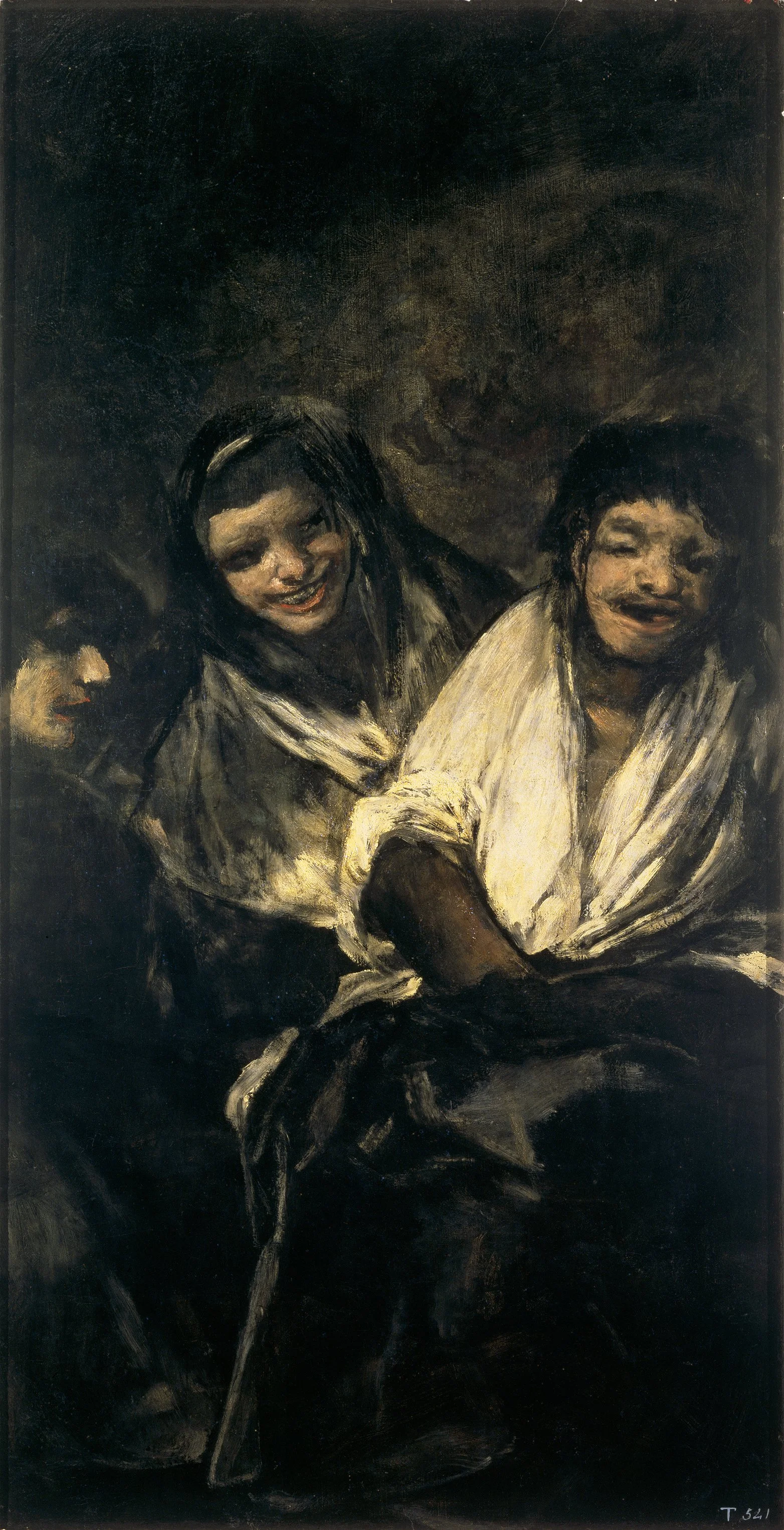
Title: Women Laughing
Artist: Francisco de Goya
Date: c. 1819–1823
Medium: Oil transferred from mural to canvas
Dimensions: Approximately 126 × 105 cm (49.6 × 41.3 in)
Current Location: Museo del Prado, Madrid, Spain
Subject: Two women laugh while observing a grotesque male figure in the foreground.
Significance: An unsettling meditation on ridicule, aging, desire, and the darker aspects of human nature.
At first glance, the painting appears almost theatrical. Three figures emerge from a dark, undefined background: two women standing together and a man occupying the foreground. Nothing in the setting tells us where they are or what has just happened. Goya directs our attention to the expressions of the figures, allowing human emotion to become the true subject of the work.
The first element to capture the viewer's attention is the laughter of the two women. Their faces are animated, their mouths open in apparent amusement, yet their expressions do not convey warmth or shared happiness. Their laughter feels pointed, directed toward the man before them. Rather than inviting the viewer to join in, it creates an immediate sense of discomfort. We instinctively wonder what has provoked such a reaction and whether the man himself is aware that he has become its target.
The male figure is one of the most disturbing elements of the composition. Art historians have long interpreted him as masturbating while the two women mock him, an interpretation first advanced by Diego Angulo and still regarded as the most widely accepted reading. His exaggerated features, awkward posture, and strained expression transform a private act into a scene of humiliation. Yet the painting is not entirely settled. Technical examinations have revealed later overpainting that altered the position of his hands, leading some scholars to suggest that he may originally have been holding a sheet of paper or a book. Even so, the dominant interpretation remains that Goya deliberately depicted an act of onanism exposed to ridicule, turning sexual vulnerability into a profoundly unsettling spectacle. Whether one accepts this reading or not, the painting ultimately derives its power from a deeper ambiguity that extends beyond the action itself. Goya refuses to guide the viewer toward a single emotional response. Are the women mocking, encouraging, or simply observing? Is the man oblivious, ashamed, or lost in his own world? None of these questions receives a definitive answer. The surrounding darkness strips away every distracting detail, isolating the three figures in an undefined space where gesture and expression become more important than narrative. Rather than telling a complete story, Goya invites us into a psychological drama whose meaning remains deliberately unresolved. It is this tension between certainty and uncertainty that gives the painting its enduring fascination.
Goya's palette is remarkably restrained, offering continuity through all the 15 black paintings. Goya builds the scene with ochre, raw and burnt umbers, ivory black, and lead white, punctuated by discreet touches of muted vermilion in the women's faces and lips. Rather than relying on colour contrasts, he orchestrates subtle tonal relationships that allow the figures to emerge gradually from the surrounding darkness. Every value is carefully calibrated: light does not flood the scene but skims across the faces and hands, modelling forms through delicate transitions rather than sharp contours. This disciplined chromatic economy strips away all unnecessary distractions, directing the viewer's attention to gesture, expression, and psychological tension.
This uncertainty invites a fundamental question that will guide the rest of our exploration: what are we truly witnessing? Is this simply an elderly man being mocked by two women, or has Goya transformed an everyday moment into a meditation on ridicule, vulnerability, and the fragile nature of human dignity? As so often in his later works, the answer remains deliberately elusive, encouraging each viewer to confront the painting with their own experience of laughter, shame, and social judgment.
Having established the unsettling atmosphere of the scene, the painting invites a deeper question: why has Goya chosen laughter as its central expression? Throughout his career, laughter rarely appears as a sign of simple joy. More often, it serves as a weapon—an instrument of ridicule, vanity, or moral criticism. The laughter in Women Laughing belongs firmly to this darker tradition.
The man in the foreground has generated numerous interpretations, yet none has achieved universal acceptance. Some scholars have seen him as an elderly suitor attempting to recapture his youth, a familiar subject in eighteenth-century satire. Others have suggested that he represents a fool, a social outcast, or simply an anonymous figure whose exaggerated features transform him into a symbol rather than a portrait.
Goya deliberately withholds the information that would allow us to identify the man, preserving the painting's openness to multiple interpretations. Yet the deeper significance of this ambiguity lies elsewhere. Unlike his official portraits or commissioned works, this was never intended for a public audience. Painted directly onto the walls of his own house, the work belongs to a body of images that appears driven less by the desire to communicate a clear message than by an urgent need for personal expression. Goya no longer seems concerned with explaining, persuading, or pleasing the viewer. He paints because the image demands to be painted. Meaning is not imposed upon the spectator but released onto the wall as a direct expression of his inner world.
This ambiguity recalls the spirit of Los Caprichos, where Goya repeatedly exposed the absurdities of human behaviour. Vanity, self-deception, misplaced desire, and public humiliation appear throughout that series, often expressed through exaggerated faces and theatrical situations. In Women Laughing, however, the satire becomes quieter and more disturbing. The artist no longer relies on explanatory captions or recognizable narratives. Instead, a single exchange of glances and expressions is enough to evoke the emotional weight of ridicule.
The women's laughter is therefore more than a spontaneous reaction. It becomes an expression of social judgment. Their shared amusement isolates the man, placing him in a position of vulnerability before both the women and the viewer. Whether he deserves their mockery is impossible to know, and that uncertainty is essential. Goya refuses to tell us who is right. Our attention shifts instead to the dynamics of humiliation itself.
This psychological dimension gives the painting a strikingly modern character. Nearly everyone has experienced the fear of becoming the object of another person's laughter. Public embarrassment, rejection, and the loss of dignity are universal human experiences, transcending culture and historical period. By reducing the scene to its emotional essentials, Goya transforms what might once have been a social anecdote into an enduring reflection on human insecurity.
Rather than illustrating a specific event, Women Laughing explores the invisible tensions that exist whenever people judge one another. The composition suggests that ridicule reveals as much about those who laugh as it does about the person being laughed at, leaving us uncertain whether the true subject is the grotesque man, the laughing women, or the uncomfortable relationship that binds them together.
One of the most remarkable qualities of Women Laughing is its extraordinary economy. With only three figures, a dark background, and a restrained palette of blacks, ochres, and earthy browns, Goya creates an image that remains unforgettable. Every unnecessary detail has been stripped away. There is no setting to distract us, no narrative to resolve the mystery, and no symbolic object to explain the scene. What remains are human faces, human emotions, and the silent tension between them.
This simplicity is matched by an astonishing freedom of execution. Viewed closely, the brushstrokes appear loose, almost spontaneous, dissolving into broken passages of paint and energetic marks. Yet as the viewer steps back, those seemingly chaotic strokes resolve into convincing expressions filled with psychological intensity. Goya was no longer concerned with polished surfaces or academic precision. Instead, he sought something more elusive: the ability to capture the instability of the human mind.
The work's greatest achievement lies in its refusal to offer certainty. We never learn why the women laugh, whether the man understands their mockery, or even whether he deserves it. By withholding these answers, Goya invites each generation to complete the story according to its own experiences. The work becomes less a narrative than a mirror, reflecting universal fears of rejection, humiliation, and social judgment.
Ultimately, Women Laughing is not about a particular man or two anonymous women. It is about the fragile nature of human dignity. Goya transforms an ordinary moment into a timeless meditation on vulnerability, inviting us to question not only the figures before us, but also our own role as spectators. We cannot simply observe the scene from a distance. By looking, we become part of it, forced to decide whether we stand with those who laugh, with the one who is laughed at, or somewhere uneasily between the two. It is this profound ambiguity that gives the painting its lasting power and secures its place among the most psychologically compelling works of Goya's final years.
Juan e Barrientos