

Two Men Reading
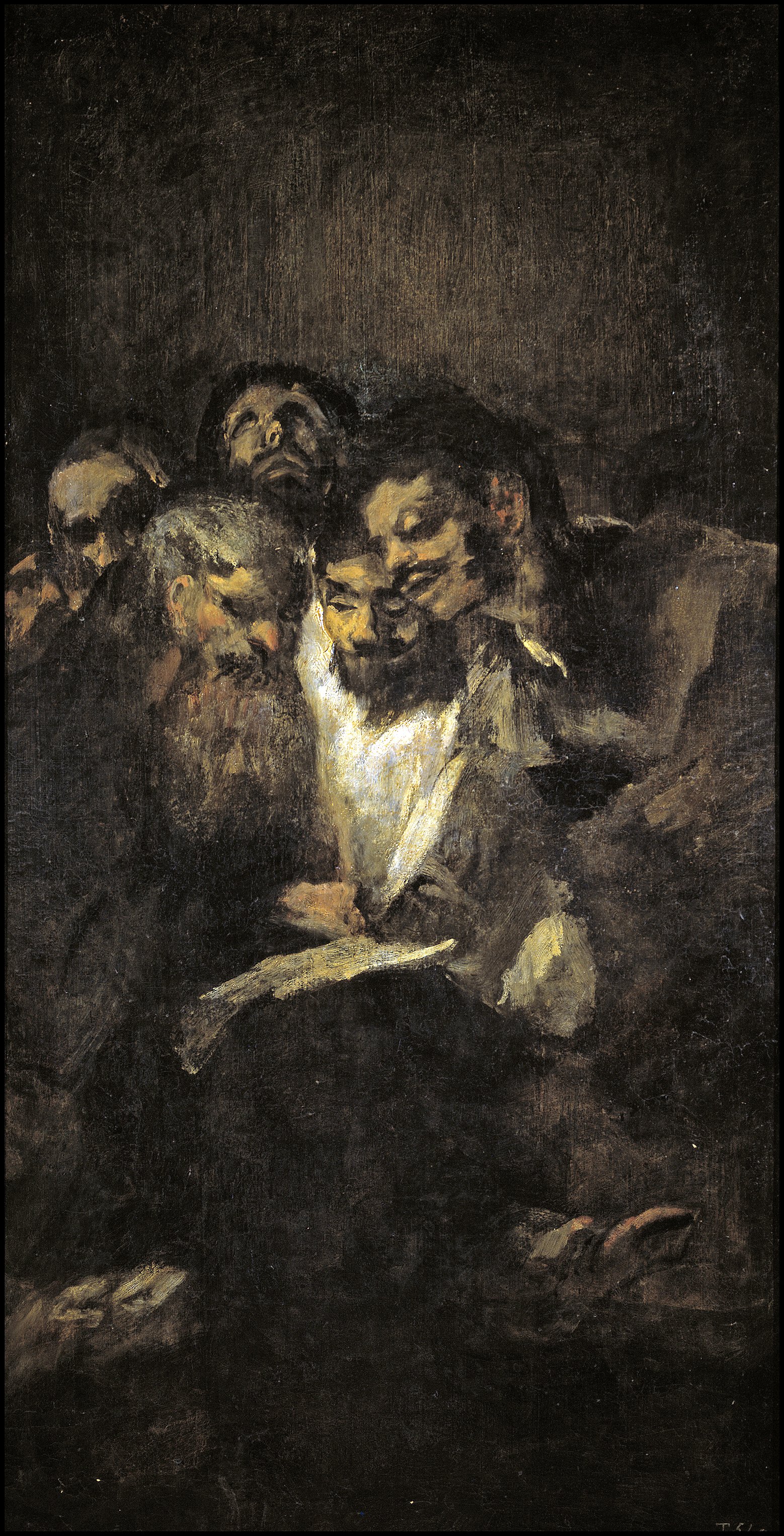
Title: Two Men Reading
Artist: Francisco Goya
Date: c. 1819–1823
Medium: Oil transferred from mural to canvas
Dimensions: 125 × 65 cm (approx.)
Current Location: Museo Nacional del Prado, Madrid, Spain
Series: The Black Paintings
Subject: Two anonymous men share the reading of a mysterious text, their absorbed expressions suggesting secrecy, curiosity, or intellectual reflection.
Significance: Through a remarkably restrained composition, Goya transforms an ordinary act of reading into an unsettling meditation on knowledge, uncertainty, and the limits of human understanding.
At first glance, the painting appears to show two elderly men absorbed in a sheet of paper. Yet a closer look reveals that they are not alone. Emerging from the darkness behind them are at least three additional faces, their expressions ranging from curiosity to unease. They lean forward as if trying to glimpse the same document, transforming what first appears to be a private act of reading into a shared moment of intense attention.
The artist never explains who these figures are. They could be companions, witnesses, students, or simply anonymous observers. One man peers from the left, almost swallowed by shadow; another lifts his head above the group, his face catching the light; a third inclines towards the central reader with an expression that hovers between fascination and amusement. Their presence creates an unsettling atmosphere. Rather than forming a peaceful gathering, they seem irresistibly drawn towards something unusually compelling—perhaps even disturbing.
The document itself remains almost invisible. We cannot read a single word. Instead, Goya directs our attention to the faces gathered around it. The true subject is not the text but the human responses it awakens. Curiosity, concentration, expectation, and uncertainty pass silently from one figure to another, inviting the viewer to become the final participant in this mysterious circle.
Although Two Men Reading appears spontaneous, its composition is remarkably deliberate. The composition arranges the figures in a compact pyramid that rises from the illuminated document towards the faces emerging from the darkness. The eye naturally follows this upward movement, lingering on each expression before disappearing into the vast, undefined background. The empty space above the group is striking. It neither describes an interior nor a landscape, but instead surrounds the figures with an atmosphere of uncertainty, isolating them from any recognisable world. Light is used with extraordinary economy. Rather than illuminating the entire scene, it falls selectively on the paper, the white garment of the central figure, and a handful of faces. These bright passages act as visual anchors, guiding the viewer through the composition while leaving much of the painting deliberately concealed. Darkness is not merely the absence of light; it becomes an active element that obscures identities, dissolves forms, and deepens its enigmatic atmosphere.
Equally expressive is Goya's handling of paint. Thick, energetic brushstrokes define the illuminated areas, while looser passages allow figures to emerge gradually from the background. Details are sacrificed in favour of atmosphere, demonstrating the artist's growing interest in suggestion rather than precise description. Faces are only partially modelled, clothing dissolves into broad masses of pigment, and contours remain intentionally unstable.
This economy of means gives the work an astonishing modernity. The work demonstrates that emotional intensity does not depend on meticulous finish but on the careful orchestration of light, shadow, and gesture. Every compositional decision reinforces the same idea: the viewer is invited to look closely, yet never allowed to see everything. The painting reveals only enough to awaken curiosity, leaving imagination to complete what the brush deliberately leaves unresolved.
The greatest mystery in Two Men Reading is not the identity of the figures but the document itself. The painter deliberately conceals its contents, preventing the viewer from sharing the knowledge that has captured the group's attention. This omission transforms an ordinary act of reading into a meditation on curiosity and the human desire to understand what remains beyond our reach.
Reading occupies a unique place in human civilisation. It allows ideas to survive their authors, preserves memory across generations, and gives access to worlds that cannot be experienced directly. Yet throughout history, books and written documents have also carried political power, religious authority, scientific discovery, forbidden knowledge, and dangerous ideas. By refusing to reveal what is written on the page, Goya leaves every possibility open.
The painting therefore becomes less about a specific text than about the reactions it provokes. Some faces appear deeply absorbed, others seem anxious, sceptical, or quietly intrigued. Each viewer may interpret these expressions differently, making the act of observation an extension of the act of reading itself. Just as the figures attempt to decipher the document, we attempt to decipher them.
This ambiguity reflects one of the painting's greatest strengths. Rather than illustrating a clear narrative, he creates an image that continues to generate questions more than two centuries later. The painting never tells us what to think. Instead, it reminds us that knowledge is rarely complete and that every discovery brings new uncertainty. In this sense, Two Men Reading is not simply about reading a text; it is about the endless human search for meaning, a search in which every generation becomes another reader gathered around the same invisible page.
Juan de Barrientos