

Asmodea
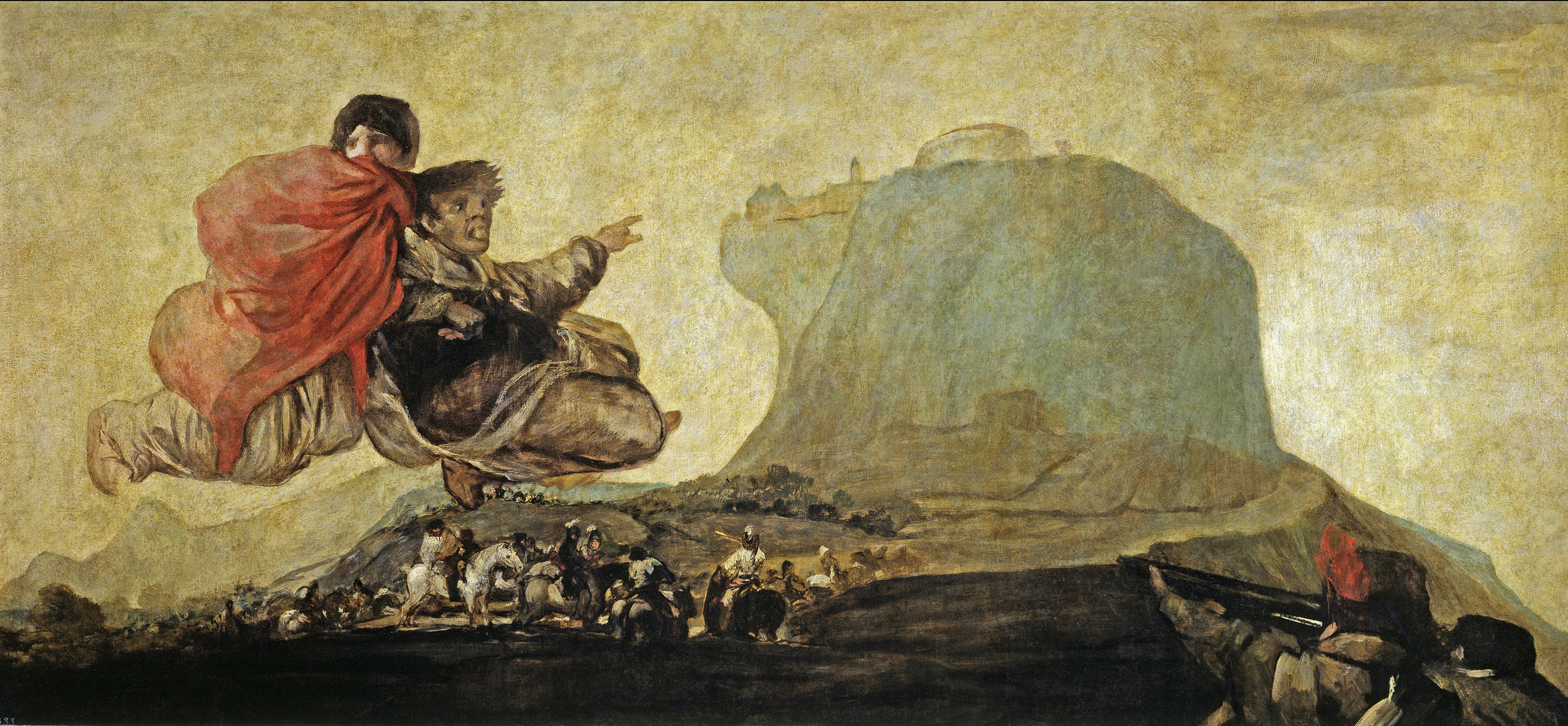
Title: Asmodea (Fantastic Vision)
Artist: Francisco de Goya
Date: c. 1820–1823
Medium: Oil mural on plaster, later transferred to canvas.
Dimensions: 123 × 265 cm (48.4 × 104.3 in)
Current Location: Museo del Prado
Period: Late Period
Subject: Allegorical vision.
Significance: One of Goya's most enigmatic paintings.
Subject: Allegorical and visionary scene.
Significance: A masterpiece of ambiguity and symbolic imagination.
At first glance, almost nothing appears to follow the rules of ordinary experience. Two mysterious figures drift effortlessly through the sky above a bleak mountain landscape. Below them, armed soldiers stand on the ground, their rifles raised toward a distant destination. A rocky peak crowned by an isolated structure dominates the horizon, while the surrounding landscape fades into muted shades of ochre, grey and violet. Everything feels familiar, yet profoundly strange.
The work offers no obvious point of entry. Goya places the viewer in the uncomfortable position of a witness arriving too late—or perhaps too early—to understand the events taking place. We instinctively search for clues, but each detail seems only to deepen the mystery.
The two airborne figures immediately command our attention. Their effortless flight contradicts the physical world, yet Goya presents it without theatrical flourish, as though it were entirely natural. The male figure extends his arm toward the distant mountain, suggesting urgency or warning, while his companion turns her face away, partially concealed by a flowing red cloak. Whether she recoils in fear, grief or disbelief remains impossible to determine. Their gestures communicate emotion without revealing its cause.
Meanwhile, the soldiers below belong to an altogether different reality. Unlike the floating figures, they are firmly anchored to the earth, weapons in hand, apparently engaged in a conflict that the viewer cannot fully perceive. The coexistence of these two worlds—one grounded in human violence, the other suspended in the realm of vision or imagination—creates an unsettling tension that defines the entire composition.
Perhaps the most remarkable aspect of Asmodea is that its mystery does not arise from complexity alone, but from restraint. Goya withholds just enough information to prevent certainty while revealing enough to provoke endless questions. Long before we ask what the work means, we experience something more immediate: the quiet unease of standing before an image that refuses to explain itself. That first impression, hovering between recognition and uncertainty, may be the most enduring experience the work has to offer.
Only after absorbing the work's unsettling atmosphere do we begin to ask its most obvious question: who are these flying figures? The answer, surprisingly, is far from certain. Unlike many of his earlier works, Goya left no written explanation, no title, and no indication of the story he intended to depict. The name Asmodea, by which the work is known today, was assigned only after his death, probably by Antonio Brugada when cataloguing the murals from the Quinta del Sordo. Whether Goya himself would have recognised the title remains unknown.
The name immediately evokes Asmodeus, the demon described in the Book of Tobit. In the biblical narrative, Asmodeus falls in love with Sarah and kills each of her seven husbands before they can consummate their marriages. Only through the intervention of the Archangel Raphael is the demon finally driven away, allowing Tobias and Sarah to begin a new life together. Because of this story, Asmodeus became associated with destructive passion, jealousy and spiritual disorder.
Yet the work refuses to fit comfortably within that biblical framework. Nothing clearly identifies either airborne figure as a demon, nor is there any obvious reference to Tobias, Sarah or Raphael. If Goya intended to illustrate Scripture, he did so in an extraordinarily indirect manner. Most scholars therefore regard the title as a useful label rather than a definitive explanation. This ambiguity is significant. Rather than guiding the viewer toward a single interpretation, the title opens the door to many possibilities. The flying figures may represent supernatural beings, allegorical forces, dreams, memories or even manifestations of the human mind itself. Goya offers symbols instead of answers, inviting us to remain within uncertainty rather than escape from it.
Perhaps that is precisely the point. The work is not a puzzle waiting to be solved but a mystery to be contemplated. By refusing to identify its protagonists with certainty, Goya transforms Asmodea into something timeless: an image that continues to challenge every generation to search for meaning where certainty is impossible.
Although Asmodea resists any definitive interpretation, many historians have looked beyond its supernatural imagery to the turbulent world in which Goya lived. The work was created during one of the darkest periods of Spanish history, when war, political repression and exile had become part of everyday life. Rather than illustrating a specific event, Goya may have transformed the anxieties of his age into a vision that exists somewhere between reality and nightmare.
Particular attention has been given to the soldiers in the lower right corner. Unlike the floating figures above, they belong unmistakably to the earthly world. Their rigid posture and raised rifles suggest military discipline, yet the object of their attention remains frustratingly distant. Some scholars have proposed that they are pursuing liberals fleeing after the collapse of the Trienio Liberal, while others have connected the isolated mountain with the Rock of Gibraltar, a refuge for political exiles. These interpretations are plausible, but none can be demonstrated with certainty. What makes the work remarkable is that historical reality never fully replaces imagination. The landscape is recognisably Spanish, yet it feels strangely detached from any precise location. The mountain rises like a monument or a fortress, but its true identity remains elusive. Even the soldiers, the most realistic figures in the composition, seem absorbed into an atmosphere where certainty dissolves.
This fusion of history and fantasy reflects Goya's extraordinary artistic maturity. Rather than documenting political events as a chronicler might, he explores their emotional consequences. Fear, displacement and uncertainty become more important than factual accuracy. The result is a painting that speaks not only to nineteenth-century Spain but to any society living under the shadow of violence and instability. Goya reminds us that history is never experienced as a sequence of dates alone; it is lived through the imagination, where memory, anxiety and hope become impossible to separate.
If Asmodea cannot be understood through narrative alone, it must be approached through its visual language. Every element of the composition seems chosen less to describe an event than to evoke an emotion. Goya abandons the clarity of traditional storytelling and instead constructs a world of symbols whose meaning remains deliberately fluid. The two airborne figures dominate the work, yet they do not appear triumphant or liberated. Their flight is strangely silent, almost weightless, as though they were suspended between earth and sky rather than travelling through either. The landscape contributes equally to the work's psychological power. The mountain rising in the distance functions almost like a destination, yet Goya offers no indication of what awaits there. Is it a sanctuary, a prison, a fortress or simply another illusion? Its ambiguity invites the viewer to project personal meaning onto the scene, transforming observation into participation.
Equally significant is Goya's restrained use of colour. Earthy browns, muted greens, greys and deep reds create an atmosphere that feels heavy without becoming theatrical. Light does not illuminate the landscape so much as reveal fragments of it, leaving large areas suspended in shadow. The effect is profoundly unsettling: we see enough to recognise the world, but never enough to master it.
Goya does not invite us to decipher a code but to inhabit ambiguity itself. His vision endures because it resists definitive conclusions, allowing each generation to discover fresh significance within the same haunting image.
At first glance, the ability to fly appears to represent absolute freedom. Throughout history, human beings have dreamed of rising above the earth, escaping its dangers and leaving behind the limits imposed by gravity. Yet in Asmodea, flight offers no liberation. Goya presents two figures suspended high above the landscape, but neither conveys joy, serenity or triumph. They have escaped the ground, yet they have not escaped fear.
This paradox lies at the heart of the work. The true prison is not the mountain, the soldiers or even the violence suggested below. It is the invisible burden carried by the figures themselves. One points anxiously toward the horizon; the other turns away, shielding her face as if unwilling to confront what lies ahead. Whether the danger is real or imagined ultimately becomes irrelevant. What matters is that it has already taken possession of their minds.
In this sense, Asmodea speaks to an experience that transcends its own time. Fear has always accompanied the human condition. Wars, political upheaval and personal loss may change from one generation to another, but the emotions they awaken remain strikingly familiar. Goya understands that the greatest battles are often fought within the imagination, where uncertainty magnifies every threat and the future becomes impossible to predict.
Perhaps this explains why the work continues to defy any final reading. Fear rarely provides clear answers, and neither does Goya. History, religion and symbolism all illuminate part of the image, yet none can fully dispel its haunting ambiguity.
More than two centuries after Goya painted this extraordinary vision, Asmodea still compels us to look beyond its enigmatic imagery and recognise something deeply familiar. The figures suspended in the sky are not simply witnesses to an unknown event; they are reflections of ourselves, forever seeking a place of safety while discovering that the greatest distance we must travel is not across the landscape below, but within our own hearts.
Juan deBarrentos