

Two Old Men
Duality lies at the heart of the human experience. Light and darkness, youth and old age, hope and despair, life and death. We understand the world through contrasts, and in Two Old Men, Goya reduces that universal principle to its purest visual form.
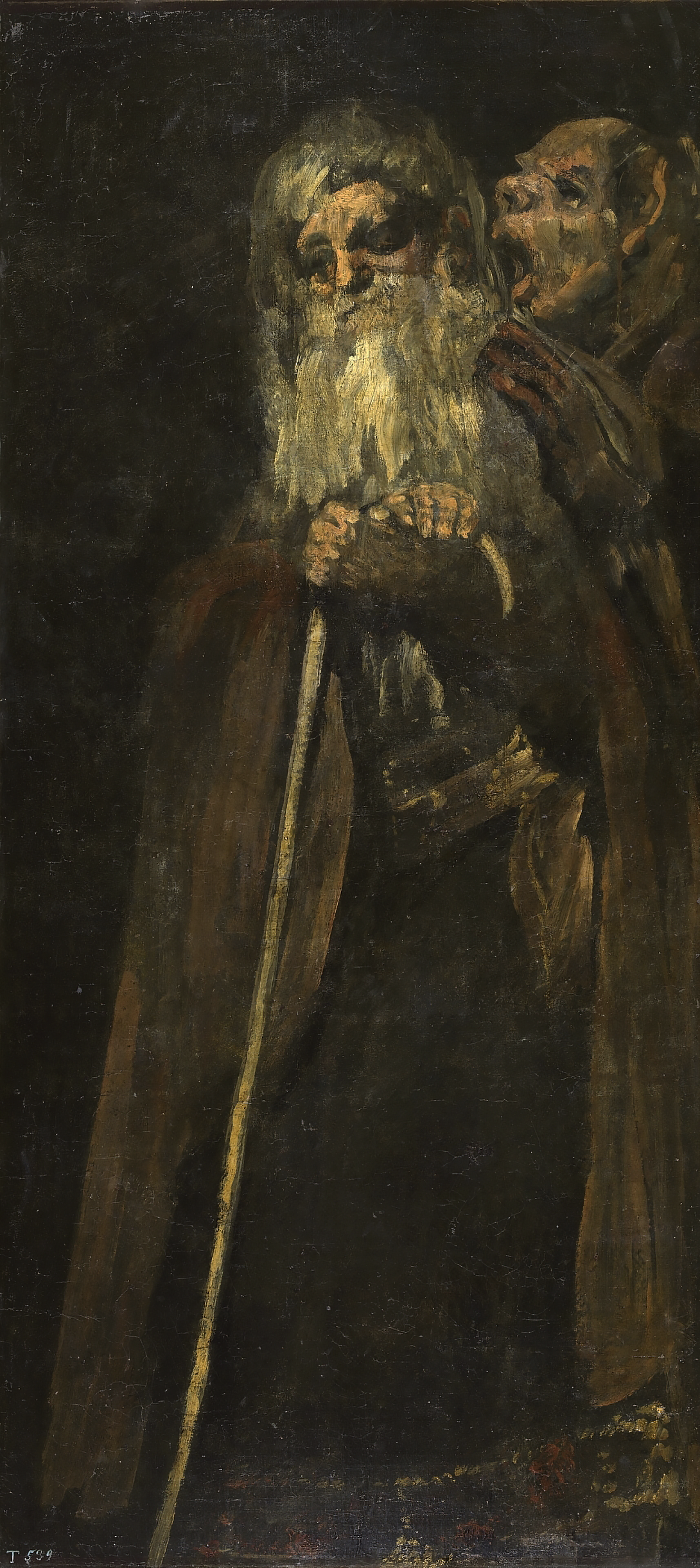
An elderly man, leaning on a walking stick, occupies the centre of the scene while a second figure emerges from the darkness behind him. Is it speaking, shouting, whispering, or merely standing in silent companionship?
Perhaps this is the painting's greatest strength. Rather than providing answers, Goya invites each viewer to participate in the act of interpretation. Some perceive a dialogue, others a warning, a recollection, a hallucination, or a final farewell. The painting does not attempt to explain itself. Instead, it poses a question—one that every generation is invited to answer anew.
Human beings instinctively seek to name what they cannot fully understand. By assigning a name, we create the comforting illusion that a mystery has been solved. Yet the deepest experiences of life—love, suffering, beauty, death or faith—rarely submit to a single definition. They remain open, inviting reflection rather than certainty.
The mysterious figure standing behind the elderly man belongs to that category of symbols. Since the nineteenth century, scholars have proposed remarkably different interpretations. Some identified the figure as a friar, giving rise to the alternative title An Old Man and a Friar. Others recognised Death itself, while still others saw a demon, a hallucination, the voice of conscience, madness or the invisible burden of old age.
Each interpretation illuminates one aspect of the image without exhausting its meaning. Rather than asking who the figure is, we might ask a different question: what invisible presence stands behind each of us?
Silence is rarely empty. It can comfort, accuse, protect or condemn. Long before a single word is spoken, posture, distance and expression begin to tell their own story.
In Two Old Men, Goya removes every distraction. The background dissolves into darkness, leaving only two figures suspended in an undefined space. The central figure leans heavily upon his walking stick; his posture suggests resignation rather than resistance. Behind him, the companion intrudes into his personal space with unsettling intimacy. Its open mouth remains poised between warning and mockery. By reducing the composition to its essentials, Goya transforms silence into the principal language of the work.
Perhaps the greatest mysteries are not those that exist outside us, but those we discover within ourselves. As the years pass, recollections, disappointments, hopes and unanswered questions accumulate, becoming silent companions that shape our inner lives.
From this perspective, the second figure may represent an invisible reality rather than another individual. Some scholars have suggested that the elderly figure recalls Goya himself, echoing late drawings sometimes regarded as self-portraits. Whether that identification is correct matters less than the broader insight: this aged figure becomes a universal image of inward reflection, where the visible self encounters the hidden life carried within.
Every life is, in the end, a journey toward a conversation that no one else can have on our behalf. There comes a moment when achievement, reputation and possessions begin to lose their urgency, leaving only the questions that have quietly accompanied us for decades.
Two Old Men offers no answers, and perhaps that is its greatest act of wisdom. By refusing certainty, Goya preserves the painting's universality. The unknown companion belongs to everyone because it belongs to no one in particular.
Each generation approaches the painting carrying different fears and different hopes. A young viewer may perceive anxiety about the future; an older one may recognise the quiet persistence of the past. Others may discover faith, loneliness, forgiveness or acceptance.
The true subject of the painting, therefore, is not old age but self-knowledge. Goya reminds us that the deepest encounters of life often take place in silence, beyond the reach of language. We spend years trying to understand the world, only to discover that the greatest mystery has always been within ourselves.
It is not simply a painting to be admired, nor even a puzzle to be solved. It is an invitation to pause, to reflect, and to recognise that the unseen companion has perhaps been walking beside us all along.
Juan de Barrientos