

Akelarre
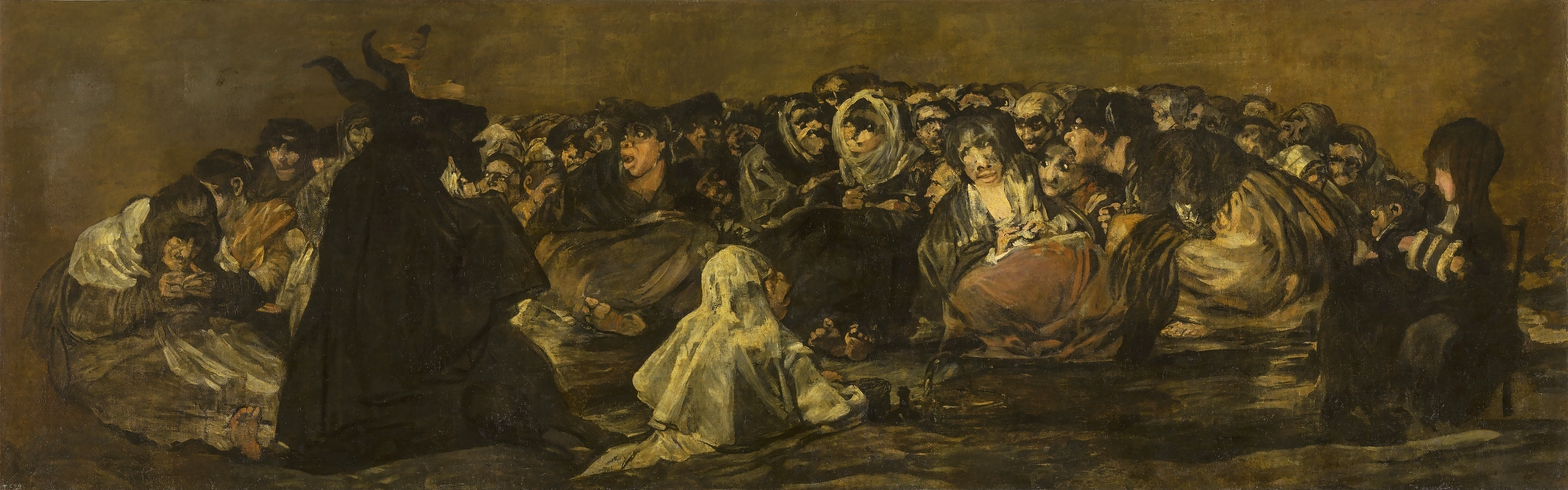
The painting depicts a gathering, a peculiar gathering nonetheless. A group of figures has gathered beneath a dark sky. Some sit on the ground. Others lean forward attentively. Their faces emerge from the shadows in uneven clusters, illuminated just enough for us to recognise their presence without fully understanding their expressions. The atmosphere is strangely quiet. Nothing dramatic appears to be happening, and yet the entire scene feels charged with expectation. The eye gradually moves toward the centre of the composition, where a large black goat stands above the assembly. Its silhouette immediately distinguishes it from every other figure in the painting. The horns are visible against the darkness. The animal appears elevated, almost authoritative, as though occupying a position reserved for a speaker, a teacher, or a judge.
The surrounding figures seem oriented toward it. Whether they are listening, obeying, learning, or merely observing remains uncertain. The painting does not tell us exactly what is taking place. There is no inscription, no explanation, and no narrative sequence. We arrive in the middle of an event that has already begun. This sensation of exclusion gives the image much of its power. Unlike many earlier representations of witches and demons, Goya avoids theatrical spectacle. There are no storms, no bursts of supernatural energy, and no elaborate visions of Hell. The setting has been reduced to its essentials: a gathering of human beings, a dark landscape, and a black goat at the centre of attention. Why have they assembled here? What do they expect to hear? Why do they appear willing to listen?
Before we can understand the painting, we must understand a word. The painting is commonly known as Akelarre, yet we cannot be certain that Goya ever used that title. He painted directly onto the walls of the Quinta del Sordo and left no catalogue of titles for the works later known as the Black Paintings. Akelarre comes from Euskera and is usually explained as a combination of aker, meaning he-goat, and larre, meaning meadow or pasture. Over time, the word became associated with nocturnal gatherings at which witches were believed to meet the devil, often imagined in the form of a black goat. For English-speaking readers, the nearest equivalent is 'Witches’ Sabbath,' although the translation is imperfect. Akelarre carries a distinctly Iberian history rooted in a particular landscape, language, and set of beliefs. How did a regional Basque word become attached to one of the most famous paintings in Spanish art? The answer lies in a small village in Navarre whose name became permanently linked with the history of witchcraft: Zugarramurdi.
In the early seventeenth century, Zugarramurdi became the centre of one of the most famous witchcraft investigations in European history. Accusations spread through the region. Neighbours denounced neighbours, children accused adults, and entire communities became caught in an atmosphere of suspicion. Under interrogation, many individuals confessed to extraordinary activities. Some claimed to have flown through the night to secret gatherings. Others described casting spells, transforming into animals, or worshipping the devil in the form of a black goat. The alleged meeting place of these gatherings became known as the Akelarre. The affair eventually reached the attention of the Spanish Inquisition, culminating in the Auto de Fe of Logroño in 1610. Yet one investigator, Alonso de Salazar Frías, carefully reviewed the evidence and found little reliable proof that the alleged gatherings had actually occurred. He suspected that fear, rumours, suggestion, and repeated questioning had helped create the phenomenon people believed they were discovering. This uncertainty became one of the enduring legacies of Zugarramurdi. More than two centuries later, Goya would paint a gathering around a black goat. Whether he was thinking specifically of Zugarramurdi we cannot know, but by his time the stories of Basque witchcraft had become part of Spain’s cultural memory.
The goat is not the protagonist of the painting, at least not in the way we might initially expect. Its presence dominates the composition, yet Goya tells us remarkably little about it. The animal performs no visible action, threatens no one, and demonstrates no supernatural power. Instead, Goya directs our attention toward the people surrounding it. Most depictions of witchcraft focus on magical rituals, demonic apparitions, or acts of sorcery. In Akelarre, however, the most important activity may simply be listening. The figures have gathered around a shared object of attention. Whatever the goat represents, its authority appears to depend upon the response of those before it. Without the crowd, it would merely be an animal standing in the darkness. Goya seems less interested in the object of belief than in the mechanism of belief itself. What transforms an idea into a conviction? Why do certain voices acquire influence while others do not? At what point does a shared story begin to feel indistinguishable from reality? The black goat occupies the centre of the composition, but the true subject of Akelarre may be something far more human: the willingness of individuals to participate in a collective belief.
By the time Goya painted Akelarre, he was an old man, deaf, disillusioned, and increasingly withdrawn from public life. He had witnessed war, political violence, repression, and the collapse of many Enlightenment ideals. The Black Paintings belong to this final stage of reflection. Painted directly onto the walls of his own house, they seem less concerned with public reputation than with private observation. Seen in this context, Akelarre becomes more than a painting about witches. The supernatural elements remain ambiguous. What appears to interest Goya is not the demonstration of magic but the human response to it. Whether the beliefs represented in the painting are true or false is not his primary concern. Instead, he focuses on the tendency of human beings to gather around shared convictions, particularly when those convictions promise certainty in uncertain times. The goat belongs to folklore. The Akelarre belongs to history. The questions raised by the painting belong to every age. In the end, Akelarre is not merely a painting about what people feared. It is a painting about what people choose to believe.
Juan de Barrientos