

Saturn devouring his Son
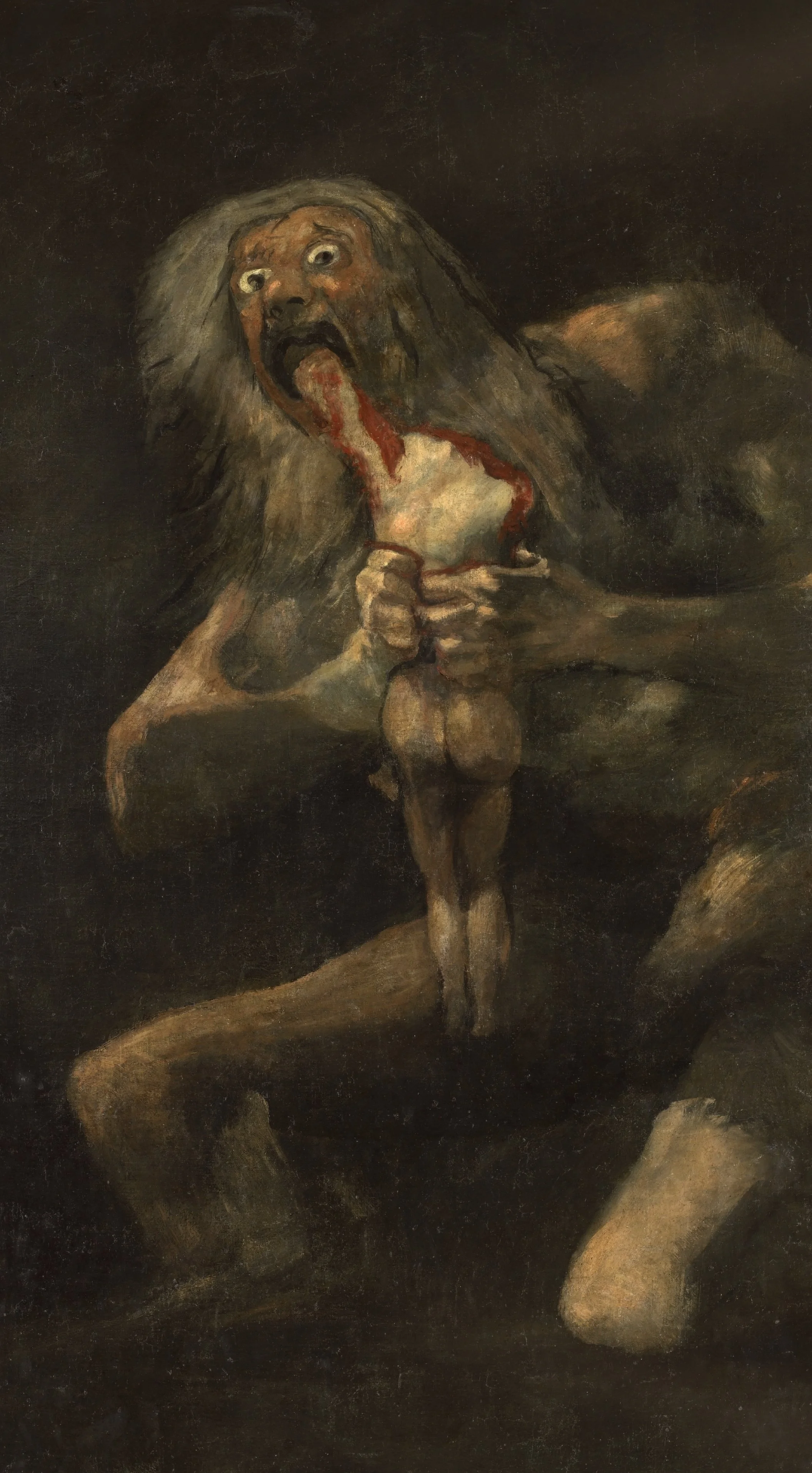
SATURN DEVOURING HIS SON
SATURNO DEVORANDO A SU HIJO
Title: Saturn Devouring His Son / Saturno devorando a su hijo
Artist: Francisco de Goya y Lucientes (1746–1828)
Date: c. 1820–1823
Series: The Black Paintings
Medium: Oil mural on plaster, transferred to canvas
Dimensions: 143.5 × 81.4 cm (56.5 × 32.0 in)
Original Location: Quinta del Sordo, Madrid
Current Location: Museo Nacional del Prado, Madrid, Spain
Support: Canvas (transferred from plaster, 1874–1878)
Style: Late Romanticism
Subject: Saturn (Cronus) consuming one of his children to prevent the prophecy that one of them would overthrow him.
Significance: One of the most iconic and disturbing images in Western art, transforming a classical myth into a profound meditation on fear, madness, mortality, and the destructive nature of power.
Inventory Number: P000763
When you enter the room that houses Goya's Black Paintings, you eventually encounter a grotesque image that is almost impossible to ignore. Emerging from a background of darkness, a wild-eyed figure crouches over a mutilated body, locked in an act of shocking violence. Even among Goya's most disturbing creations, Saturn Devouring His Son possesses a singular power.
Painted between 1819 and 1823 as part of the Black Paintings cycle, the work was never intended for public exhibition. Goya painted it directly onto the walls of his house, La Quinta del Sordo, during the final years of his life. Removed from its original setting and transferred to canvas decades later, it remains one of the most enigmatic images in Western art.
At first glance, the scene appears brutally simple. A giant figure devours a human body. There is no landscape, no explanatory narrative, and no visible context. Darkness surrounds the figure, isolating him from both place and time. The viewer is offered no escape from the central action.
Yet what makes the painting unforgettable is not simply its violence. Art history contains countless images of suffering, war, and death. Goya's Saturn disturbs us for another reason. The figure appears driven by an overwhelming fear, as though the act itself is born from desperation rather than cruelty.This impression raises a fundamental question. What exactly are we looking at? Is this merely an illustration of an ancient myth, or is Goya using that myth to express something deeper about power, time, fear, and the human condition?
To answer that question, we must begin with the story that inspired the painting.
To understand Goya’s painting, we must first look at the ancient myth from which it emerged. In Greek mythology, the figure later known to the Romans as Saturn was originally Cronus, ruler of the Titans and father of the Olympian gods.According to the myth, Cronus himself had seized power by overthrowing his father, Uranus. Having gained his throne through violence, he received a terrifying prophecy: one of his own children would eventually overthrow him in the same way. The prediction planted a seed of fear that would govern all his actions.
Determined to prevent his downfall, Cronus adopted a drastic solution. Each time his wife Rhea gave birth, he swallowed the child immediately. Hestia, Demeter, Hera, Hades, and Poseidon all disappeared into their father's body. The act was not motivated by hunger or cruelty alone. It was an attempt to stop time, halt succession, and preserve power forever. The plan ultimately failed. When Zeus was born, Rhea deceived Cronus by giving him a stone wrapped in swaddling clothes. Zeus survived, reached adulthood, and eventually fulfilled the prophecy. Cronus was defeated, his children were freed, and a new divine order emerged.The myth contains a profound irony. The very actions taken to avoid destiny become the means through which destiny is fulfilled. Cronus destroys his own peace in his desperate effort to preserve it.
Yet when we compare this story with Goya's painting, something immediately stands out. The artist removes nearly everything that belongs to the classical narrative. There is no throne, no palace of the gods, no symbolic attributes, and no sense of divine grandeur. The majestic Titan of antiquity has vanished. What remains is a solitary creature in darkness, consumed by fear.This transformation is the key to understanding the painting. Goya is not simply illustrating a myth; he is reshaping it into something far more unsettling and universal.
The story of Saturn devouring his children had been represented by artists long before Goya. Perhaps the most famous earlier example is the version painted by Peter Paul Rubens in the seventeenth century. In Rubens’s interpretation, Saturn remains recognizably a god. He possesses a powerful body, a sense of grandeur, and an almost theatrical dignity, despite the horror of his actions. The scene belongs to the world of classical mythology.
Goya takes the same subject and strips it of nearly everything that traditionally defined it.
There is no divine setting. There are no mythological symbols. There is no attempt to present Saturn as a majestic ruler of the cosmos. Instead, the figure emerges from a void of darkness. He is naked, disheveled, and almost animal-like. Rather than a god performing a terrible act, he appears as a creature trapped by an uncontrollable impulse.The body of the victim reveals another significant departure from tradition. Classical artists generally depicted Saturn swallowing small children, in accordance with the myth. Goya does not. The figure being consumed appears closer to an adolescent or even an adult body. This decision radically alters the emotional impact of the scene. The viewer is no longer observing an illustration of a mythological episode but witnessing an act that feels immediate, physical, and disturbingly real.
Even the moment selected by Goya is unusual. Earlier artists often portrayed Saturn before or during the act of swallowing. Goya chooses a later and more brutal instant. The body has already been mutilated. The event is irreversible. We arrive too late to prevent it.
Most striking of all are Saturn’s eyes. They are wide open, staring directly outward, as if suddenly aware of being observed. This transforms the relationship between the painting and the viewer. We are no longer distant spectators of an ancient legend. We become witnesses.
By removing the comforts of mythology, Goya forces the image into our world, where its meaning becomes far more difficult—and far more disturbing—to escape.
For centuries, scholars have sought to explain what Saturn represents in Goya’s painting. Some have interpreted the image politically, others biographically, and others psychologically. Yet one of the oldest and most enduring interpretations may also be the most revealing: Saturn as Time itself. The association is ancient. In Renaissance and Baroque art, Saturn was often linked to the relentless passage of time. Time creates, nourishes, transforms, and ultimately destroys all living things. Every generation gives way to another. Every empire rises and falls. Every human life moves toward its inevitable end. Seen in this light, Saturn devouring his child becomes a powerful metaphor. Time consumes everything it produces. The child represents youth, possibility, and the future; Saturn represents the force that eventually reclaims them all.
Yet Goya’s painting seems to go beyond this traditional symbolism. The figure does not merely consume another being; he appears consumed himself. His expression is not one of satisfaction but of terror. He is attempting to preserve his power through destruction, yet the act itself reveals his weakness. This paradox lies at the heart of the image. The fear of losing power often leads individuals, institutions, and even nations to act against their own interests. In trying to prevent change, they accelerate it. In trying to preserve themselves, they begin to destroy the very things that sustain them. The painting therefore speaks not only about time but about possession, control, and fear. Saturn cannot accept succession. He cannot tolerate the existence of a future that does not belong to him. His response is to devour it. But the ultimate tragedy is that his victory is impossible. No one defeats time by resisting it. No ruler remains forever. No generation can prevent the next from arriving. Saturn's violence achieves nothing except the revelation of his own desperation. The monster's greatest victim may not be the child in his hands, but Saturn himself.
Throughout this essay, we have examined Saturn as a figure from mythology, as a symbol of time, and as a powerful image transformed by Goya's imagination. Yet one final question remains: are we truly looking at Saturn, or are we looking at Goya himself?
When Goya painted the Black Paintings, he was an old man living in relative isolation. He was completely deaf, physically weakened, and profoundly disillusioned by the events he had witnessed during his lifetime. The celebrated court painter who had once enjoyed the favor of kings now spent his final years surrounded by silence.This context inevitably changes the way we see the painting. The wide eyes of Saturn do not convey the confidence of a ruler. They suggest something far more fragile. Beneath the violence, there is an unmistakable sense of anxiety.
It is impossible to know precisely what Goya intended. Yet the painting invites us to consider the possibility that Saturn embodies some of the artist's own fears. The fear of aging. The fear of decline. The fear of becoming irrelevant in a world that belongs increasingly to younger generations.Seen from this perspective, the myth acquires a deeply personal dimension. Saturn is no longer merely a god attempting to prevent a prophecy. He becomes an image of a man confronting the reality that time cannot be stopped.
Perhaps this is why the painting continues to speak to us. The monster before us is not simply devouring his child. He is also confronting his own defeat. Every bite brings him closer to the fate he is trying to escape.
In the end, Saturn Devouring His Son may be less a painting about violence than a meditation on mortality. Behind the terrifying figure emerging from the darkness, we may glimpse an aging Goya wrestling with the oldest and most universal of human fears: the knowledge that time devours us all.
Juan de Barrientos