

The Black Pond
The Black Lagoon and Bosch's Silent Question
The Dark Water in Eden
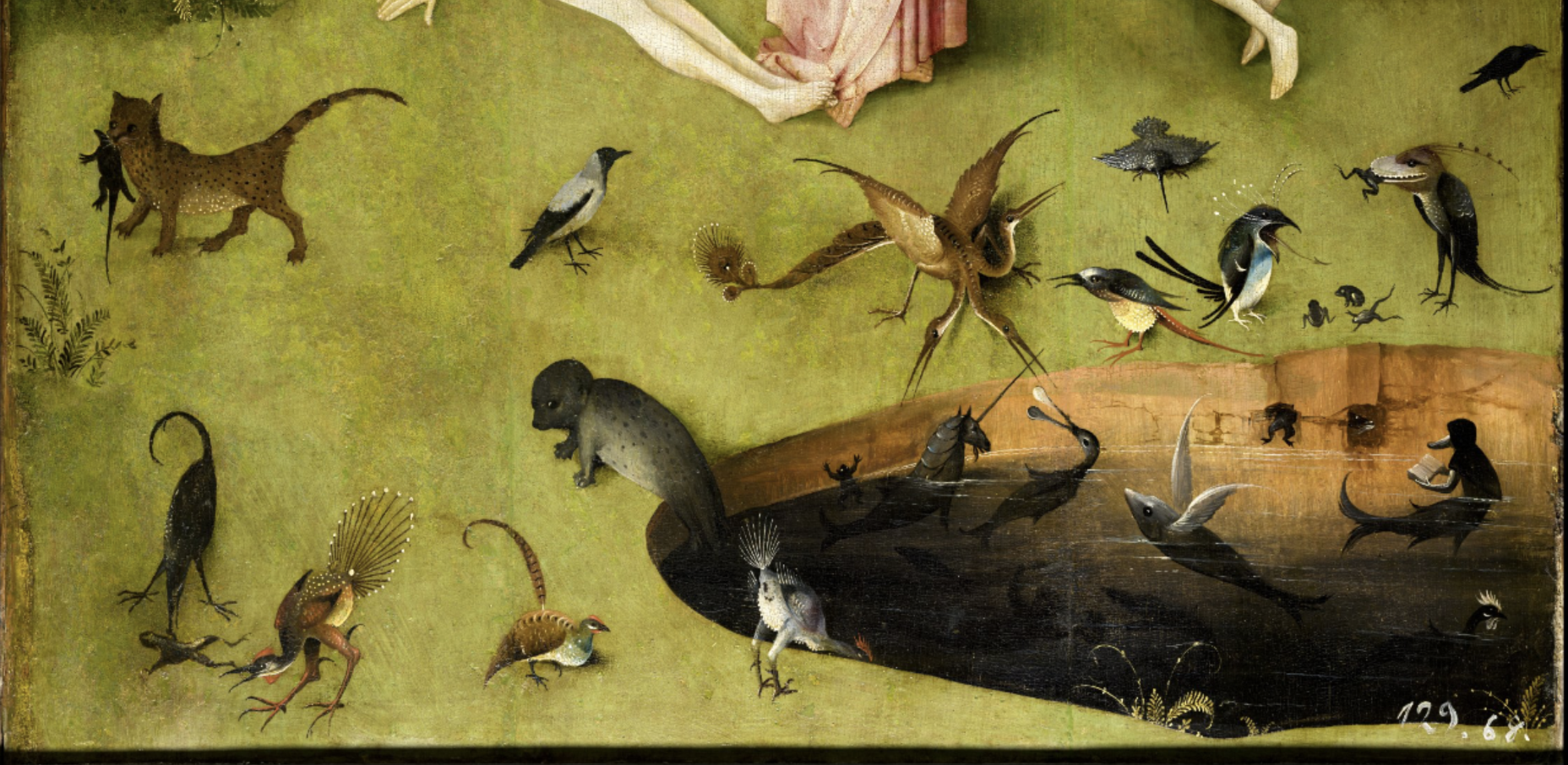
Now, let us talk about the Black Pond on the first panel. The first question that comes to mind is: why is it there?
Unlike most of the surrounding landscape, this little pond it is remarkably dark, almost black.The pond is not hidden in a remote corner of the composition. It occupies a visible position within the foreground and lies relatively close to the central theological drama of Adam, Eve, and Christ. Once discovered, it becomes difficult to ignore.
The surrounding area is also unusual. Several of the panel's most curious creatures gather around its edges. Strange birds, aquatic animals, hybrid forms, and one of the most enigmatic figures in the entire triptych—the platypus like creature reading a book
This essay begins with a simple observation. Bosch chose to place one of the darkest visual elements in the entire panel within a scene traditionally understood as Paradise. The decision may have been purely pictorial. Yet given Bosch's extraordinary attention to detail, it is worth asking whether the Black Pond was intended to play a more significant role within the visual and symbolic structure of the Garden.
What Have Scholars Seen Through the Centuries?The Black Pond may appear conspicuous to viewers once it has been noticed, yet it occupies a surprisingly modest place in the history of Bosch scholarship. Over the centuries, countless pages have been devoted to The Garden, but relatively little attention has been given specifically to this dark body of water. Most scholars have concentrated on the central theological drama of the panel: the presentation of Eve, the figure of Christ, the exotic animals, and the extraordinary fountain that dominates the landscape.
This relative silence is itself noteworthy. Bosch is among the most studied artists in the history of Western art. Few paintings have generated more commentary than The Garden.Since the sixteenth century, theologians, historians, collectors, writers, and art historians have proposed interpretations ranging from the deeply orthodox to the highly imaginative. Yet the Black Pond has rarely occupied a central position within these discussions.
Early commentators tended to view the triptych primarily as a moral and religious work. Their attention focused on the relationship between the three panels: Creation, human behaviour, and divine judgement. The left panel was generally understood as Paradise, the central panel as a world given over to earthly pleasures, and the right panel as the consequences of sin. Within such readings, individual details often received less attention than the overall moral structure.
The nineteenth and twentieth centuries brought new approaches. Some scholars explored symbolic and psychological interpretations. Others searched for alchemical, esoteric, or even proto-surrealist meanings within Bosch's extraordinary imagery. The artist's hybrid creatures, unusual landscapes, and enigmatic details encouraged increasingly diverse interpretations. Yet even within this expanding body of scholarship, the Black Pond remained largely a secondary feature.
More recent research has generally moved toward greater caution. Technical examinations, conservation studies, and close visual analysis have encouraged scholars to distinguish more carefully between what can be observed and what can only be hypothesised. This approach has deepened our understanding of Bosch's working methods, materials, and compositional choices, while also reminding us how much remains uncertain.
No broadly accepted interpretation has emerged. Some scholars have regarded it as a natural feature of the landscape. Others have viewed it as part of the painting's broader atmosphere of symbolic complexity. Neither position has achieved consensus.
The result is a curious paradox. One of the most famous paintings in the world has been examined for more than five centuries, yet one of its darkest and most visually distinctive features remains comparatively understudied. The Black Pond has always been there. Every viewer has seen it, whether consciously or unconsciously. Yet it has rarely become the primary subject of investigation.
Perhaps this is precisely why it deserves closer attention. Before attempting to interpret the pond itself, we must first examine the remarkable creatures that gather around its shores, for it is there that some of the most unusual visual problems in the entire panel begin to emerge.
The creatures of the lagoon are quite peculiar, especially if we consider that, supposedly, we are in Paradise. Are these Paradise creatures?
The question may sound simple, yet it touches upon one of the most intriguing aspects of Bosch's left panel. When modern viewers think of Eden, they often imagine a world of harmony, order, and innocence. The animals are expected to reflect that condition. Yet the region surrounding the Black Pond presents a far more complex picture.
What makes this especially interesting is Bosch's demonstrated ability to paint animals with considerable accuracy. His elephants, giraffes, bears, and birds show careful observation rather than mere fantasy. When he departs from naturalistic representation, it is reasonable to suspect that the departure may be intentional.
The area around the pond seems to contain a higher concentration of such departures than many other parts of the panel. Birds gather at the water's edge. Aquatic creatures emerge from the dark surface. Strange forms occupy the boundary between land and water. The viewer repeatedly encounters animals that invite a second look.
The question is not whether these creatures are "real" or "imaginary." Medieval viewers lived in a world where bestiaries, travellers' accounts, folklore, and religious symbolism often coexisted. The more important question is why Bosch chose to place so many unusual beings in this particular location.
The answer remains uncertain, but the visual pattern is difficult to dismiss. The Black Pond appears to function as a gathering place for creatures that challenge easy classification. This does not necessarily imply danger or corruption. The scene remains calm. Yet it introduces a note of complexity into a landscape traditionally identified as Paradise.
Some of the creatures also display behaviour that feels unexpected. Elsewhere in the panel, Bosch occasionally depicts predatory activity, reminding us that Eden in the Garden of Earthly Delights is not always as straightforward as modern expectations might suggest. Around the pond, this sense of visual tension becomes particularly noticeable. The animals do not simply populate the landscape; they seem to contribute to a broader atmosphere of curiosity and inquiry.
This observation brings us back to the question posed at the beginning of the movement. Are these Paradise creatures?
Perhaps the answer depends on what we expect Paradise to be. If Eden is understood as a place of perfect simplicity, the creatures of the lagoon seem strangely out of place. If, however, Paradise is understood as a realm of immense richness and complexity, then their presence becomes easier to understand.
Bosch offers no definitive answer. Instead, he presents a remarkable collection of living beings at the edge of a dark body of water and allows the viewer to draw conclusions. Among them sits one creature that appears even more unusual than the rest—not because of its form, but because of what it is doing. While the others inhabit the landscape, this small figure seems to study it. It is to that extraordinary reader that we must now turn.
Now we come to study the most intriguing figure of the left panel, a subtle one, but indeed one of the most important ones in the triptych.At first glance, the creature is easy to miss. It occupies a relatively small area near the Black Pond and lacks the visual prominence of the central fountain, the figure of Christ, or the presentation of Eve. Many visitors to the Prado pass over it entirely. Yet once discovered, it becomes remarkably difficult to forget.
The reason is simple. The creature is reading a book.This is an extraordinary detail. Bosch's Paradise is populated by animals engaged in recognisable activities. They move through the landscape, occupy the water, interact with one another, and contribute to the rich diversity of Creation. The reader, however, behaves differently. It seems detached from the activity surrounding it. Its attention is directed toward the object it holds rather than toward the world around it.
The act of reading immediately raises questions. Reading is not simply a physical action. It implies concentration, interpretation, and understanding. It is one of the most distinctly intellectual activities known to human beings. To find such an action represented within the animal world of Eden is unexpected. The book, along with Savior´s clothes and jewel are the only man made objects in the left panel, for I would say that the fountain is not man made, if the reader will permit me to say so…
The figure itself is difficult to identify. Some viewers remark that it resembles a platypus, although such a comparison is necessarily anachronistic. Bosch could never have seen such an animal. What matters is not the specific resemblance but the broader observation that the creature resists easy classification. Like several of the beings that inhabit the shores of the Black Pond, it appears to occupy a territory between the familiar and the unfamiliar.
Bosch could have placed any number of curious creatures beside the lagoon. Instead, he chose to depict one apparently engaged in reading. This decision is quite deliberate. The creature does not merely exist within the landscape, it is performing an intellectual act.
Its posture reinforces this impression. Unlike the surrounding animals, it conveys a sense of attention and absorption. The viewer has the impression of encountering not merely a creature, but a creature occupied with a task.
This small figure introduces a remarkable paradox into the panel. The scene depicts the beginning of human history. Eve has only just been presented to Adam. The great events of civilisation have not yet unfolded. No libraries exist. No scholars have written books. No accumulated body of human learning has emerged. Yet here, beside the darkest body of water in Paradise, sits a figure apparently engaged in study.
The paradox becomes even more striking when we consider its location. Bosch did not place the reader beside the central fountain or among the principal figures of the narrative. He placed it beside the Black Pond, among some of the most unusual creatures in the panel. Whether this association is symbolic or compositional, it deserves careful consideration.
The reader does not explain the lagoon. If anything, it makes the lagoon more enigmatic. The creature seems to possess a purpose that remains inaccessible to the viewer. We can observe the action, but we cannot fully understand it. We see the reader, yet we do not know what is being read.
This may be why the figure has such a powerful effect on attentive viewers. It transforms a small corner of the painting into one of its most intellectually provocative spaces. The eye naturally begins to ask questions. Why is the creature reading? What knowledge does it seek? Why has Bosch placed it here?
The answers remain elusive. Yet before exploring possible interpretations, we must first examine the object that gives the figure its unique significance: the book itself.
The creature is reading a book without words. Why?
At first sight, the object appears unmistakable. The small figure seated beside the Black Pond holds what seems to be an open book. Bosch took care to distinguish it from the creature's body, making it clear that the object is significant. Yet the closer we look, the stranger the scene becomes.
The book is blank. Technical examinations have not revealed hidden text beneath the paint. As far as current evidence allows us to determine, the reader is studying a book that contains no readable words.This immediately creates a paradox.
A book exists to communicate meaning. Reading presupposes content. Yet Bosch presents the action while withholding the message. We can see the reader, but we cannot share its knowledge. The gesture is visible; the contents remain inaccessible.
One possible explanation is that Bosch simply wished to indicate the presence of a book without concerning himself with its details. Such a solution cannot be excluded. Artists often simplify small objects that would have been difficult to render at such a scale. Yet in this particular case, the explanation feels incomplete. Bosch placed the figure in a highly unusual location and gave it a highly unusual activity. The book appears too deliberate to dismiss so easily.
A more interesting possibility emerges when we consider the symbolic role of books in medieval culture. Books frequently represented wisdom, learning, memory, authority, and revelation. Saints carried books. Prophets carried books. Scholars carried books. The image would have been immediately recognisable to Bosch's contemporaries.
Yet this interpretation introduces another question.
What knowledge could possibly exist at this moment?
The scene unfolds at the very beginning of human history. Adam and Eve stand at the threshold of existence. No kingdoms have risen. No chronicles have been written. No libraries have been built. The Scriptures themselves belong to the future. In this context, the presence of a book appears almost anachronistic.
The object seems to belong to a world that has not yet arrived. Perhaps this is why the blank pages are so important.
Bosch may be suggesting that the significance of the book lies not in its contents but in the act of reading itself. The creature appears engaged in observation, reflection, and interpretation. It is not merely holding a book; it is attempting to understand something.
The ambiguity becomes even more intriguing when we remember the location of the figure. The reader sits beside the darkest body of water in Paradise. It occupies a place where unusual creatures gather and where familiar categories seem to become less certain. The blank book therefore appears within a broader context of unanswered questions.
Perhaps the pages are empty because Bosch wanted them to remain open.
An unreadable book invites interpretation. It encourages the viewer to search for meaning rather than simply receive it. In that sense, the object mirrors the experience of looking at The Garden of Earthly Delights itself. For more than five centuries, scholars and visitors have attempted to decipher Bosch's extraordinary imagery. Each generation has proposed new explanations. Yet many of the painting's most fascinating details continue to resist definitive interpretation.
The small reader beside the Black Pond embodies that condition perfectly. It possesses a book that cannot be read. We stand before a painting that cannot be fully explained.
What is this reader telling us? What is going to happen? Are we going to write our future?
These questions may sound surprisingly modern, yet they arise naturally from the image itself. Bosch has placed a reading creature in Paradise, before the Fall, before history, before civilisation, and before the great drama of human existence unfolds. The figure appears to be studying something at a moment when almost nothing has yet happened.This observation deserves careful attention.
The reader occupies a peculiar position within the narrative structure of the triptych. It belongs to the first panel, yet it seems almost aware of the panels that follow. Around it, Creation appears fresh and new. Adam and Eve stand at the beginning of human history. Yet the viewer knows what comes next. We know the temptation, the expulsion, the suffering, and the final judgement depicted elsewhere in the work. The creature does not. Or does it?
Bosch gives us no answer. Yet the question remains difficult to avoid.
The figure sits beside the Black Pond, surrounded by unusual creatures, holding an open book whose pages appear empty. The image almost invites the viewer to think about possibility rather than certainty. Nothing has yet been written. Nothing has yet been decided. The future remains open. In this respect, the blank pages become especially intriguing.
A written book records what has already happened. A blank book suggests what has not yet been written. The distinction may be important. Bosch may not be showing a creature studying the past. He may be showing a creature contemplating a future that remains unwritten.
Such an interpretation cannot be proven, but it emerges naturally from the visual evidence. The reader appears at the beginning of the story, not at its conclusion. It sits at the threshold of events rather than at their end.This raises another possibility.
Perhaps the figure functions as a silent witness to human freedom.
One of the central themes of the triptych is choice. The movement from Paradise to the central panel and ultimately to Hell is not presented as an unavoidable sequence of events. It is the consequence of decisions. Human beings shape their destiny through their actions.If this reading is correct, the empty book acquires a powerful symbolic significance. The pages remain blank because the story has not yet been written. Adam and Eve stand at the beginning of a narrative whose outcome still lies ahead.
The Black Pond may reinforce this idea. Throughout the history of art and literature, dark waters often symbolise uncertainty. One cannot easily see what lies beneath their surface. They conceal possibilities, dangers, and futures not yet revealed. Bosch's pond occupies precisely such a position within the panel. It appears calm, yet its darkness introduces an element of expectation.
The reader sits beside it as though contemplating what may emerge.
Whether Bosch intended such a meaning can never be known with certainty. Yet the image encourages reflection upon questions that lie at the heart of the human condition. Are our futures fixed, or do we participate in shaping them? Is Paradise merely the beginning of a predetermined story, or the moment before a choice? The reader offers no verbal answer.
Instead, it remains seated beside the dark water, gazing into an unreadable book whose pages await completion. In doing so, it becomes one of the most thought-provoking figures in the entire triptych—not because it reveals the future, but because it reminds us that the future has yet to be written.
Juan de Barrientos