

Jheronimus´s Family
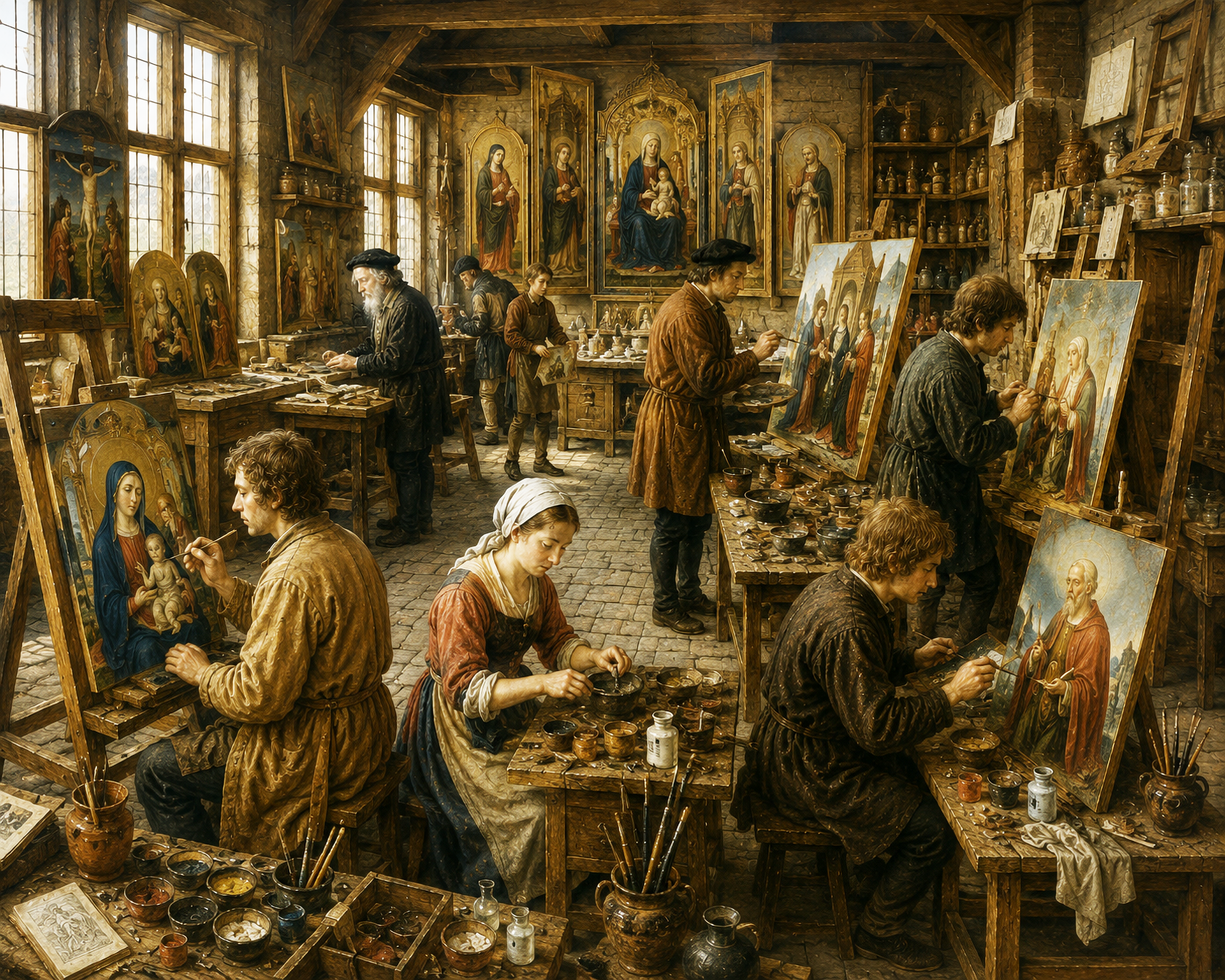
The Famous Name and the Forgotten Family
Few artists are as famous as Hieronymus Bosch. His works hang in major museums, attract millions of visitors, and continue to inspire historians, writers and filmmakers more than five centuries after his death. The Garden of Earthly Delights has become one of the most recognisable images in the history of art. Yet the man behind these extraordinary creations remains strangely elusive.
This paradox has fascinated scholars for generations. Bosch's imagery is known throughout the world, but the details of his life remain remarkably scarce. Unlike many Renaissance artists, he left no diary, no collection of letters, no theoretical writings and no personal reflections explaining his ideas. The surviving records reveal fragments of his existence, yet much of the individual behind the art remains hidden.
An even greater paradox lies behind this familiar mystery. Bosch is often imagined as a solitary genius emerging unexpectedly from the streets of medieval 's-Hertogenbosch. The reality appears rather different. Far from standing alone, he belonged to a large family of professional painters whose presence can be traced through the city's records. His grandfather was a painter. His father was a painter. Several of his uncles practised the same profession, and members of the next generation seem to have continued the tradition. For decades, the Van Aken family formed part of the artistic life of the city.
If Bosch emerged from a family of painters, what happened to the rest of them?
The question is more than a matter of genealogy. It touches upon a broader mystery of artistic memory. Why do some names survive while others disappear? Why does history preserve one voice while allowing many others to fade? Behind the celebrated figure of Hieronymus Bosch stands an entire dynasty of artists whose story has been almost forgotten.
To understand Bosch fully, we must first step beyond the famous name and enter the world that shaped him. Only then can we begin to explore one of the most curious disappearances in the history of art: the lost painters of the Van Aken dynasty.
Long before the name Bosch became known beyond the walls of 's-Hertogenbosch, another name was associated with the family's artistic activity: Van Aken.
The surname suggests connections with the city of Aachen, known in French as Aix-la-Chapelle and in Latin as Aquisgranum. Whether the family itself originated there cannot be established with certainty, but the name preserves a memory of roots extending beyond the city in which Bosch would eventually live and work. By the fifteenth century, however, the Van Akens were firmly established in 's-Hertogenbosch, one of the most prosperous urban centres in the Duchy of Brabant.
The first family member to emerge clearly from the surviving records is Jan van Aken, Bosch's grandfather. Although the documentation is limited, it reveals something important. Jan appears not merely as an individual painter but as the founder of a family enterprise that would continue across several generations. His workshop became the nucleus of an artistic dynasty whose members contributed to the visual culture of the city for decades.
The scale of this activity is striking. Jan van Aken had several sons, and at least four of them became painters. Such continuity was not unusual in the late Middle Ages, when artistic knowledge was commonly transmitted within families and workshops passed from one generation to the next. Yet the Van Akens seem to have embraced this model with particular success. Painting was not the profession of a single individual; it was the occupation of an entire household.
This fact changes the way we think about Bosch's origins. We often imagine artistic genius as something sudden and isolated, appearing almost without precedent. The surviving evidence suggests a different reality. Long before Bosch held a brush, members of his family had spent decades preparing panels, grinding pigments, accepting commissions and producing religious images for local patrons.
The Van Akens appear to have functioned as a family enterprise, sharing technical knowledge, practical experience and professional connections that made artistic production possible. Whatever made Bosch exceptional would emerge later. The foundations had already been laid by previous generations. Yet this only deepens the mystery. If the family was so active, and if its members worked as painters for decades, why has so little of their artistic production survived? The records preserve their names, but almost none of their work. Before we can understand the extraordinary figure who became Bosch, we must first enter the bustling world of the workshop where his story truly began. He was not raised in a household where art appeared occasionally. He grew up in a world where artistic production formed part of everyday life.
For a young boy, such a setting was an education long before any formal apprenticeship began. Every stage of artistic production unfolded before his eyes. Panels arrived from carpenters. Wood was seasoned and prepared. Pigments were ground into fine powders and mixed with oils or binding agents. Drawings were transferred onto wooden surfaces. Gold leaf was applied to sacred images destined for churches and chapels.
Although the surviving records tell us little about the daily life of the household, the nature of fifteenth-century workshops allows us to reconstruct certain aspects with reasonable confidence. Artistic production was rarely the work of a single individual. Cooperation was essential. Experienced painters executed the most important passages, assistants carried out routine tasks and apprentices learned through observation and practice. Women also played roles within such enterprises, even if official documents seldom recorded their contributions. Brushes had to be prepared, pigments organised, accounts maintained and commissions managed. The workshop was almost certainly a family endeavour in the fullest sense of the word.
One can easily imagine the young Jheronimus observing this activity with fascination. Around him were men discussing commissions, negotiating prices and solving practical problems. Painting was not a distant ambition. It was simply the normal rhythm of life.
This environment may help explain one of the most remarkable aspects of Bosch's later career. When we look at his works today, we naturally focus on their originality. We see fantastic creatures, strange architectures and scenes unlike anything else in Northern European art. Yet before Bosch became an innovator, he first had to become a craftsman. The technical mastery visible in his surviving paintings was built upon years of observation, training and experience acquired within a household that had already spent generations working with paint.
The familiar image of Bosch as an isolated visionary therefore requires some adjustment. Whatever imaginative gifts he possessed, they developed within a highly practical environment. The dreamer emerged from a working workshop. The creator of impossible worlds first learned his trade among pigments, brushes, wooden panels and the routines of a busy artistic household.
The surviving records tell us surprisingly little about Bosch's artistic development. We do not know which works he produced as a young man. We do not know how his style evolved from one year to the next. We cannot even identify with certainty who may have trained him. The documents confirm the existence of the painter, but reveal almost nothing about the formation of the artist. Yet the surviving works leave little doubt that something unusual happened.
The paintings associated with Bosch possess a character that is difficult to find elsewhere in Northern European art. Other artists of the period painted saints, altarpieces and devotional scenes. Bosch worked within the same religious culture, yet approached it in a strikingly different way. His compositions are populated by hybrid creatures, improbable architectures, symbolic objects and visual inventions that continue to provoke discussion more than five centuries later.
The contrast becomes even more striking when we consider what has survived. Bosch's paintings continue to attract worldwide attention. By comparison, the work of his father, uncles and other relatives has largely disappeared from view. This difference cannot be explained by documentation alone. Something in Bosch's art captured the imagination of contemporaries and later generations in a way that the work of his relatives apparently did not.
The question, however, is not simply whether Bosch was more talented than the other members of his family. Talent alone rarely guarantees survival. History is filled with gifted artists whose names are now forgotten. A more interesting question is whether Bosch possessed a vision that set him apart from the traditions he inherited.
His paintings suggest that he did.
Again and again, Bosch appears less interested in describing the visible world than in exploring the forces that shape human behaviour. Temptation, folly, desire, fear, judgment and salvation become tangible realities within his art. Familiar settings are transformed into stages upon which moral and spiritual dramas unfold through images of extraordinary invention.
Whether this tendency developed gradually or appeared suddenly remains impossible to determine. The evidence simply does not survive. Yet by the end of the fifteenth century, Bosch had become something more than another member of a successful workshop. He had become an artist whose work could no longer be mistaken for that of his contemporaries.That achievement would eventually bring him lasting fame. It may also explain why history remembered him while forgetting so many of the painters who surrounded him. The Van Akens produced respected craftsmen and successful professionals. Bosch became something rarer: an artist whose imagination continued to speak long after the workshop itself had fallen silent.
The silence surrounding Bosch extends beyond the written record. Not only have his letters, notebooks and personal reflections disappeared, but so too have the works produced by the family from which he emerged.This is perhaps the most curious aspect of the Van Aken story.
We know that Bosch's grandfather was a painter. Several of his sons practised the same profession. The family workshop operated for decades and provided its livelihood across multiple generations. Such an enterprise must have produced a substantial body of work. Altarpieces, devotional panels, commissions for churches and paintings for private patrons would have occupied the workshop continuously.Yet where are these paintings today?
No work can be securely attributed to Bosch's grandfather Jan van Aken. The same is largely true of his father Anthonius and most other members of the family. Their names survive in the records, but their artistic production has almost completely disappeared. It is as though an entire generation of painters receded into the background of history.
Several explanations are possible. The simplest is that many works simply failed to survive. Medieval and Renaissance paintings were fragile objects. Fires, floods, wars, iconoclasm, neglect and changing fashions destroyed countless works of art. Churches were rebuilt. Altarpieces were dismantled. Wooden panels deteriorated. What appears exceptional today may, in reality, reflect a common historical fate.
Another possibility is that some works survive but can no longer be identified. Attribution is often a delicate process. When signatures are absent and documentary evidence is scarce, paintings can become detached from their creators. Works produced within the Van Aken workshop may still exist under different names or anonymous classifications. Some could rest in museum storerooms. Others may hang in churches or private collections without any recognised connection to the family that created them.
A third possibility is perhaps the most intriguing. Bosch's paintings survived not merely because they escaped destruction, but because they were considered exceptional. Patrons preserved them. Collectors sought them. Successive generations recognised something distinctive in them. While many contemporary works gradually faded from attention, Bosch's paintings continued to attract admiration, curiosity and debate.
If this is true, survival itself becomes a form of historical judgment.
Juan de Barrientos