

The Garden telling a Story
The triptych clearly is telling a story. The eye naturally moves from the left panel to the centre and finally to the right, following a sequence that seems almost self-evident. On the left we encounter the origins of humanity, on the centre panel we witness a world immersed in pleasure, desire and distraction, and on the right we confront suffering, punishment and loss. The structure feels familiar because it resembles a narrative. Yet a closer look reveals an unexpected omission. One of the most important destinations in Christian thought appears to be missing. Heaven is nowhere to be seen. Bosch presents creation, temptation and consequence, but offers no corresponding vision of salvation. This absence becomes even more striking when one remembers that medieval Christianity was profoundly concerned with the fate of the soul. One might reasonably expect a work of such ambition to include not only the dangers awaiting humanity but also the reward promised to the faithful. Instead, Bosch appears to direct the viewer's attention elsewhere. The triptych seems less interested in celebrating redemption than in examining a particular chain of events and their outcome. Whether this omission was intentional, symbolic or merely apparent remains open to debate. Yet the question deserves careful consideration, for understanding why heaven is absent may help us understand what Bosch was truly trying to say.
For centuries, most interpretations of The Garden have followed a remarkably straightforward path. The left panel has generally been understood as the Garden of Eden, the central panel as humanity surrendered to earthly pleasures, and the right panel as the punishment awaiting those who persist in sin. Such a reading possesses an obvious appeal. It corresponds closely to familiar Christian teaching and provides a coherent framework capable of explaining the triptych as a moral lesson. Medieval viewers were accustomed to visual narratives designed to instruct as much as to delight, and Bosch's extraordinary imagination did not exempt him from that tradition. The abundance of nude figures, unusual activities and sensual encounters in the central panel naturally encouraged associations with temptation and moral excess, while the terrifying scenes of the right wing appeared to confirm the consequences of such behaviour. Within this framework, the triptych becomes a visual sermon, one that requires little specialised knowledge to understand. Its message seems clear: humanity departs from divine order, pursues transient pleasures and ultimately suffers the results. The durability of this interpretation should not be dismissed lightly. A theory does not survive for centuries without possessing explanatory power. Indeed, many elements of the painting fit comfortably within this model. Yet the very success of the traditional reading presents an interesting challenge. When an explanation becomes widely accepted, it can sometimes discourage us from asking whether additional layers of meaning remain hidden beneath its apparent simplicity.
The conventional interpretation begins from an assumption so familiar that it is rarely questioned: the left panel depicts a state of complete harmony. Yet the more closely one studies the scene, the more difficult that assumption becomes to accept without qualification. Bosch's landscape contains elements that sit uneasily within the idea of an entirely peaceful creation. Predatory animals appear among the living creatures. Strange hybrid forms emerge from the terrain. Certain details possess a tension that feels oddly out of place in a world supposedly untouched by disorder. Even the atmosphere differs from the serene paradise one might expect. Rather than presenting a static vision of perfection, Bosch seems to depict a world in motion, a world in which possibilities have already begun to unfold. This observation does not require us to reject the identification of the scene with Eden. It merely encourages caution. The question is not whether the panel contains beauty, for beauty is everywhere evident, but whether beauty alone defines what Bosch intended to show. Some features appear to hint at developments not yet fully revealed. Others seem to foreshadow events that will emerge later in the triptych. The result is a landscape that feels less like a final destination than the opening chapter of a story whose outcome remains uncertain. If that impression proves correct, then the left panel may represent something more complex than paradise preserved. It may depict paradise standing at the threshold of change.
Whatever else the central panel may represent, it is difficult to ignore the role played by attraction. Everywhere the eye turns, figures move toward something they find desirable. They gather around fruits of extraordinary size, pursue companions, enter curious structures, ride exotic animals and participate in activities whose purpose often seems unnecessary from a practical point of view. The landscape itself appears designed to encourage pursuit rather than reflection. Yet one of the most striking aspects of the scene is the absence of obvious coercion. No armies march across the terrain, no rulers issue commands, and no visible force compels the inhabitants to act as they do. The movement originates from within. The figures appear drawn forward by fascination, appetite, curiosity and pleasure. This may help explain why the panel continues to feel surprisingly modern despite the passage of more than five centuries. Bosch is not depicting a specifically medieval temptation but something more fundamental to human experience. The objects of desire may change from one age to another, yet the mechanism remains remarkably familiar. Human beings are attracted by what appears beautiful, pleasurable, novel or rewarding. The central panel transforms that tendency into an entire world. Everything seems organised around the pursuit of immediate satisfaction, while questions of consequence remain conspicuously absent. For that reason, the scene possesses an unusual ambiguity. It can appear joyful, innocent, playful or troubling depending on the assumptions brought by the viewer. Bosch offers no explicit commentary. He simply invites us to observe a society governed primarily by desire and to consider where such a condition might ultimately lead.
The right panel introduces a principle largely absent from the world that precedes it: accountability. Actions that seemed effortless now reveal consequences. Pleasures that appeared harmless acquire a different meaning when viewed through the lens of their results. Bosch's nightmarish landscape is filled with instruments, objects and activities that seem strangely familiar, as though elements from earlier scenes have returned in altered form. What once entertained now torments. What once attracted now imprisons. The transformation is so consistent that the panel often feels less like a separate realm than the logical continuation of processes already set in motion. This observation is important because it shifts attention away from demons and punishments alone. The central question becomes not who imposes suffering, but how suffering emerges. Bosch appears deeply interested in the relationship between choices and outcomes. The figures inhabiting this dark world rarely seem shocked by what surrounds them. Instead, many appear trapped within realities that have somehow grown out of their own actions. Whether interpreted theologically, morally or psychologically, the pattern remains remarkably coherent. Human beings frequently pursue immediate rewards while overlooking long-term consequences, only to discover later that the two cannot be separated. In this sense, the right panel functions as more than a vision of punishment. It becomes a study of cause and effect. The pleasures of the garden have not simply vanished; they have revealed their hidden price. Bosch's warning lies precisely in that revelation. What appears attractive at the beginning of a journey may look very different once the destination comes into view.
At this point, it becomes useful to consider the triptych not merely as a collection of symbolic images but as a carefully constructed narrative. Many stories throughout history have been designed less to describe reality in its entirety than to warn audiences about particular dangers. Folktales, fables and religious narratives frequently operate in this manner. They simplify certain aspects of experience, emphasise others and guide the listener toward a specific lesson. Their purpose is not completeness but instruction. Viewed from this perspective, The Garden of Earthly Delights begins to resemble a visual warning tale. Bosch does not attempt to portray every dimension of Christian doctrine, nor does he provide a comprehensive account of humanity's relationship with God. Instead, he concentrates on a particular sequence that appears to concern him deeply. The narrative moves from an initial condition, through a world dominated by attraction and appetite, toward an outcome that exposes the dangers concealed within that path. Such a structure helps explain several features of the triptych that might otherwise seem surprising. Elements that are absent become as important as those that are present, because a warning story selects its material according to its purpose. The artist's objective is not to map the whole universe but to direct attention toward a specific problem. Once this possibility is recognised, the triptych acquires a new coherence. Rather than asking what Bosch omitted, we may begin asking what lesson required such careful concentration. The answer may lie not in the details of any single panel, but in the trajectory connecting all three.
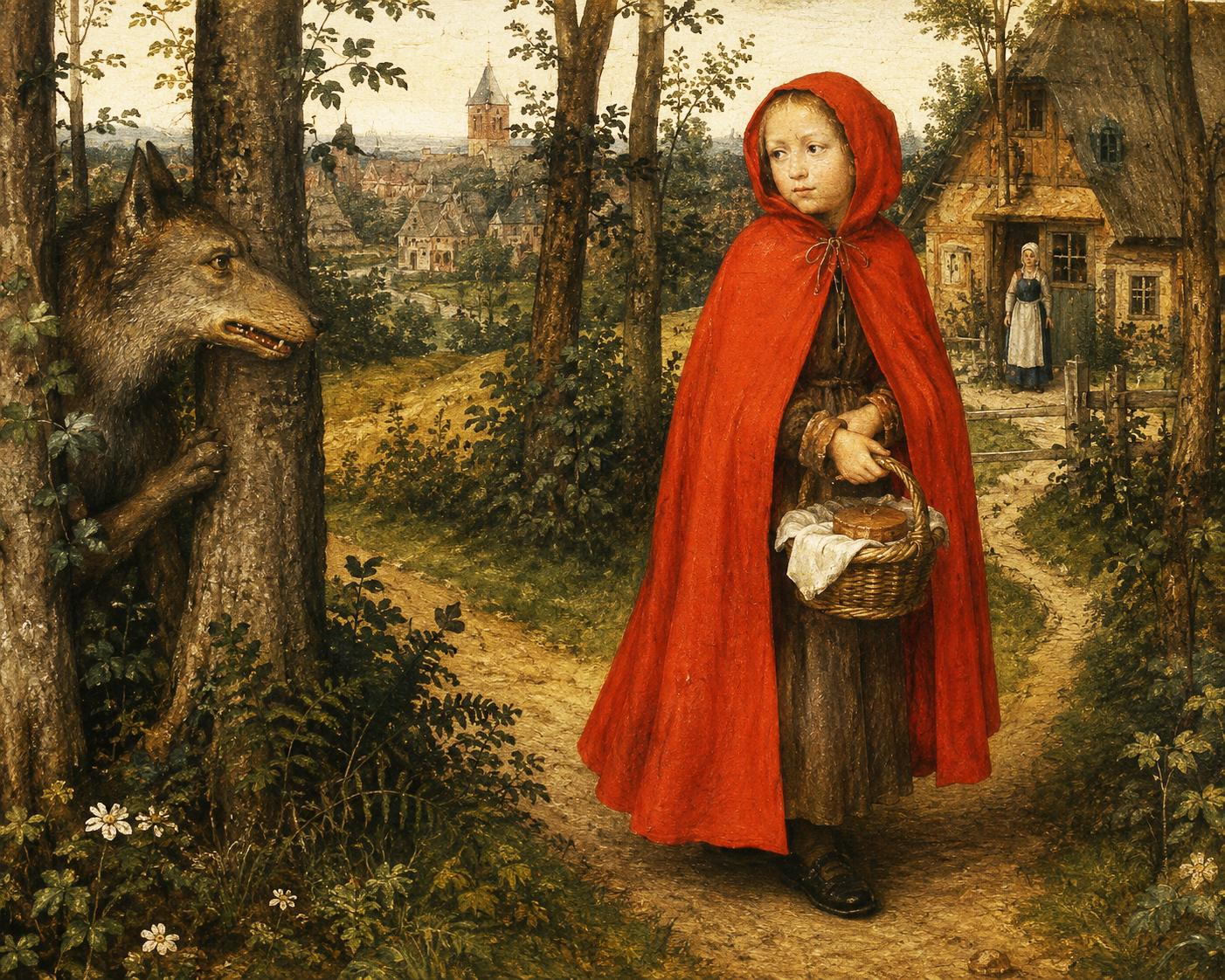
German folklore contains a category of stories known as Warnmärchen, literally "warning tales." These narratives were not created primarily to entertain but to teach caution. They presented situations in which apparently harmless actions led to undesirable consequences, encouraging listeners to recognise dangers before experiencing them personally. One of the best-known examples is Little Red Riding Hood. Beneath the familiar story lies a simple warning: do not stray from the path, do not trust every stranger, and do not assume that appearances are reliable. The tale does not attempt to describe the whole of human existence. Instead, it focuses attention on a particular risk and follows it to its conclusion. Bosch's triptych may operate in a surprisingly similar manner. Rather than offering a complete summary of Christian theology, the painting concentrates on a specific moral trajectory. The viewer is shown an attractive world filled with beauty, novelty and pleasure, yet the narrative does not end there. Bosch insists on continuing the story until the consequences become visible. Seen in this light, the triptych resembles a monumental visual Warnmärchen. Its purpose is not to explain everything, but to warn about something. The artist selects those elements necessary for the lesson and leaves others outside the frame. Such an approach may help explain certain absences within the work. A warning tale does not require completeness. It requires clarity. The storyteller's task is to reveal where a particular road leads before the traveller decides to follow it.
Having followed the triptych from its opening scene to its final outcome, we may now return to the question that initiated this investigation. Why does Bosch omit a visible representation of heaven? One possibility is that he simply assumes its existence. Medieval viewers did not require reminders of a reality that occupied a central place in Christian belief. Churches, sermons, devotional texts and religious art continually reinforced the promise of salvation. If Bosch wished to depict heaven, he certainly possessed the means to do so. The more interesting possibility is that he deliberately chose not to. Such a decision would make sense if the artist's purpose was not to present the full drama of redemption but to focus attention on a particular danger. The structure of the triptych supports this interpretation. Every panel contributes to a narrative concerned with choices and their consequences. Introducing a celestial reward at the conclusion would have shifted the centre of gravity toward a different subject altogether. Bosch appears determined to keep the viewer's attention fixed upon a single question: what happens when desire becomes the guiding principle of human life? From this perspective, heaven is absent not because it lacks importance, but because it lies beyond the scope of the lesson. A warning tale achieves its effect by concentrating on the hazard it seeks to illuminate. The destination omitted from the painting may therefore be the very destination Bosch expected his audience already to know.
If the triptych functions as a Warnmärchen, the absence of heaven ceases to be surprising. A warning tale does not attempt to describe every possible destination. Its purpose is to draw attention to a particular danger and to the consequences that may follow from it. From this perspective, Bosch had no need to paint paradise at the end of his narrative. The lesson he wished to communicate was already complete. The viewer has been shown beauty, temptation and consequence. The task that remains is reflection.
Perhaps this is why the missing heaven continues to intrigue us. We naturally expect it to appear, yet Bosch leaves it outside the frame. Rather than providing an answer, he leaves the question with the spectator. After contemplating the strange landscapes, pleasures and punishments of the triptych, we are invited to consider what has not been painted as carefully as what has. And this leads to a final curiosity. If Bosch chose not to show heaven, how might he have painted it had he decided to do so? The question cannot be answered with certainty. Yet the fact that we continue to ask it more than five centuries later may be one of the clearest signs that Bosch's warning still works.
Juan de Barrientos