

Could Jheronimus have used Drugs?
Could Jheronimus have used Drugs?
People standing before The Garden often ask the same question. Sooner or later, someone points to a giant fruit, a transparent structure, a bird-headed creature, or one of the painting's countless visual surprises and concludes that Bosch must have been taking something. The reaction is understandable. The Garden bears little resemblance to ordinary experience. Its landscapes are unfamiliar, its creatures seem impossible, and its events defy everyday expectations. It is hardly surprising that modern viewers frequently describe the painting as dreamlike, hallucinatory, or surreal.
What drugs were known in Bosch's time? The answer is more complicated than many people expect. We possess no evidence that Bosch used drugs. No letter mentions it, no contemporary account suggests it, and no document records such behaviour. As with many aspects of Bosch's life, we begin with uncertainty. We know that we do not know. The question nevertheless remains interesting because it tells us something about Bosch, and perhaps even more about ourselves. When looking at The Garden, we may feel tempted to assume that extraordinary images require extraordinary causes, and many modern viewers instinctively search for a chemical explanation. A fifteenth-century observer, however, might have approached the painting differently, asking whether it was a vision, a warning, an allegory, or a reflection on human behaviour.
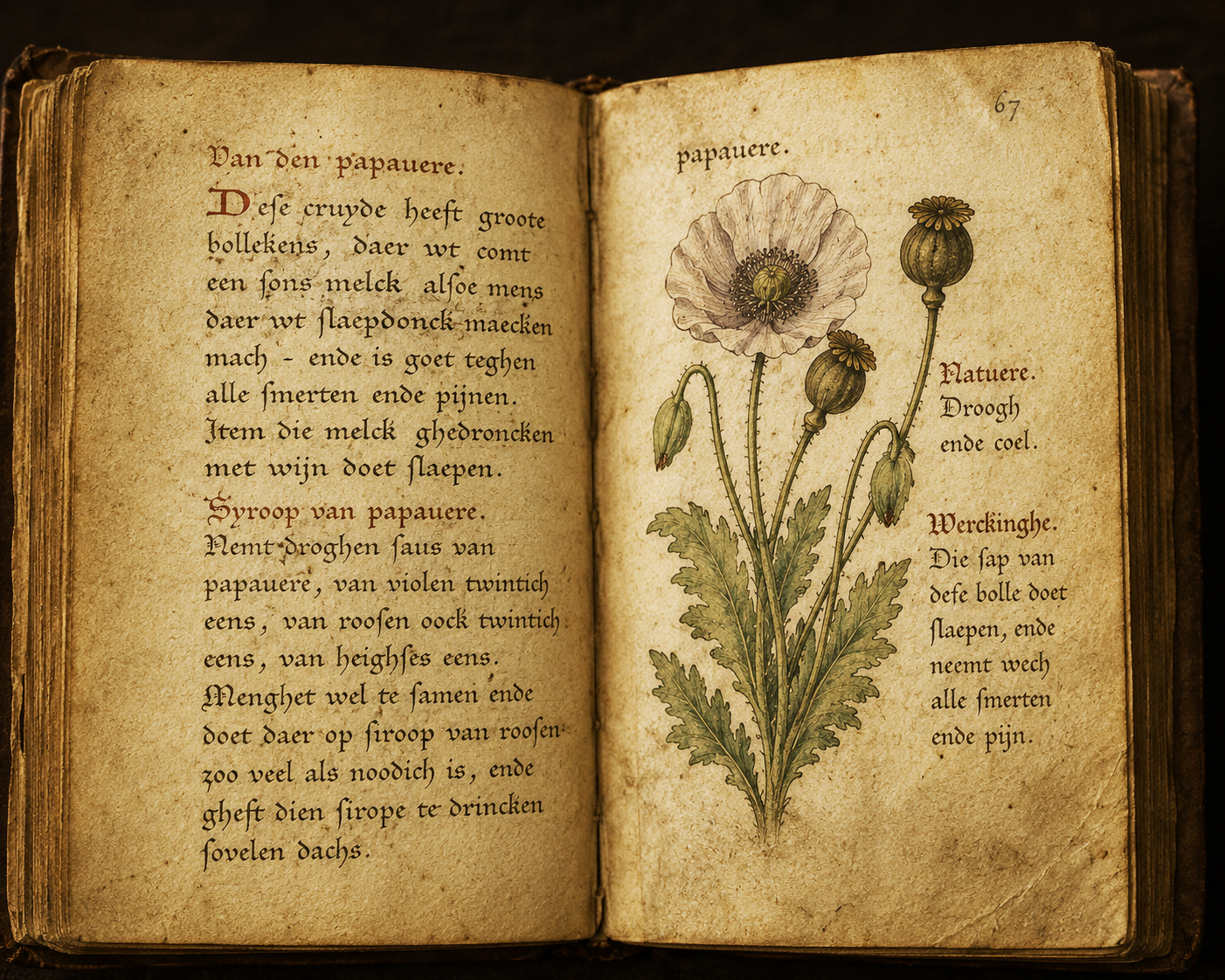
The difference matters. The question of drugs belongs as much to our world as it does to Bosch's. Psychoactive substances certainly existed during his lifetime, although their role in everyday society was often different from modern assumptions. Alcohol was by far the most common intoxicant. Beer was consumed daily throughout much of northern Europe, wine was widely available, and taverns formed an important part of urban life. Excessive drinking appears repeatedly in medieval sermons and moral literature, suggesting that Bosch lived in a society thoroughly familiar with intoxication. Opium was also known. Derived from the opium poppy, it had been used for centuries before Bosch was born, and physicians and apothecaries employed preparations containing it to treat pain, insomnia, and a variety of other ailments. The substance therefore belonged to the medical world of late medieval Europe. Could Bosch have encountered it? Certainly. Did he use it? We simply do not know.
Cannabis was known primarily as hemp, a plant valued for practical purposes such as rope and textile production rather than for its psychoactive properties. Hashish belonged more closely to parts of the Islamic world than to everyday life in the Low Countries, although trade routes made knowledge of such substances possible. No evidence, however, links Bosch to their use. Hallucinogenic fungi also existed, and medieval people undoubtedly encountered mushrooms capable of altering perception, yet neither Bosch's imagery nor the surviving historical record provides any indication that they played a role in his work. Ergot occupies a special place in these discussions. This fungus, which infects rye and other grains, can under certain conditions produce hallucinations, convulsions, and severe physical suffering when consumed in contaminated bread. Some modern writers have therefore suggested connections between ergot and unusual forms of medieval imagery. The theory attracts attention, but supporting evidence remains elusive. Ergot poisoning is neither a pleasant nor a reliable source of inspiration; it can be debilitating, dangerous, and even fatal. More importantly, nothing connects Bosch to the intentional consumption of ergot, leaving the theory firmly within the realm of speculation.
At this point, another question emerges: why are modern people so eager to explain Bosch through drugs? The answer may lie partly in the painting itself. The Garden feels extraordinary. Its imagery seems to exceed ordinary experience, its inventions appear almost limitless, and many modern observers struggle to imagine such visions emerging from an unaided mind. A chemical explanation therefore offers an attractive solution, reducing mystery to a familiar cause and making the work appear more easily understandable. Yet history presents a problem.t this point, another question emerges: why are modern people so eager to explain Bosch through drugs? The answer may lie partly in the painting itself. The Garden feels extraordinary. Its imagery seems to exceed ordinary experience, its inventions appear almost limitless, and many modern observers struggle to imagine such visions emerging from an unaided mind. A chemical explanation therefore offers an attractive solution, reducing mystery to a familiar cause and making the work appear more easily understandable. Yet history presents a problem.
Bosch was not the only creator to imagine extraordinary worlds. Dante described journeys through Hell, Purgatory, and Heaven, while the author of Revelation filled his vision with beasts, angels, dragons, and apocalyptic scenes. Medieval bestiaries populated the imagination with unicorns, griffins, and countless symbolic creatures, and visionary literature circulated widely throughout Europe. None of these works requires evidence of drug use. Imagination was already operating at full power. Bosch inherited a world rich in stories, symbols, sermons, legends, proverbs, and religious imagery, while daily life placed him among merchants, pilgrims, priests, craftsmen, gamblers, drunkards, prostitutes, and ordinary citizens.
Indeed, The Garden has an astounding display of imagination. Yet the painting is not a chaos of disconnected inventions. Upon examining it, the more deliberate it appears. Symbols interact with one another, themes recur across the composition, and ideas develop from panel to panel with remarkable consistency.
The work feels constructed rather than intoxicated. None of this proves that Bosch never encountered psychoactive substances. He may have received medicines containing opium, heard stories about ergot, or listened to travellers describe exotic substances from distant lands.
Such possibilities belong to the realm of speculation and cannot be entirely dismissed. What can be dismissed is certainty. The evidence simply does not exist. We know only that we do not know. For that reason, the most revealing question may not concern the substances Bosch might have encountered, but our persistent desire to explain his imagination through them. Faced with a work of such originality, modern observers often seem reluctant to accept that an extraordinary mind might be sufficient. Yet perhaps the most interesting possibility is the simplest one: Bosch did not require a substance to create The Garden. He required only the materials already available to him—an attentive eye, a curious mind, and an imagination capable of transforming the ordinary into the unforgettable.
Juan de Barrientos