

Den Bosch in Flames
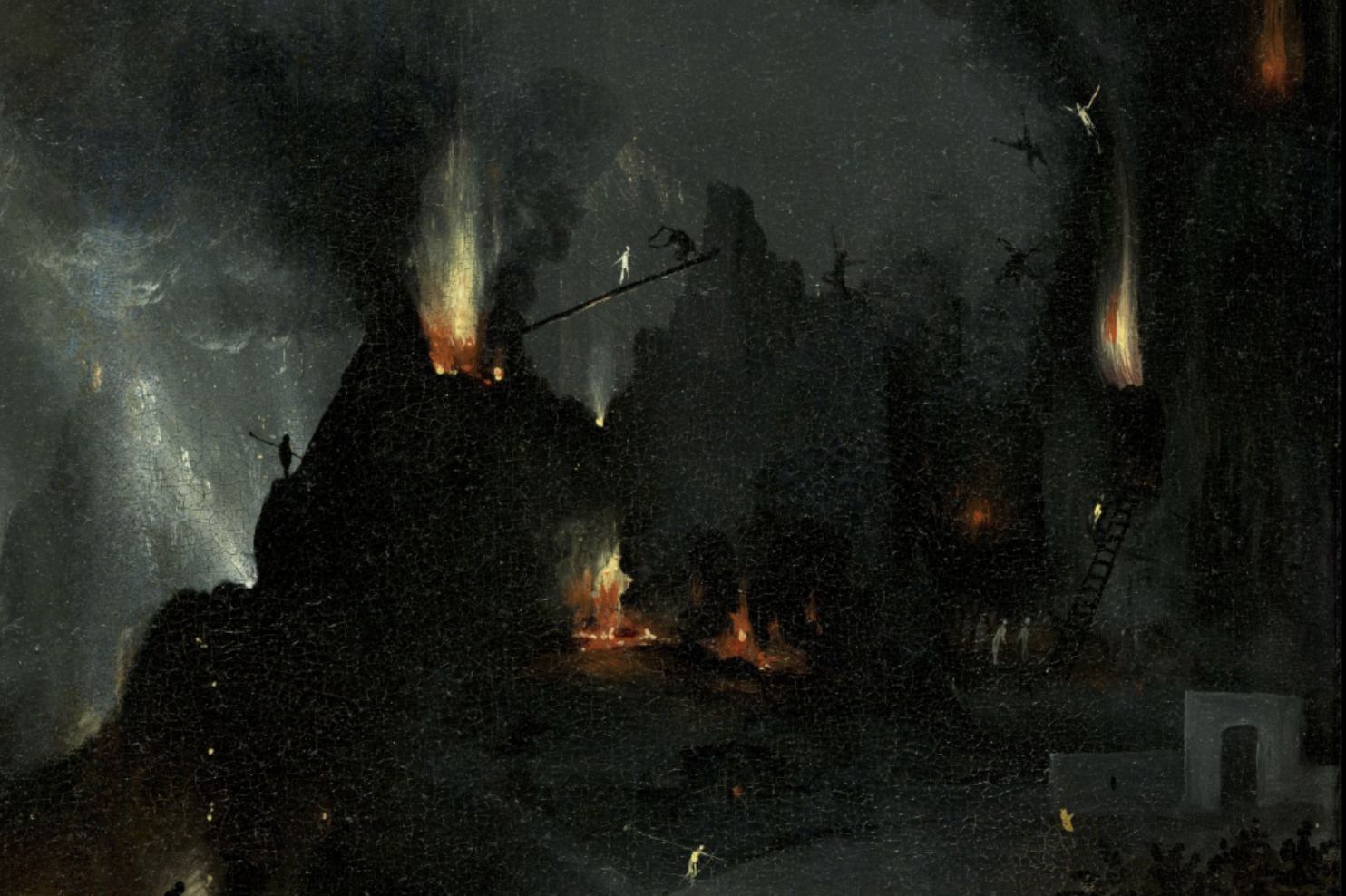
Young Jheronimus Saw Den Bosch in Flames
As I often say, we know that we do not know.
Most of my Bosch essays begin with the painting and move toward the man. I usually start with an image, a detail, a gesture, an anomaly, or a symbolic element and attempt to work backwards toward the mind behind it. The investigation begins with what Bosch painted and gradually proceeds toward the imagination that conceived it.This essay follows the opposite path.
Rather than beginning with a painting, it begins with a documented event from Bosch's youth. Instead of asking what a particular image means, it asks a different question: what experiences may have helped shape the imagination that produced those images?
We are not attempting to explain Bosch through biography. Great artists are never the product of a single event. Yet certain experiences may leave lasting impressions upon a developing mind, and few experiences could have been more dramatic than witnessing one's city consumed by fire. One such event occurred in 1463.
At that time, the future Hieronymus Bosch was approximately thirteen or fourteen years old when a devastating fire swept through 's-Hertogenbosch. Thousands of buildings were destroyed, and large portions of the city were transformed into a landscape of ruin. It was one of the greatest catastrophes in the history of the town.The young Jheronimus van Aken almost certainly witnessed the consequences of the disaster and may well have witnessed the blaze itself. We cannot know what passed through his mind as he watched the catastrophe unfold. Did he see only destruction, or did he search for meaning within it? Such questions remain beyond our reach. Yet it is difficult to imagine that an event of such magnitude left him untouched.
For a young apprentice growing up within a family of painters, additional questions naturally arise. Did the fire reach the van Aken household? Were family possessions lost? Could works produced by his father, his grandfather, or other members of the family workshop have disappeared in the flames? Might early drawings by the young Jheronimus himself have been destroyed?. We do not know.
Yet these questions remind us how little survives from Bosch's formative years and how profoundly such a catastrophe might have altered the world of a young artist in training.
Today, we may underestimate what a medieval urban fire represented. In a city largely constructed of timber, fire was not merely a local inconvenience. It was an existential threat capable of transforming an ordered world into chaos within hours. Smoke filled the streets. Bells rang in alarm. Families fled carrying whatever possessions they could save. Workshops disappeared. Homes vanished. Familiar streets became unrecognisable.
The question is not whether the event remained in Bosch's memory. The more interesting question is what form that memory may have taken.
Artists often carry visual impressions throughout their lives. Certain images acquire unusual permanence. A landscape, a storm, a funeral procession, a public execution, or a moment of collective catastrophe may remain dormant within the imagination long after the event itself has passed. Years later such memories can reappear transformed, disguised, or absorbed into entirely different creations. I believe this possibility deserves consideration.
Bosch is frequently associated with fire. Throughout his works, flames illuminate the darkness. Cities burn. Buildings collapse. Distant horizons glow with destruction. The temptation is to draw a direct line between the catastrophe of 1463 and these later images. Such certainty would be unwise.
Great works rarely emerge from a single cause. Bosch's imagination was formed by family traditions, religious life, sermons, books, local customs, artistic influences, and the devotional culture of his age. No serious interpretation should attempt to reduce such complexity to a single childhood experience. Yet acknowledging this complexity does not require dismissing every possibility. The fire of 1463 may have given Bosch something that no sermon, theological treatise, or devotional text could provide: a direct experience of catastrophe.
This observation becomes particularly interesting when viewed through the mentality of the fifteenth century. A medieval Christian did not necessarily interpret disaster as a purely physical event. Fire, plague, famine, and flood were often understood as occasions for moral reflection and spiritual examination. Whether such interpretations were correct is beside the point; what matters is that they formed part of the intellectual atmosphere in which Bosch lived. One wonders what questions a fourteen-year-old boy might have asked while watching his city burn. Why had it happened? Had God permitted it for a reason? Was it a warning, a punishment, or a call to repentance? Such questions would not have been unusual in fifteenth-century Europe, and one may speculate that the fire introduced the young Jheronimus to an idea that would later permeate much of his art: the fragile relationship between appearance and consequence. This possibility may bring us closer to understanding the peculiar quality of Bosch's fires.
Fire in Bosch rarely functions as a simple physical phenomenon. It appears charged with significance. Cities burn, buildings collapse, and distant horizons glow with destruction, yet these scenes seem to communicate more than material catastrophe. They belong to a visual world in which actions have consequences and hidden realities are suddenly revealed. Fire often serves not merely as an agent of destruction but as an instrument of disclosure.
Perhaps the greatest lesson of 1463 was not the destructive power of fire itself. Perhaps it was the discovery that ordinary life is fragile.
A city consumed by flames offers a powerful image of life's fragility. The events of a single night can reveal how vulnerable apparently stable realities truly are: what seems permanent may vanish, what appears secure may prove precarious, and familiar surroundings can become unrecognisable within hours. Such ideas resonate deeply with the moral universe of The Garden of Earthly Delights, where Bosch repeatedly presents worlds that appear stable on the surface while concealing the seeds of their own transformation. His figures celebrate, wander, and pursue pleasure within landscapes of extraordinary beauty, yet beneath the surface another reality moves steadily toward revelation. The relationship between appearance and consequence seems to have fascinated him throughout his career.
We cannot prove that Bosch consciously connected his later artistic concerns to the fire he witnessed as a youth, nor should we pretend that such a connection can be demonstrated with certainty. Yet historical inquiry involves not only certainties but also plausible possibilities worthy of consideration. The great fire of 's-Hertogenbosch is one of the few dramatic events from Bosch's formative years that can be documented with confidence, and for that reason alone it deserves attention. The purpose of this essay is not to diagnose Bosch or to claim trauma where evidence is absent, but simply to acknowledge a profoundly human possibility: that a boy who watched his city burn may have carried that memory throughout his life.
Years later, when that boy had become one of the most extraordinary imaginations in the history of art, the fire may have returned—not as memory alone, but as symbol, warning, theology, and image.
We know that we do not know.
Yet it is difficult to believe that young Jheronimus watched Den Bosch burn and felt nothing. More importantly, it is difficult to believe that he watched it burn and failed to ask why.
Juan de Barrientos