

Bosch Architectures part IV
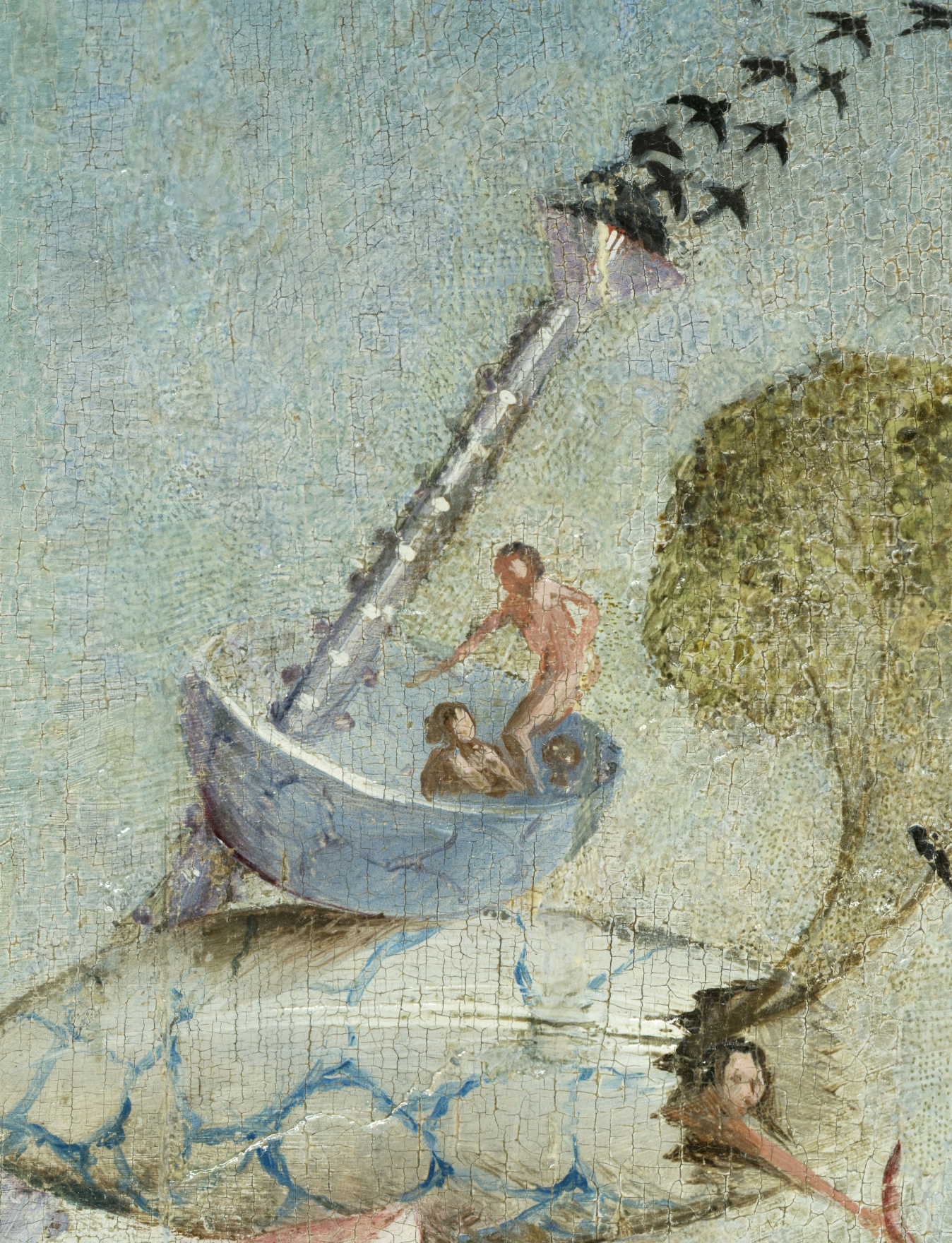
The Garden has been primarily examined for its symbolic meanings, with scholars asking what the various elements of the painting represent. I propose to explore a different possibility: why do the inhabitants of Bosch's world behave as they do?
The question is simple. The longer one examines the central panel, however, the more unusual the behaviour becomes. Adults climb impossible structures, balance in precarious positions, gather around gigantic fruits and participate in activities that often resemble play more than work. Animals appear drawn into the same atmosphere. Curiosity, impulse and pleasure seem to dominate the landscape.
The observation becomes more intriguing when viewed alongside the organic edifices that grow throughout the scene. Humans and animals gather around them, enter them and climb them in remarkable ways. Is this merely a compositional device, or is Bosch suggesting some relationship between environment and conduct?
The purpose of this essay is not to propose an immediate answer. Explanations for the conduct of Bosch's figures have been offered for generations. Instead, the present investigation asks whether another factor deserves closer consideration. If Bosch's edifices are among the most extraordinary features of his imagined world, might they also help explain the extraordinary activity unfolding around them?
The unusual nature of this conduct becomes clearer the longer one observes it. The inhabitants of the central panel are not engaged in the activities normally associated with everyday life. Yet perhaps this should not surprise us. The landscape itself is a fantasy, a world constructed within Bosch's imagination. Why should its inhabitants behave according to ordinary rules? At times they appear absorbed in experiences detached from practical concerns, as though participating in a reality governed by a different logic.
Many figures engage in activities that resist straightforward explanation. Some climb enormous fruits. Others ride animals, balance upon fantastic objects or gather in groups whose purpose remains uncertain. The scene is filled with movement, yet much of that movement defies immediate understanding. The figures act with conviction, but the reasons for their actions are often difficult to discern.
What makes the scene particularly curious is that these patterns appear widespread rather than exceptional. Curiosity and pleasure seem to guide much of the activity unfolding across the landscape, creating the impression of an entire world operating according to different priorities.
Playfulness and impulsiveness dominate the scene. Men and women appear suspended in a strange condition of adult childhood, where curiosity, sensuality and experimentation unfold with remarkably little restraint.
They climb, explore, balance, chase, gather and experiment. Their actions often seem driven by immediate fascination rather than long-term purpose. The atmosphere recalls a playground more than a city, a court or a place of labour. Yet these are not children. Bosch has populated his landscape almost entirely with nude adults.
The phenomenon appears widespread among the human figures. The question now is whether it remains exclusively human.
It does not. Animals throughout the central panel appear deeply integrated into the same world of unusual activity. Birds emerge from the edifices, perch upon them and interact with human figures in ways that are not easily comprehensible.
In many medieval paintings, animals serve primarily symbolic or decorative functions. Bosch's creatures often appear to play a more active role. They move through the landscape with remarkable freedom, participating in the same atmosphere of curiosity and spontaneity that characterises the human inhabitants.
The idea may seem unusual, yet today we readily accept that environments influence conduct. Public squares attract crowds. Monuments become meeting places. Buildings shape movement. Certain spaces encourage particular forms of activity. The question is whether Bosch may be exploring a similar relationship within his imagined world.
If so, the constructions are no longer merely visual curiosities. They become active components of the environment, helping to establish the conditions under which life in the central panel unfolds.
The question becomes even more interesting when one considers the role of water. Pools, streams, fountains and other aquatic elements appear throughout the central panel, and the inhabitants of Bosch's world seem repeatedly drawn toward them. In many traditions, water is associated with life, fertility and renewal. Here, however, it appears closely connected to pleasure, leisure and experience, forming part of an environment in which ordinary concerns recede into the background.
This observation proves nothing by itself, yet it contributes to a broader impression. The central panel presents a world of abundance, where food, pleasure and opportunity appear readily available. Few figures seem occupied by necessity or responsibility. Whether this condition should be understood as paradise, temptation, illusion or something else entirely remains uncertain. What is clear is that Bosch has created an setting in which activity unfolds according to principles very different from those of everyday life.
The unusual conduct depicted in the central panel inevitably raises questions about altered states of consciousness. Although various intoxicating substances were known during Bosch's lifetime, there is no evidence that The Garden depicts the effects of any specific drug.
The world in which Bosch lived was not unfamiliar with extraordinary states of human experience. Medieval Europeans knew dreams, visions, ecstasies, deliriums and altered conditions associated with illness. They were also aware of certain plants and natural substances capable of affecting perception and behaviour. Among the most remarkable examples was ergotism, a condition caused by the consumption of rye contaminated by the fungus Claviceps purpurea. Victims could experience visions, sensory disturbances and unusual psychological effects.
None of this establishes any direct connection with Bosch. The purpose of the comparison is not to explain the painting but to provide historical context. The late medieval imagination was familiar with the idea that human beings might sometimes perceive and behave differently from their ordinary selves.
As I often say, caution is of utmost importance. The observations presented thus far raise interesting questions, yet questions are not conclusions. The unusual conduct of Bosch's figures may invite comparisons with altered states of consciousness, but other explanations remain possible.
The most traditional interpretation understands the central panel as a moral allegory. In this reading, the strange actions of the figures reflect humanity abandoned to pleasure, temptation and earthly desire. Their conduct appears unusual not because perception has changed, but because Bosch wishes to expose the consequences of moral disorder.
Other interpretations emphasise the dreamlike nature of the landscape itself. The improbable constructions, enormous fruits and fantastic creatures combine to create a world that operates according to its own visual logic. The behaviour of the inhabitants may simply reflect the nature of the environment in which they exist.
A further possibility returns us to the question that initiated this investigation. The edifices may not merely decorate the landscape. Their repeated association with gathering, movement and activity suggests that environment and conduct could be linked in ways not yet fully understood.
None of these explanations can be demonstrated with certainty. Yet the more closely one examines Bosch's world, the more difficult it becomes to regard the activity of its inhabitants as arbitrary. Something appears to be shaping it. Whether they merely occupy Bosch's landscape or help organise it remains uncertain. The possibility is difficult to dismiss.
Juan de Barrientos