

The Garden Architectures part III
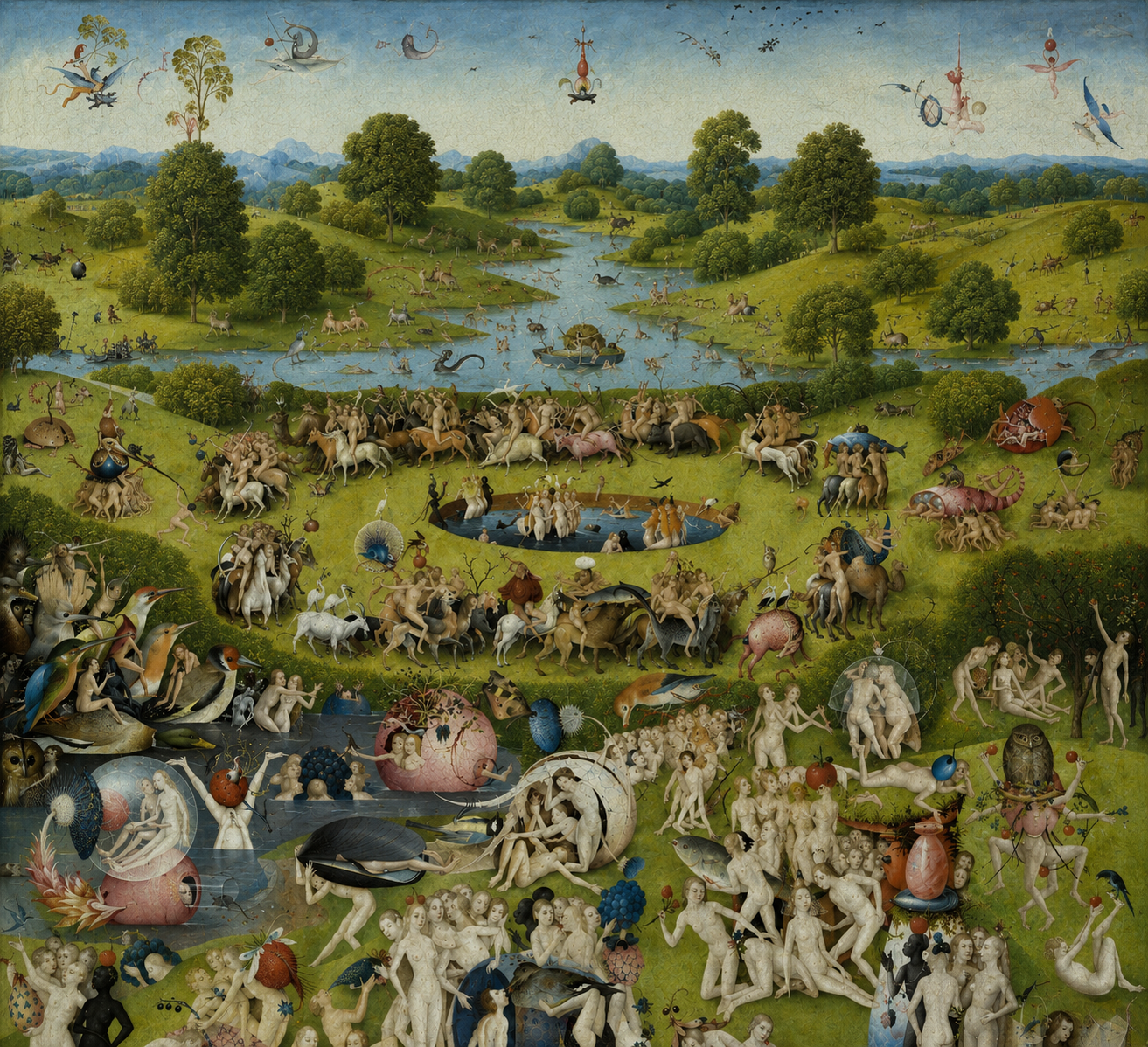
The Garden´s Architectures, Part III
What Would Happen If the Constructions Were Not There?
Scholars have proposed many explanations for the remarkable constructions that appear throughout The Garden of Earthly Delights. Some have interpreted them symbolically, while others have connected them to theological ideas, visionary traditions, alchemy, or the imaginative culture of Bosch's time. These approaches are valuable and deserve careful consideration.Yet there may be another way to approach the problem.
The traditional iconographic method often begins by asking what a particular element means. The observer identifies a form, searches for its possible significance and then attempts to place it within a broader interpretative framework. Such an approach has produced many valuable insights into Bosch's work. Yet it is not the only possible path.
Sometimes a different question can prove equally revealing. Instead of asking what an element means, one may ask what happens when it is removed. The question is deliberately simple. It does not seek symbolism, theology or historical sources. It begins with observation. What role does the element play within the visual experience of the painting itself?
This inversion of the usual process forms the basis of the present essay. Before asking what these extraordinary constructions might represent, it may be worth asking a simpler question: what would happen if they were not there?
A useful experiment is to remove the constructions in one's imagination. The figures, the activity and the narrative all remain, yet much of the painting's magnetism vanishes with them. The great blue fountain of Paradise offers the same lesson. Without it, Eden becomes easier to accept, but less compelling to contemplate. Bosch's constructions are not decorative additions to an already complete setting. They are among the principal reasons the triptych feels so strange, memorable and alive.
These forms modify the behaviour of the observer because they interrupt ordinary expectations. Most buildings explain themselves almost immediately. We recognise what they are, understand their purpose and continue on our way. Bosch's inventions behave differently. Their shapes combine architectural, mineral and organic qualities in ways that resist easy classification. The eye hesitates before them, uncertain of what it is seeing, and is drawn back for another look.
Nor is this effect limited to the large pink forms of the central panel or the great blue fountain of Paradise. Across the landscape Bosch introduces other inventions, including several blue structures that occupy the more distant regions of the painting. They attract less attention than their larger counterparts, yet they contribute to the same sense of visual strangeness. Together, these forms create the impression that the entire environment has been shaped according to principles different from those of ordinary experience. The viewer looks more carefully, not because a particular mystery has been identified, but because the landscape itself seems to obey unfamiliar rules.
These inventions may also influence what takes place within the painting itself. Birds pass through them, perch upon them and emerge from their openings. Human figures interact with them in equally curious ways. They climb them, enter them, balance upon them and gather around them. Yet it is not merely the proximity that attracts attention, but the behaviour itself. Throughout the central panel, many of the figures appear engaged in activities that seem playful, impulsive and strangely unconcerned with ordinary responsibilities. Adults often behave with a spontaneity more readily associated with childhood. Whether this impression is significant or merely incidental is difficult to determine. Yet the question may be worth asking: are these constructions simply objects within Bosch's world, or do they somehow contribute to the unusual patterns of behaviour that surround them?
This observation suggests a broader possibility. Many painters depict events. Bosch appears to construct environments capable of generating them. The distinction may seem subtle, yet it is important. The figures of the central panel do not simply occupy a pre-existing setting. They inhabit a carefully conceived world that encourages particular forms of behaviour and interaction. These inventions help establish patterns of movement, encounter and exchange. They contribute to the internal logic of the scene and encourage the viewer to accept actions that, in a more ordinary setting, might appear improbable. In this sense, they perform a role that extends beyond architecture. They help create the conditions under which the strange reality of The Garden becomes convincing on its own terms.
The loss would extend far beyond the disappearance of a few unusual forms. These impossible constructions establish scale, shape the atmosphere and signal from the very beginning that the viewer has entered a reality governed by different rules. Long before any interpretation begins, the blue fountain of Paradise and the pink inventions of the central panel define the visual language of the painting. Remove them, and the narrative survives, yet the world itself becomes less distinctive, less coherent and considerably less remarkable.
The experiment leads to a simple conclusion. These forms are not incidental details that can be removed without consequence. They help shape the world in which Bosch's figures exist and the way that world is experienced by the viewer. Remove them, and much of the painting's distinctive character disappears with them.
Yet another question remains. If these inventions exert such a powerful influence upon the observer, might they also affect the beings that inhabit Bosch's imagined world? Throughout the central panel, humans and animals alike often behave in curious and unexpected ways. Whether this relationship is meaningful or merely coincidental is difficult to determine. The question, however, may be worth pursuing.
Juan de Barrientos