

Atropos
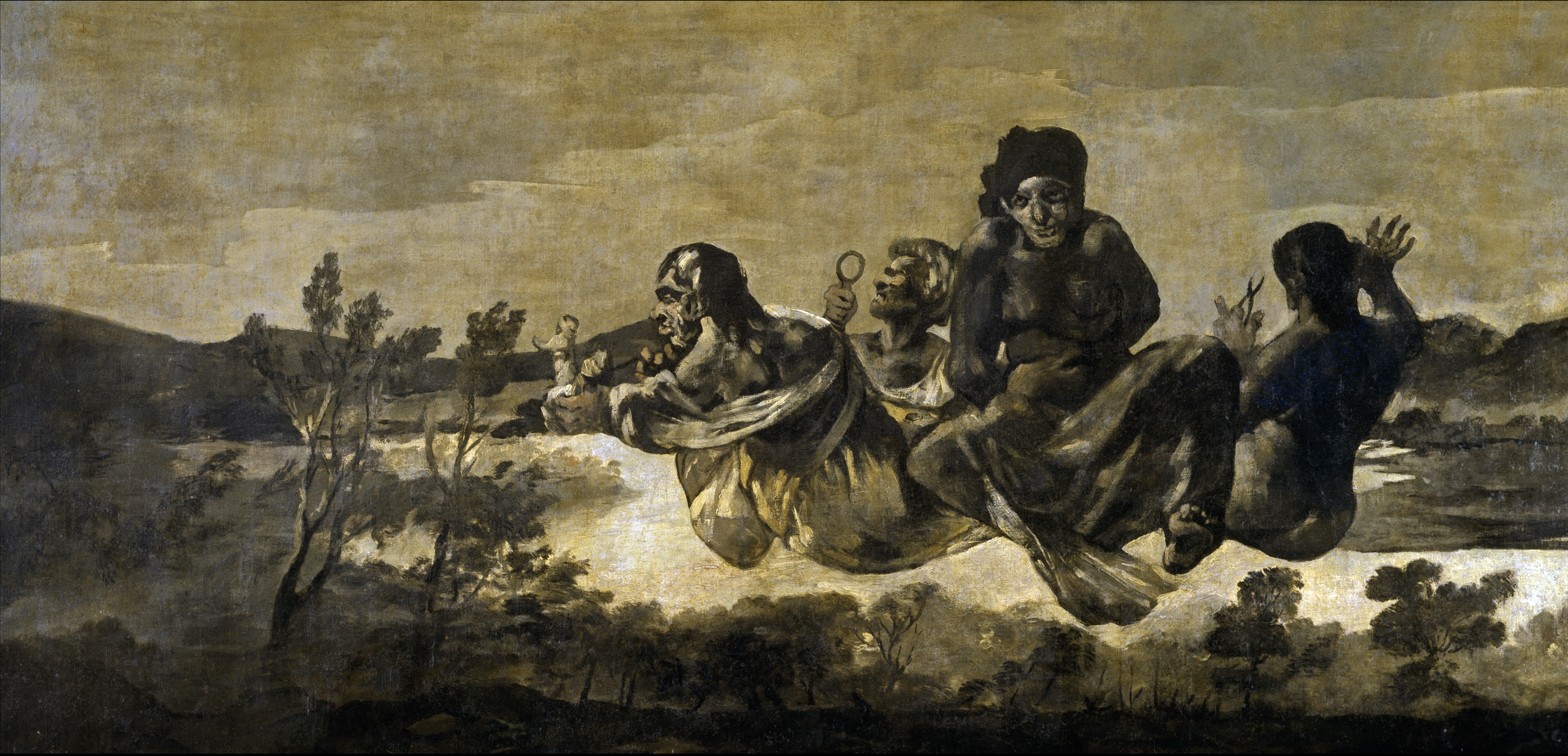
ATROPOS (THE FATES)

ÁTROPOS (LAS PARCAS)

Title: Atropos (The Fates) / Átropos (Las Parcas)
Artist: Francisco de Goya y Lucientes (1746–1828)
Date: c. 1820–1823
Series: The Black Paintings
Medium: Oil mural on plaster, transferred to canvas
Dimensions: 123 × 266 cm (48.4 × 104.7 in)
Original Location: Quinta del Sordo, Madrid
Current Location: Museo Nacional del Prado, Madrid, Spain
Support: Canvas (transferred from plaster, 1874–1878)
Style: Late Romanticism
Subject: The Three Fates (Moirai/Parcae) and a mysterious bound figure
Significance: One of Goya's most visionary works, anticipating Symbolism, Expressionism and aspects of Modern Art.
Inventory Number: P000762
Among the fifteen surviving Black Paintings, Atropos (The Fates) is perhaps Goya's most direct meditation on mortal destiny. Painted between 1820 and 1823 on the walls of the Quinta del Sordo, and later transferred to canvas, the work measures 123 x 266 cm (48.4 x 104.7 in). Its broad horizontal composition presents four spectral figures drifting through an undefined gloom, as though suspended beyond the visible world. Unlike many of Goya's late paintings, this image is not rooted in Spanish history, folklore, or religious devotion. Instead, it confronts a question that has occupied the imagination since antiquity: who, if anyone, governs the course of our lives?
The title refers to the three Fates of Greek mythology, known as the Moirai and later identified by the Romans as the Parcae. Together they embodied the irresistible force of destiny. Clotho spun the thread of each new life. Lachesis measured its allotted length. Atropos, whose name means "the inflexible" or "she who cannot be turned aside," cut it when the appointed moment arrived. Neither kings nor warriors, neither wealth nor prayer, could persuade her to delay the inevitable.
These ancient figures were not regarded simply as cruel deities. They did not choose whom to favour or whom to punish. Their authority lay in their impartiality. The thread was neither reward nor sentence; it was the invisible measure of mortal existence. Goya takes this familiar myth and strips away nearly every classical convention. The graceful women of antiquity become unsettling apparitions. Beauty gives way to ambiguity, and certainty dissolves into shadow. His figures no longer belong only to Greece or Rome; they belong to every age in which people have wondered how much of life is truly theirs to command.
Although Goya draws upon one of the best-known myths of the ancient world, his interpretation departs radically from the classical tradition. Earlier artists generally portrayed the Fates as solemn but composed figures, often seated together in harmonious balance. Their traditional attributes--the spindle, the measuring rod and the shears--made their identities unmistakable, while their calm expressions suggested an ordered universe governed by immutable laws.
Goya preserves only the essence of the myth. The objects remain, but certainty does not. The figures drift through a dark, undefined space, disconnected from any earthly setting. There is no mountain, temple or celestial realm to anchor the scene. Even gravity appears suspended. This absence of physical reference transforms the painting from a narrative illustration into a psychological vision, where the laws governing the composition seem as mysterious as the destiny they represent.
The three women themselves resist clear identification. Scholars generally associate the figure holding the shears with Atropos, while the others are understood as Clotho and Lachesis. Yet Goya deliberately blurs their individual roles. Rather than presenting three separate agents, he suggests a single, inseparable force. Birth, duration and death are not isolated events but successive moments within the same reality. Fate is not administered as a sequence of decisions; it appears as one continuous process from which no life can escape.
This transformation reflects one of the defining characteristics of Goya's late style. Mythology is no longer treated as a source of heroic stories or moral lessons. Instead, it becomes a language through which deep anxieties can be explored. The ancient gods have lost their grandeur, yet their power remains. They no longer inhabit Olympus; they inhabit the human imagination.
While the three Fates dominate the upper half of the composition, a fourth figure quietly transforms the meaning of the entire painting. Bound, helpless and wrapped in pale garments, he appears suspended beneath them, unable to resist whatever judgement is about to unfold. His presence shifts the scene from mythology to lived experience. The question is no longer only who the Fates are, but who this captive might be.
His identity has never been established with certainty. Some scholars have identified him as Prometheus, while others have interpreted him as a political prisoner reflecting the repression of Ferdinand VII's Spain. Neither theory has gained universal acceptance, and Goya deliberately leaves the figure anonymous. That uncertainty may be essential. Without a name, he can represent anyone. His vulnerability is stripped of biography, leaving only the shared condition of mortality.
Unlike the heroic figures of classical art, this captive possesses neither dignity nor defiance. He does not struggle against visible ropes, nor does he confront the Fates with courage. His body seems surrendered to forces beyond his control. The restraint is psychological as much as physical. He embodies the unsettling recognition that there are moments in life when action is no longer possible and certainty disappears.
The figure may also reflect Goya himself. By the time he painted the Black Paintings, he was an elderly man, profoundly deaf, physically weakened and increasingly isolated from the society in which he had once flourished as court painter. It would be simplistic to call this a self-portrait, but the emotional resonance is difficult to ignore. Goya had witnessed war, political upheaval, illness and the deaths of countless contemporaries. Few artists had reflected so deeply on the fragility of existence.
One of the most remarkable aspects of Atropos is not the figures themselves, but the world they inhabit. Goya removes almost every visual element that traditionally allows us to understand space. There is no landscape, architecture, horizon or stable source of light. Even the ground has disappeared. The four figures seem to float within an immeasurable void, suspended between heaven and earth, belonging fully to neither.
This absence of place profoundly alters the viewer's experience. Most paintings invite us to enter a recognisable setting, whether a palace, a battlefield or an open landscape. Here, orientation becomes impossible. We cannot determine where the figures have come from or where they are going. They exist in a realm governed by different laws, where distance, gravity and time no longer provide assurance.
Darkness becomes an active element of the composition. Goya does not use shadow simply to conceal forms; he uses it as a presence pressing against them. Blackness isolates the figures while threatening to absorb them. Light survives only in fragments: a pale face, a white garment, a hand emerging briefly before dissolving once more into obscurity. Rather than illuminating the scene, it appears fragile, almost temporary.
This treatment of space reflects the extraordinary freedom of Goya's final years. By abandoning descriptive realism, he anticipates artistic developments that would not fully emerge until the nineteenth and twentieth centuries. The painting no longer seeks to imitate the visible world; instead, it gives form to an inner reality shaped by memory, fear and reflection. The setting becomes psychological rather than geographical. The void is not merely death. It is the unknown.
For more than two thousand years, philosophers have wrestled with the same question that lies at the heart of Goya's painting: if destiny governs the course of our lives, what room remains for human freedom? Atropos offers no explicit answer, yet its enduring power comes from the way it compels us to confront that question rather than escape it.
The ancient Greeks understood fate not as blind chance but as the fundamental order of existence. Every life possessed a beginning, a measured span and an inevitable end. Goya accepts this framework, yet he shifts our attention away from the mechanics of destiny and towards the emotional experience of living beneath its shadow. His concern is not when the thread will be cut, but how we respond while it remains unbroken.
In this sense, the painting is surprisingly modern. We cannot choose the circumstances of our birth, the passage of time or the certainty of death. These realities belong to every generation, regardless of culture, wealth or power. Yet within those limits lies another form of liberty: the ability to think, to love, to create, to forgive and to seek meaning. The Fates may determine the length of the thread, but they do not dictate the character of the life woven along it.
For this reason, Atropos continues to speak directly to contemporary viewers. Its mythology belongs to the ancient world, but its questions remain unmistakably our own. Among the Black Paintings, this work stands apart for its quiet universality. It contains no violence comparable to Saturn Devouring His Son, no frenzy like Witches' Sabbath, and no earthly conflict such as Duel with Cudgels. Instead, Goya confronts us with something simpler and more profound: the invisible boundary that every life must one day cross.
Perhaps that is the deepest wisdom hidden within this extraordinary painting. We are not masters of time, nor can we bargain with the hands that spin, measure and cut the thread. Yet while that thread remains unbroken, it is ours to weave with courage, dignity and purpose. That fragile interval between the first fibre and the final cut is where every human story is written.
Juan de Barrientos