

The Pilgrimage to San Isidro
THE PILGRIMAGE TO SAN ISIDRO
LA ROMERÍA DE SAN ISIDRO
Title: The Pilgrimage to San Isidro / La romería de San Isidro
Artist: Francisco de Goya y Lucientes (1746–1828)
Date: c. 1820–1823
Series: The Black Paintings
Medium: Oil mural on plaster, transferred to canvas
Dimensions: 140 × 438 cm (55.1 × 172.4 in)
Original Location: Quinta del Sordo, Madrid
Current Location: Museo Nacional del Prado, Madrid, Spain
Support: Canvas (transferred from plaster, 1874–1878)
Style: Late Romanticism
Subject: A pilgrimage to the Hermitage of San Isidro, transformed into a haunting procession of anonymous figures moving through darkness.
Significance: One of Goya's largest and most enigmatic Black Paintings, replacing the festive atmosphere of a traditional pilgrimage with a deeply unsettling meditation on faith, humanity, and the uncertainty of the human condition.
Inventory Number: P000761
The transformation of The Pilgrimage to San Isidro mirrors the transformation of Goya himself. What had once been a joyful celebration became, in his final years, a vision filled with ambiguity and quiet unease.
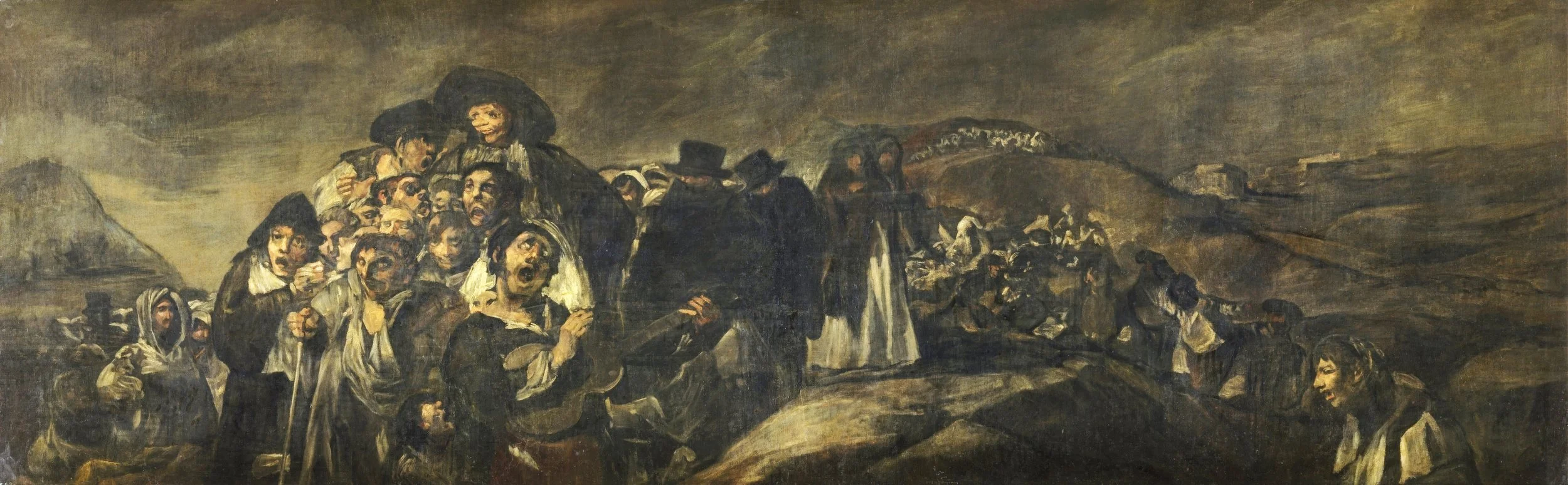
A compact procession moves beneath a vast, pale sky, its figures emerging briefly from the surrounding darkness before dissolving back into the crowd. Some appear to sing, others seem lost in thought, while a few wear expressions that verge on the grotesque. Together they cease to be individuals and become a single human mass moving with quiet inevitability. Although the title identifies the scene as a pilgrimage to Saint Isidore's shrine outside Madrid, Goya himself left no explanation, and the name was assigned only after his death. Whether this is a religious procession or something more universal remains one of the painting's enduring mysteries.
Painted during the final years of Goya's life on the walls of the Quinta del Sordo, The Pilgrimage to San Isidro belongs to the extraordinary series now known as the Black Paintings. Rather than recording a familiar religious celebration, Goya transforms it into a profound study of humanity itself. Clothing and individual identity matter little; it is the faces that command our attention. Some pilgrims appear absorbed in song, others seem weary or absent, while a few verge on the grotesque. One figure even turns to confront the viewer directly, breaking the anonymity of the crowd with an unsettling gaze. These are not idealised believers but ordinary men and women, marked by age, fatigue and vulnerability. For generations, scholars have debated whether Goya intended a sincere act of devotion, a subtle criticism of popular religiosity, or a broader meditation on the human condition. The painting never settles the question, and it is precisely this refusal to offer a definitive answer that gives the procession its enduring power.
This may well have been Goya's intention. Human beings rarely move through life with complete certainty. We follow traditions, communities and convictions, often without seeing the entire path ahead. In The Pilgrimage to San Isidro, the crowd becomes something universal: a procession not only through the Spanish countryside, but through the uncertainty of existence itself.
One of the most striking features of The Pilgrimage to San Isidro is its absence of resolution. We never see the destination. The shrine itself is almost irrelevant. Goya offers no triumphant arrival, no moment of celebration, and no clear reward awaiting the pilgrims.
Instead, the procession appears suspended between departure and arrival, as though the journey itself had become the subject. The figures continue forward, yet their movement feels strangely slow and inevitable. They seem carried by the crowd as much as by their own will.
This ambiguity has given rise to many interpretations. Some scholars see a criticism of religious fanaticism or popular superstition. Others view the painting as a meditation on old age, mortality, or the shared destiny of humanity. None of these readings can be proved with certainty, and perhaps that is precisely why the painting continues to speak so powerfully.
Goya rarely forces conclusions upon his audience. He presents a vision, leaving the final judgement to the viewer. More than two centuries later, these silent pilgrims continue their journey, inviting us to ask a simple but enduring question: Where are they truly going—and, perhaps more importantly, where are we?
It is tempting to see these pilgrims as reflections of Goya himself. By the time he painted this mural, he was elderly, profoundly deaf, politically disillusioned, and increasingly isolated from the world he had once served as court painter. Although such a reading can never be demonstrated with certainty, it deserves careful consideration.
The procession may therefore possess a deeply personal dimension. Rather than depicting a particular group of travellers, Goya may be contemplating the journey that every human being must eventually undertake. The destination remains hidden because it lies beyond earthly knowledge.
This interpretation helps explain the painting's emotional power. Its darkness does not arise from dramatic action, but from uncertainty. The figures continue forward without fully understanding what awaits them, just as we do throughout our own lives.
For this reason, The Pilgrimage to San Isidro remains so compelling. It transforms a familiar religious tradition into something universal: a quiet meditation on time, faith, ageing, and the mysterious road that every person, regardless of belief or status, must ultimately travel.
Perhaps the greatest achievement of The Pilgrimage to San Isidro is that it refuses to remain a painting about other people. Sooner or later, every viewer recognises something familiar within the procession. We, too, move through life without seeing the entire road ahead.
Goya offers neither comfort nor despair. Instead, he invites reflection. The pilgrims continue walking, carrying their hopes, fears, and unanswered questions beneath an immense sky that remains silent. Their destination is uncertain, but their journey is unmistakably human.
This quiet ambiguity explains why the painting still resonates today. It speaks not only to nineteenth-century Spain, but to every generation that has searched for meaning in the face of the unknown. Few artists have expressed this shared experience with such economy and psychological depth.
The road to San Isidro begins in Madrid, but in Goya's hands it becomes something far greater. It is the road we all travel: one marked by faith and doubt, companionship and solitude, certainty and mystery. More than two centuries later, the pilgrims are still walking—and, perhaps without realising it, so are we.
Juan de Barrientos