

Judith and Holofernes
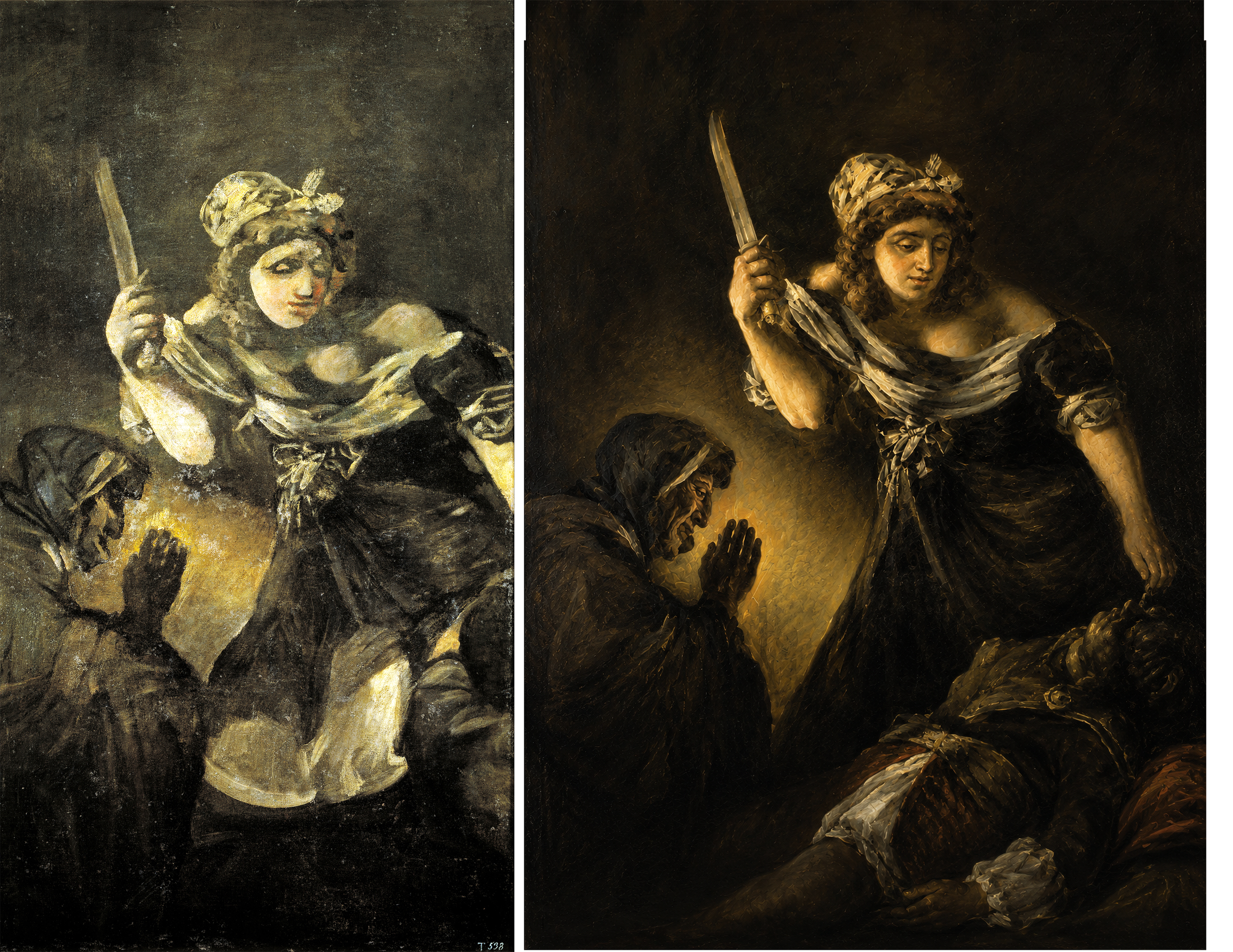
The original and a reconstruction
Confirma me, Domine Deus Israel, et respice in hac hora ad opera manuum mearum.
"Strengthen me, O Lord God of Israel, and look with favour upon the work of my hands at this hour."
— Judith 13:7 (Vulgate)
Among the women of the Old Testament, few have inspired artists as profoundly as Judith. Preserved in the Catholic and Orthodox biblical canons, the Book of Judith recounts how a widow from the besieged town of Bethulia saves her people not through military strength, but through courage, intelligence and unwavering faith in God.
When the Assyrian general Holofernes surrounds the city and cuts off its water supply, surrender seems inevitable. After fervent prayer, Judith dresses in her finest garments and enters the enemy camp accompanied only by her elderly maidservant. Captivated by her beauty, Holofernes welcomes her into his tent and, during a banquet, drinks until he collapses into a drunken sleep. Left alone with the unconscious general, Judith prays once more for strength before taking his own sword.
Throughout Christian tradition, Judith came to symbolise the triumph of faith over tyranny and of apparent weakness over worldly power. Medieval theologians regarded her as a prefiguration of the Virgin Mary, while Renaissance and Baroque artists repeatedly celebrated her as the courageous defender of God's people. Donatello, Botticelli, Caravaggio and Artemisia Gentileschi all placed the decisive moment of the beheading at the centre of their compositions.
When Goya turned to Judith during the final years of his life, however, he chose a remarkably different path.
Most artists who depicted Judith and Holofernes focused on the climax of the story. Caravaggio and Artemisia Gentileschi confront us with the violence itself: the sword descends, blood flows, Holofernes struggles, and the viewer witnesses the execution. Goya does something entirely different. Rather than adding dramatic detail, he removes it.
To understand the originality of his composition, we have prepared a reconstruction of the biblical scene. It is notintended as a reconstruction of Goya's original design, but as a visual aid showing what the complete narrative would ordinarily include: Holofernes lying fully clothed on his bed, Judith standing over him with the sword, and her maidservant waiting nearby. Comparing this reconstruction with Goya's painting immediately reveals the artist's extraordinary economy.
Almost everything has disappeared. The luxurious Assyrian tent, the banquet, the rich fabrics, the servants, the severed head and even most of Holofernes' body are absent. The darkness conceals rather than reveals, while the biblical narrative survives only through a handful of carefully chosen elements.
What remains is astonishingly simple: two women, part of a sword, an almost invisible victim and an overwhelming silence. Far from impoverishing the story, these omissions intensify it. The viewer is compelled to imagine everything that has been deliberately withheld.
This economy is one of the defining characteristics of the Black Paintings. By stripping away descriptive detail, Goya transforms a familiar biblical episode into a timeless psychological drama. The reconstruction reminds us not only of what Scripture describes, but also of what Goya consciously refused to show. The painting's power lies as much in its absences as in its visible forms, preparing us for the central question that follows: what precise moment has Goya chosen to depict?
This is where Goya's painting becomes truly extraordinary. For generations, scholars have assumed that Goya represents the aftermath of the beheading. Yet the painting itself may be less explicit than this long-established interpretation suggests.
The sword is only partially visible, and no blood can be seen upon its blade. Holofernes' severed head is nowhere to be found, while his body is almost completely swallowed by darkness. Even the maidservant deserves closer attention. Rather than displaying relief or triumph, she appears to clasp her hands in prayer, as though invoking God's help at the decisive moment.
The biblical account itself introduces another intriguing detail. According to the Vulgate, Judith does not decapitate Holofernes with a single stroke; she strikes his neck twice. That seemingly minor detail opens a possibility rarely considered. Could Goya have chosen to depict the instant before the first blow? Or perhaps the tense interval between the first and the second? The painting does not tell us.
Judith's expression deepens the mystery. She shows neither panic nor physical exertion. Her face is remarkably calm, suggesting not the frenzy of violence but the courage of someone acting with complete conviction. Whether that serenity belongs to the moment before the act or immediately after it remains impossible to determine.
This ambiguity may be entirely deliberate. Rather than illustrating the event itself, Goya suspends time at its most psychologically charged instant. He withholds the spectacle of violence and replaces it with uncertainty. The viewer is left to complete the narrative, not with the eyes alone, but with memory, imagination and conscience.
Perhaps this is Goya's greatest innovation. The decisive question is no longer what Judith did—the Bible has already answered that—but when we have encountered her. Standing before the painting, we remain forever suspended between faith and action, courage and violence, certainty and doubt.
The power of Judith and Holofernes lies in the fact that no single interpretation fully explains it. Like many of the Black Paintings, it seems to invite several readings simultaneously, each illuminating a different aspect of Goya's thought without exhausting the painting's mystery.
The biblical interpretation remains the foundation. Judith acts not from hatred or ambition but from obedience to God and love for her people. At the same time, many historians have suggested that Holofernes may also represent tyranny itself, perhaps even echoing Ferdinand VII and the restoration of absolutism. Such a political reading is plausible, yet no surviving document confirms that Goya intended this allegory.
A more personal interpretation has also attracted considerable attention. During the years in which the Black Paintings were created, Goya lived with Leocadia Zorrilla, a woman more than thirty years his junior. Since Leocadia was painted on the opposite wall of the Quinta del Sordo, some scholars have proposed a symbolic dialogue between the two works. From this perspective, Judith becomes not only a biblical heroine but also an embodiment of feminine power confronting an ageing man.
Psychoanalytic writers have taken the idea further, interpreting the absent decapitation as a symbolic form of castration anxiety. Although impossible to verify, such readings acquire additional resonance when considered alongside Goya's advanced age, declining health and increasingly introspective vision of humanity. They should not be accepted as historical fact, but neither should they be dismissed, for they reflect the extraordinary openness of the painting itself.
Perhaps that is Goya's greatest achievement. Judith and Holofernes remains simultaneously a biblical narrative, a political meditation, an intimate confession and a psychological enigma. Rather than forcing us to choose between these interpretations, Goya allows them to coexist in a single image whose silence continues to provoke reflection more than two centuries later.
When we step away from Judith and Holofernes, we do not leave with the satisfaction of having solved its mystery. Quite the opposite. Goya refuses to provide the certainty that earlier artists so often offered. He neither glorifies Judith nor condemns her. Instead, he leaves us suspended before one of the most unsettling moments in Western art.
Perhaps that is why the painting feels so remarkably modern. It does not rely on spectacle, but on suggestion; not on explanation, but on ambiguity. The violence itself remains hidden, while its moral and spiritual implications continue to unfold within the viewer's mind. Goya trusts us to complete the story, just as he trusts us to confront the questions it raises.
For Judeo-Christian readers, Judith remains an example of courageous faith. She acts only after prayer, placing her confidence not in physical strength but in God. Yet Goya refuses to transform her into an untouchable saint. She remains profoundly human, standing at the threshold where duty, conscience and sacrifice converge. Whether she is about to strike, has already struck, or even stands between the two blows described in Scripture, her calm expression reminds us that true courage is often inseparable from fear.
The enduring power of the painting lies precisely in this unresolved tension. Goya removes certainty so that contemplation may begin. Every omission—the hidden body, the absent head, the darkness, the silence—draws us into the scene as participants rather than spectators.
Perhaps the greatest mystery is not whether Judith has already beheaded Holofernes, but why Goya chose to leave that question unanswered. In doing so, he transformed an ancient biblical episode into a timeless meditation on faith, conscience and human responsibility. The silence belongs to the painting. The answer belongs to every viewer willing to stand before it long enough.
Juan de Barrientos