

Two Old Men eating Soup
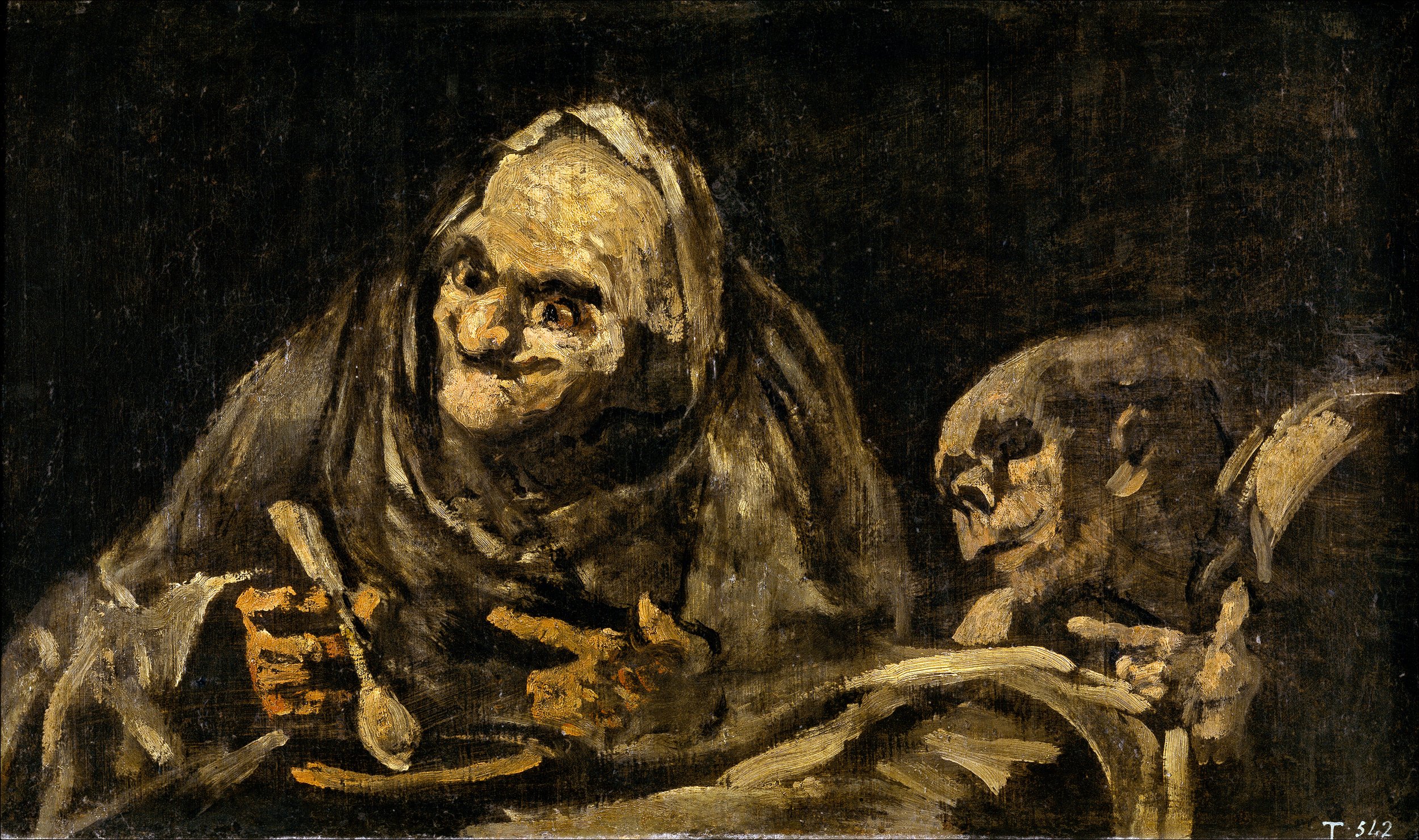
Title: Two Old Men Eating Soup (Dos viejos comiendo; Prado title: Two Old Men Eating)
Artist: Francisco de Goya y Lucientes (1746–1828)
Date: c. 1820–1823
Series: The Black Paintings
Medium: Oil mural on plaster, transferred to canvas
Dimensions: 49.3 × 83.4 cm (19.4 × 32.8 in)
Original Location: Quinta del Sordo, Madrid
Current Location: Museo Nacional del Prado, Madrid, Spain
Support: Canvas (transferred from plaster, 1874–1878)
Style: Late Romanticism
Subject: Two elderly figures sharing a simple meal, confronting old age, mortality and the fragile boundary between life and death.
Significance: One of Goya's most intimate and philosophical Black Paintings, reducing the human condition to its final essentials through an extraordinary economy of means.
At first glance, Two Old Men Eating Soup appears almost disarmingly simple. Two elderly men sit close together, sharing a bowl of soup. Compared with many of Goya's other Black Paintings, it may seem among the quietest. Yet that simplicity conceals one of the most profound reflections in the entire series.
Painted during the final years of Goya's life, when illness, deafness and political disillusionment had reshaped his vision of humanity, the work reduces existence to its bare essentials. Almost everything that usually defines a scene has disappeared. There is no identifiable room, no furniture beyond what is strictly necessary, no landscape, no architecture and no narrative comfort. The figures are surrounded so completely by shadow that they seem suspended outside ordinary space, as though memory itself had dissolved around them.
What remains is astonishingly little: two ageing faces, a bowl, a spoon and a faint light emerging from the surrounding black.
This radical economy is one of Goya's greatest achievements. Rather than adding detail, he removes it. Rather than explaining, he invites contemplation. The viewer is left without the security of anecdote or historical reference. Instead, we are placed before something fundamental: the quiet dignity, and quiet vulnerability, of growing old.
The meal itself is almost symbolic. Soup is perhaps the simplest nourishment imaginable. Soft, warm and modest, it has long been associated with care, poverty, illness and advanced age. It asks almost nothing of the body, requiring neither strength nor healthy teeth. Goya does not present abundance; he presents survival. Eating here is no longer a celebration of life, but one of its final necessities.
The composition reinforces this intimacy. The two figures lean towards one another, their faces appearing out of the enveloping gloom as if touched by an unseen source of light. We instinctively move closer, searching their expressions for clues. Who are they? Friends? Brothers? Strangers? Goya offers no answer. Their anonymity is deliberate. By withholding identity, he turns them into every man and every woman who has reached the final chapter of life.
The hush of the image is equally striking. One can almost imagine hearing nothing beyond the faint scrape of a spoon against a bowl. There is no conversation, no visible emotion and no theatrical display of suffering. Goya understands that old age often arrives not with violence, but through repetition. Daily routines continue, even as time gradually narrows the horizon.
Despite having been painted in the early 1820s, Two Old Men Eating Soup possesses a strikingly modern visual language. Its restraint, reduced palette and emotional ambiguity anticipate artistic movements that would not emerge for many decades. Goya demonstrates that complexity does not require complexity of form. Sometimes a single shared meal can carry the weight of an entire human life.
Yet beneath this apparent stillness lies a subtle unease. Something about the figure on the right resists an ordinary reading of the scene. His presence is disturbing, almost spectral. Before long, we begin to suspect that these are not simply two old men sharing supper. Perhaps one of them has brought a very different guest to the table.
The longer we look, the more the image begins to change. What first seemed like a humble domestic scene gradually reveals something far more unsettling. The bowl remains, the spoon still rises toward an open mouth, yet the figure seated on the right refuses to behave like an ordinary human being. His face is almost skeletal; his eyes sink deep into their sockets.
The mouth gapes unnaturally wide, exposing teeth that seem less alive than bone. With remarkable economy, Goya makes flesh appear to dissolve before our eyes. Rather than describing the gradual decline of old age, he creates a figure suspended somewhere between the living and the dead.
Art historians have long debated whether this companion is intended to represent another elderly man or Death itself. Goya leaves the question deliberately unresolved, and that ambiguity gives the work much of its extraordinary power. The figure is credible enough to belong to this world, yet strange enough to suggest another. Like so many of the Black Paintings, certainty gives way to suggestion.
This uncertainty transforms the entire composition. We are no longer merely watching two old men share a meal. We begin to wonder whether one of them is unknowingly taking his final supper with Death itself.
The idea would not have been unfamiliar to Goya's contemporaries. Throughout European art, the memento mori tradition reminded viewers that death accompanies every stage of life. Medieval frescoes of the Danse Macabre, Renaissance still lifes with extinguished candles and scattered skulls, and Baroque meditations on vanitas all carried the same warning: mortality is not a distant event, but a constant companion.
Goya, however, strips away every conventional symbol. There is no skull resting on the table, no hourglass, no wilting flower, no inscription warning of life's brevity. Allegory has almost disappeared. Instead, death simply sits beside us, quietly sharing our food.
That restraint makes the scene all the more disturbing. Death is not dramatic here. It does not threaten, pursue or triumph. It waits with extraordinary patience. The horror lies precisely in its ordinariness.
The contrast between the two figures deepens this reading. The man on the left still participates in the physical act of eating. His hand grips the spoon, his body leans forward and his attention remains fixed on the humble task before him. He belongs, however tenuously, to the world of the living. The figure opposite appears detached from such necessities. His expression is impossible to interpret. Is he smiling? Grimacing? Laughing? Or is the skull-like face merely exposing what all human faces eventually become?
Goya refuses to answer. Instead, he asks the viewer to complete the painting.
This openness is characteristic of his late style. By the early 1820s, he no longer painted to illustrate stories or satisfy academic expectations. His images had become psychological spaces, where meaning emerges through contemplation rather than explanation. The Black Paintings do not tell us what to think; they invite us to confront what we already know but often choose to ignore.
Perhaps that is why Two Old Men Eating Soup remains so deeply moving. Its subject is not only death, but companionship in its presence. No one escapes the final horizon, yet few wish to approach it alone. The two figures sit close together, almost shoulder to shoulder, united by a bowl of soup that has become far more than nourishment. It is a last gesture of shared humanity before silence overtakes both conversation and appetite.
In Goya's hands, the simplest meal becomes a meditation on the encounter every human being must eventually face. The question is no longer whether death is present, but whether we have already noticed that it has taken a seat beside us.
One of the most remarkable qualities of Two Old Men Eating Soup is not what Goya includes, but what he deliberately leaves behind. Throughout his career he had demonstrated extraordinary technical brilliance, capable of painting sumptuous court portraits, complex historical scenes and vibrant religious compositions. Here, however, he abandons almost every convention that had defined European painting for centuries.
There is scarcely any setting to speak of. No carefully described interior surrounds the figures, no decorative objects distract the eye, no architecture defines their environment and almost no illusion of depth remains. Even colour has been reduced to its most elemental vocabulary. Blacks, earth tones and muted ochres dominate the surface, interrupted only by pale passages of flesh and the faint highlight of the bowl. Light itself seems reluctant to enter the composition, revealing only what is necessary before surrendering the rest to shadow.
This radical simplification was not the result of declining ability. It was the expression of artistic confidence. Only a master who fully understands the language of painting can decide how much of that language may be discarded without sacrificing meaning. By the early 1820s, Goya had reached a point where every unnecessary detail had become an obstacle to truth.
The brushwork embodies that same freedom. Seen at close range, the surface appears astonishingly loose. Individual strokes remain visible, edges dissolve into one another and forms emerge through suggestion rather than precise description. Flesh is constructed with remarkably few marks, while clothing disappears into broad, almost abstract passages of pigment. From nearby, the image can seem fragmented; from a distance, it gathers itself with extraordinary conviction, acquiring a haunting sense of life.
In this respect, the work appears decades ahead of its time. Its preference for emotional intensity over polished finish anticipates the expressive freedom later explored by Manet, Whistler and, ultimately, the psychological power of Munch and the German Expressionists. Looking at its surface today, it is difficult to believe that it was painted in the early 1820s. Chronologically, it belongs to the Romantic period; visually, it reaches towards modern art.
Its modernity, however, is not merely technical. It is philosophical.
Traditional painting often sought to describe the visible world. Here, the ambition is different. The obscurity surrounding the figures is not simply the absence of light, but the absence of certainty. By stripping away context, the composition removes distraction. Nothing remains except the essential encounter between two fragile beings suspended between life and death.
This economy profoundly alters the viewer's role. Because so little information is provided, our imagination begins to complete the scene. We invent the room, the quiet, the smell of the soup and the temperature of the air. We wonder who these men are, what has brought them together and what will happen after the next spoonful. Every unanswered question draws us further into the work.
Few artists trusted the intelligence of their audience as completely as Goya did during his final years.
There is another consequence to this process of elimination. As objects disappear, faces become everything. The painting no longer depends upon narrative or elaborate symbolism to carry its emotional weight. A slight movement of the mouth, the hollow around an eye or the tilt of a head becomes more eloquent than richly furnished interiors or carefully orchestrated historical dramas.
It is an extraordinary lesson in artistic restraint. Rather than overwhelming us with visual information, Goya creates meaning through absence. The surrounding void becomes as significant as the figures themselves. Silence becomes a language.
By removing almost everything that painters traditionally relied upon to tell stories, Goya discovers something more enduring: the shared experience of human vulnerability. In this sparse and shadowed world, every brushstroke matters because every brushstroke has survived a ruthless process of elimination.
Nothing is superfluous; every brushstroke serves a single meditation on human mortality.
And in that remarkable act of subtraction, Goya achieves a rare artistic purity that remains as compelling today as it was two centuries ago.
Although each of the Black Paintings possesses its own identity, they are united by a common thread: the relentless passage of time. Few artists have explored this theme with such consistency or emotional depth. In Saturn Devouring His Son, time appears as a monstrous force that destroys life with terrifying violence. In The Dog, it becomes an invisible power slowly engulfing the solitary individual. Here, in Two Old Men Eating Soup, time adopts an altogether quieter form.
It simply waits, revealing itself not through struggle, screams or dramatic gestures, but through two ageing figures quietly sharing a modest meal beneath an overwhelming gloom.
This restraint makes the work uniquely unsettling. The terror does not arise from sudden catastrophe, but from quiet recognition. Every viewer understands, consciously or not, that the scene is shared by all. If Saturn represents the violence of mortality, these two old men embody its certainty.
The meal becomes a measure of time. Every spoonful suggests another passing moment, another heartbeat, another step towards the inevitable conclusion of earthly life. Goya transforms a domestic ritual into a silent meditation on the fragility of existence. The soup nourishes the body, yet it cannot halt its decline.
The scene also invites reflection on companionship. Human beings rarely confront their final chapter entirely alone. Family members, friends, caregivers and strangers often accompany us through the last stages of life. Yet Goya offers no sentimental consolation. The closeness of the two figures provides presence, but not rescue. One cannot preserve the other from the destiny they share.
Perhaps this explains the extraordinary emotional balance of the work. It is neither despairing nor hopeful, neither religious nor overtly secular. Instead, it observes. The image accepts mortality with remarkable honesty, refusing both melodrama and easy comfort. That restraint gives it a dignity rarely encountered in representations of old age.
Seen alongside the other Black Paintings, Two Old Men Eating Soup reveals another aspect of Goya's late philosophy. Violence is no longer the principal subject. In works such as Fight with Cudgels, human beings destroy one another through conflict. In Saturn, destruction becomes mythological and absolute. Here, however, no external enemy remains. The final adversary is time itself, advancing with complete indifference.
This idea echoes one of the oldest themes in Western thought. Ancient philosophers repeatedly reminded their readers that awareness of death is not meant to produce despair, but wisdom. To recognise that life is finite is to understand its value. Goya does not illustrate this lesson through symbols or allegory; he allows two anonymous old men, seated before a humble bowl of soup, to embody it.
There is something profoundly compassionate in that decision. These figures are not kings, saints or heroes. They possess neither wealth nor power. They are common people, and precisely that simplicity grants the painting its enduring reach. We do not admire them from a distance; we recognise ourselves in them.
Perhaps this is why the work continues to resonate so deeply. It reminds us that mortality is not an interruption of life, but one of its defining conditions. Every meal shared, every conversation and every quiet moment acquires meaning because time is limited.
Perhaps that is where the painting ends, but not necessarily where the conversation must. Goya confronts us with the certainty of death; Christian faith responds with the promise that death is not the final destination, but a passage. Time devours every earthly life, yet eternity belongs to God.
Some paintings overwhelm us with action. Others impress us through technical brilliance or spectacular beauty. Two Old Men Eating Soup achieves something rarer. It remains in the mind because of its extraordinary stillness.
Long after we have left the museum, we remember neither the bowl nor the spoon, but the profound quiet that surrounds them. Goya has removed almost everything that might distract us, until only two ageing figures remain, suspended between the ordinary and the eternal.
There is a deep humility in this scene. No kings are honoured, no saints are glorified, no victories are celebrated. The subjects are anonymous, their supper is modest and their surroundings have dissolved into obscurity. Yet precisely because they are humble, they become timeless. Their story is every human story.
Perhaps this is why the painting continues to speak across two centuries. It reminds us that our lives are not measured by moments of spectacle, but by quiet acts of presence: a shared meal, an attentive silence, a hand that continues to reach for another even as strength begins to fade.
Goya neither explains suffering nor promises consolation. Instead, he confronts us with mortality and quietly leaves unanswered the question that has accompanied humanity for centuries: is death the final guest at the table, or merely the threshold to eternity?
For the believer, the humble meal shared by Goya's two old men recalls another table, where Christ transformed bread into the promise that death would not have the final word, reminding us that while every earthly meal must one day end, the deepest hunger of the human heart is ultimately for the eternity that belongs to God.
Juan de Barrientos