

La Leocadia
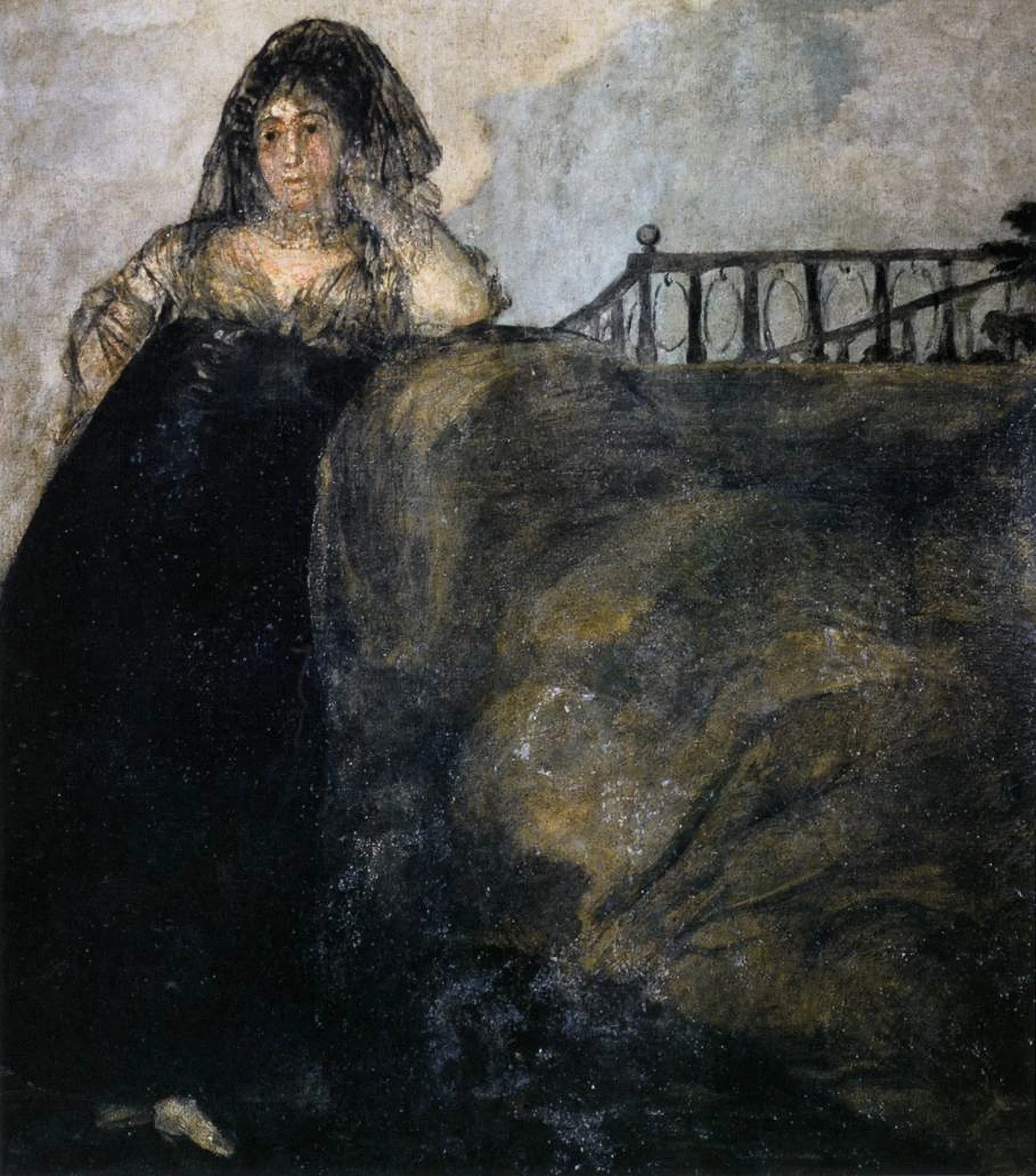
Her expression is calm yet deeply melancholic, inviting contemplation rather than fear.
Painted between approximately 1820 and 1823 on the walls of Goya's house, the Quinta del Sordo, this work belongs to the extraordinary series known as the Black Paintings. Unlike many of its companions, however, La Leocadia offers no obvious narrative. Its power lies in its mystery. Every element—the woman's identity, the stone beside her and even the meaning of her silent gaze—remains open to interpretation.
The title identifies the figure as Leocadia Weiss, the woman who lived with Goya during his final years and cared for him after his serious illness. Whether she was his companion, his housekeeper, a close friend or something more remains one of the enduring questions surrounding the artist's private life. No document settles the matter with certainty, and much of what has been written belongs as much to legend as to history.
Perhaps that uncertainty is precisely what gives the painting its enduring fascination. Rather than presenting a portrait of a specific individual, Goya creates a universal image of deep sorrow. The woman becomes less a historical figure than a symbol of those who remain after loss, suspended between memory and acceptance. In a series often remembered for its darkness and violence, La Leocadia begins instead with silence.
The identity of the woman has intrigued historians for more than a century. She is traditionally identified as Leocadia Zorrilla Weiss, who entered Goya's household around 1817 with her two children and remained by his side during the final years of his life. When the artist left Spain for Bordeaux in 1824, Leocadia accompanied him and stayed with him until his death four years later.
Their relationship has long been the subject of speculation. Some biographers have described her as Goya's companion or lover, while others argue that the evidence is too limited to support such conclusions. Although they shared a home and a close personal bond, no surviving document definitively establishes the nature of their relationship. Like much of Goya's private life, certainty remains elusive.
The painting itself offers few answers. Leocadia does not look towards the viewer but seems absorbed in quiet reflection. She rests against a dark stone structure, often interpreted as a tomb, though its exact nature is uncertain. Rather than explaining the scene, Goya deliberately leaves it unresolved.
This deliberate uncertainty is one of the painting's greatest strengths. Whether the figure represents the historical Leocadia, an allegory of mourning, or a symbolic farewell, Goya avoids every obvious clue. The result is a work that resists definitive interpretation, inviting each generation to contemplate it anew. Sometimes the most enduring images are those that refuse to explain themselves.
At first glance, La Leocadia appears remarkably simple. There is a single figure, a muted landscape and a large stone mass dominating one side of the composition. Yet this apparent simplicity conceals extraordinary sophistication. Goya strips the scene of every unnecessary detail, allowing posture, light and colour to carry the emotional weight.
The woman's body forms a gentle diagonal as she leans against the stone. Her relaxed posture suggests neither despair nor resignation, but silent reflection. She does not gesture dramatically or display visible grief. Instead, her emotion is restrained, inviting the viewer to linger rather than react immediately.
The palette is equally restrained. Earthy browns, soft ochres and deep blacks merge into an atmosphere that seems suspended between daylight and shadow. Unlike many of the Black Paintings, where darkness overwhelms the composition, here light still survives. It falls delicately across Leocadia's face and clothing, preserving a sense of dignity amid the surrounding gloom.
Even the background remains deliberately undefined. Goya offers no architectural setting, no identifiable landscape and no narrative details that might anchor the scene in a particular place or moment. Everything unnecessary has disappeared.
This economy of means is one of the hallmarks of Goya's late style. By reducing the painting to its essential elements, he transforms a private image into a universal one. The silence surrounding the figure becomes as expressive as the figure herself, reminding us that some emotions cannot be explained through words, only through presence.
If the identity of the woman remains uncertain, the meaning of the stone beside her is even more elusive. It is commonly described as a tomb, though some scholars have suggested it may simply be a rocky outcrop or a fragment of ruined architecture. Goya offers no clue that settles the question, and that ambiguity appears entirely deliberate.
Should the stone represent a grave, the painting naturally becomes an image of mourning. Yet there is nothing theatrical about Leocadia's grief. She neither weeps nor embraces the monument. Instead, she leans upon it with natural familiarity, as though sorrow has become part of everyday life rather than an overwhelming emotion.
Others have proposed a broader interpretation. The woman may not be mourning a single individual at all, but an entire world that was disappearing. Goya had witnessed war, political repression, exile and the collapse of many of the ideals that had once inspired his generation. In that light, La Leocadia can be read as a meditation on endings rather than on death alone.
Perhaps this refusal to define its subject explains the painting's enduring power. The stone becomes whatever each viewer has lost: a loved one, a dream, a homeland or simply the passing of youth. Goya leaves the monument unnamed so that it may belong to us all.
Few paintings remind us more gently that grief is not always expressed through tears. Sometimes it is revealed by nothing more than the simple act of remaining beside what cannot be recovered.
Among the Black Paintings, La Leocadia occupies a unique place. It confronts neither monsters nor violence, but something far more familiar: the silent endurance of the human heart. Goya seems less interested in death itself than in the unspoken moments that surround it, when memory becomes stronger than words and grief settles into acceptance.
Whether the woman is Leocadia Weiss or an imagined figure ultimately matters less than what she represents. She reminds us that love often reveals itself most clearly through presence. She does not flee, protest or despair. She simply remains, remaining faithfully beside beside the stone.
For Christians, this silence carries a particular resonance. Mourning is never the final chapter of the human story. The grave, however real, is not understood as a place of ultimate defeat but as the threshold to a promise fulfilled through the Resurrection. Grief remains painful, yet it is transformed by hope—a hope that does not erase sorrow but gives it meaning.
Perhaps Goya intended no explicit religious message. Yet great works of art often speak beyond the conscious intentions of their creators. They invite each generation to bring its own questions, beliefs and experiences to the canvas.
More than two centuries later, La Leocadia continues to do precisely that. In her quiet posture and thoughtful gaze, we recognise something deeply human: the courage to remain beside what we cannot change, to remember without bitterness, and to discover that even in the darkest paintings Goya left space for compassion, dignity and perhaps the first glimmer of hope.
Juan de Barrientos