

Duel with Cudgels
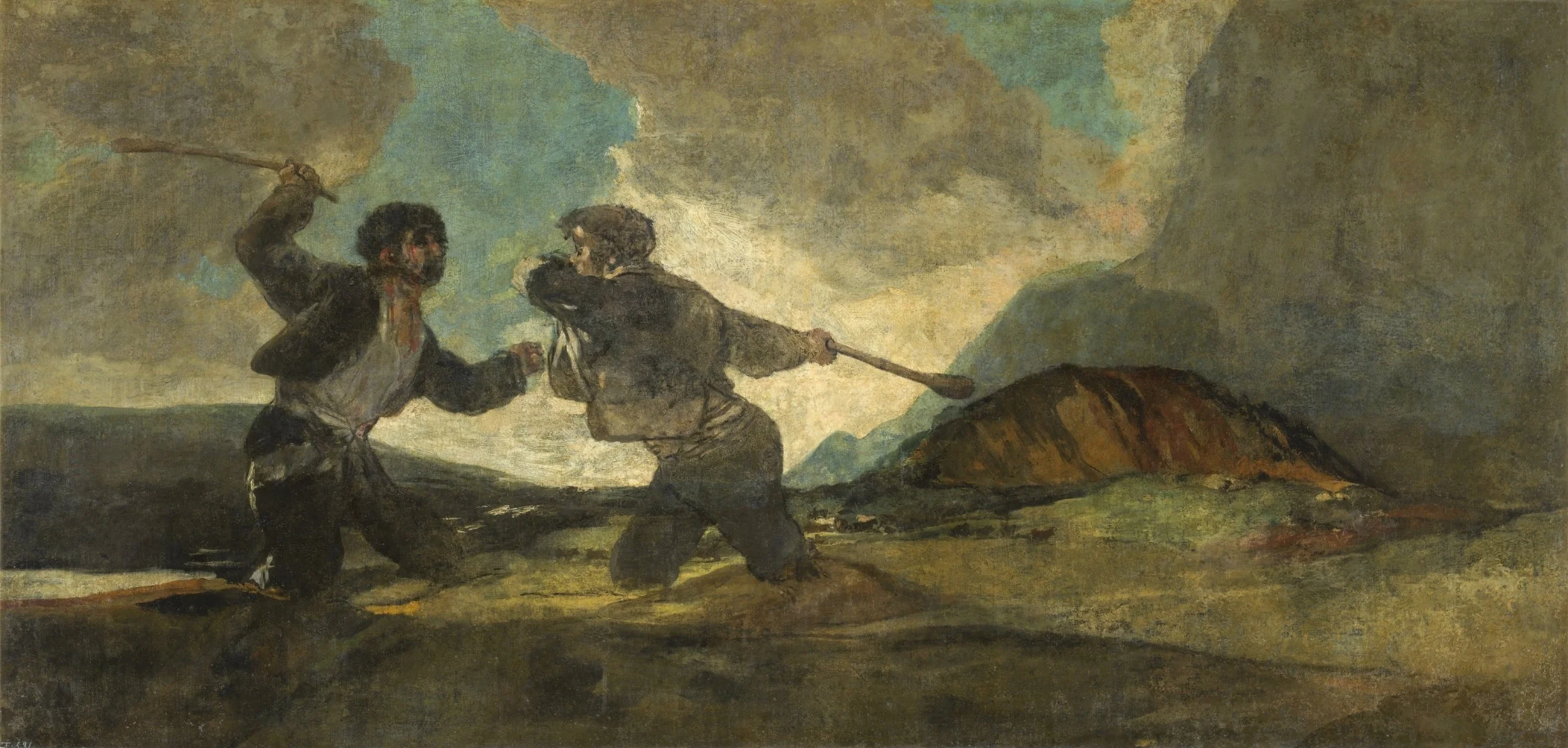
DUEL WITH CUDGELS
DUELO A GARROTAZOS
Title: Duel with Cudgels / Duelo a garrotazos
Artist: Francisco de Goya y Lucientes (1746–1828)
Date: c. 1820–1823
Series: The Black Paintings
Medium: Oil mural on plaster, transferred to canvas
Dimensions: 123 × 266 cm (48.4 × 104.7 in)
Original Location: Quinta del Sordo, Madrid
Current Location: Museo Nacional del Prado, Madrid, Spain
Support: Canvas (transferred from plaster, 1874–1878)
Style: Late Romanticism
Subject: Two men engaged in a violent cudgel fight, traditionally interpreted as an allegory of human conflict and the division of Spain.
Significance: One of Goya's most powerful Black Paintings, combining historical reality with universal symbolism. Modern conservation research indicates that the figures originally stood on solid ground rather than being buried in the earth.
Inventory Number: P000767
At first, Duel with Cudgels appears almost brutally simple. Two men stand alone in an open landscape, facing one another with raised clubs. The absence of an urban setting, spectators, or any visible explanation strips the scene to its essentials, leaving only two men and the violence between them. The scene is remarkable not for its theatrical drama but for its silence: beneath a pale, empty sky, the two figures seem isolated from the world, leaning forward with the grim concentration of men who have passed beyond reason. Neither emerges as hero nor villain. Each mirrors the other, becoming at once attacker and victim, while Goya refuses to offer the viewer a moral side to embrace. As with the other Black Paintings, his purpose is not to recount an event but to expose a condition of the human soul, reducing violence to its starkest expression: two human beings locked in the tragic act of mutual destruction.
The practice Goya depicts was rooted in reality. Fights with cudgels were known in rural Spain during the late eighteenth and early nineteenth centuries. Unlike the formal duels fought by officers or aristocrats with swords or pistols, these confrontations belonged to ordinary people. Farmers, shepherds, and labourers settled disputes over land, livestock, honour, or longstanding family grievances with the stout wooden staffs they carried as everyday tools.
There is no evidence that Goya personally witnessed a duel exactly like this one. Yet it is difficult to imagine that he was unfamiliar with such scenes. Throughout his life he travelled extensively across Spain, observing its customs with extraordinary attention. More importantly, he had witnessed the devastation of the Peninsular War and had explored human cruelty with unmatched honesty in The Disasters of War. He understood that violence was rarely heroic. More often, it was ordinary.
By the time Goya painted the Black Paintings, around 1820–1823, he was living in near isolation at the Quinta del Sordo. Old, deaf, and profoundly disillusioned by decades of war, political upheaval, and repression, he had little reason to believe that society had learned from its suffering. A simple fight between two villagers could therefore become something much larger: not merely a local quarrel, but a reflection of humanity's enduring tendency to answer conflict with force rather than reason.
For more than a century, viewers believed that the two men were buried up to their knees in the earth. This unsettling detail became one of the painting's defining features and inspired countless interpretations. Critics argued that Goya had deliberately trapped the combatants, suggesting that hatred can imprison people until violence becomes unavoidable. The image seemed to embody a tragic truth: neither man could escape, even if he wished to. Modern research, however, has transformed our understanding of the work. Early photographs taken before the Black Paintings were removed from the walls of the Quinta del Sordo reveal that Goya originally painted the figures standing on grassy ground. During the difficult process of transferring the murals to canvas in the nineteenth century, much of the lower portion of the composition was damaged or lost. Restorers reconstructed the missing area, inadvertently creating the illusion that the men were sinking into the soil.
This discovery does not diminish the painting's power; it redirects it. The fighters are not prisoners of the earth but of their own choices. They remain free to step away, yet neither does. The tragedy lies not in physical entrapment but in moral blindness. Goya suggests that human beings often continue destructive conflicts long after escape is still possible. The real prison is not beneath their feet. It exists within the mind, where pride, resentment, and hatred silence every path toward reconciliation.
Few paintings have inspired as many political interpretations as Duel with Cudgels. Although Goya never explained its meaning, many historians view it as an image of a nation turning against itself. Painted during the turbulent final years of his life, after decades of invasion, civil unrest, and the struggle between liberal reformers and defenders of absolute monarchy, the work reflects a Spain deeply divided by ideology, where victory for one faction often meant suffering for all. The two combatants thus become more than individuals: they embody opposing visions of the same nation, locked in a contest from which neither can truly emerge victorious. Goya offers no banner, no uniform, and no political slogan because the conflict transcends any single historical moment. Each blow weakens not only an opponent but the society they share, making the painting a striking precursor to the idea of "the two Spains." Whether or not Goya consciously intended such a prophecy is impossible to know, but he had witnessed enough revolutions and political upheavals to recognise a recurring truth: when fellow citizens cease to see one another as neighbours, violence no longer resolves conflict—it becomes its lasting inheritance.
Duel with Cudgels endures because it refuses to remain confined to nineteenth-century Spain. The clubs belong to another age, yet the impulse behind them is timeless. Every generation discovers new reasons to divide itself—politics, religion, ideology, identity—but the pattern remains unchanged. Two opponents become so consumed by defeating one another that they forget the cost of the struggle itself. Unlike history paintings that celebrate victory, Goya offers no triumph. We never learn who will survive because the outcome is ultimately irrelevant. Even if one man remains standing, he inherits only silence, exhaustion, and loss. Violence may settle a contest, but it rarely resolves the conflict that gave rise to it. Rather than offering answers, Goya leaves us with an unsettling question: at what moment could these two men have lowered their clubs and walked away? Nearly two centuries later, the painting still confronts us with the same dilemma. It is not simply a scene of rural violence, nor merely a political allegory, but a profound reflection on the human condition. In the end, Duel with Cudgels reminds us that the greatest battles are often those we choose to continue, long after we still possess the freedom to stop.
Juan de Barrientos