

Heads in a Landscape
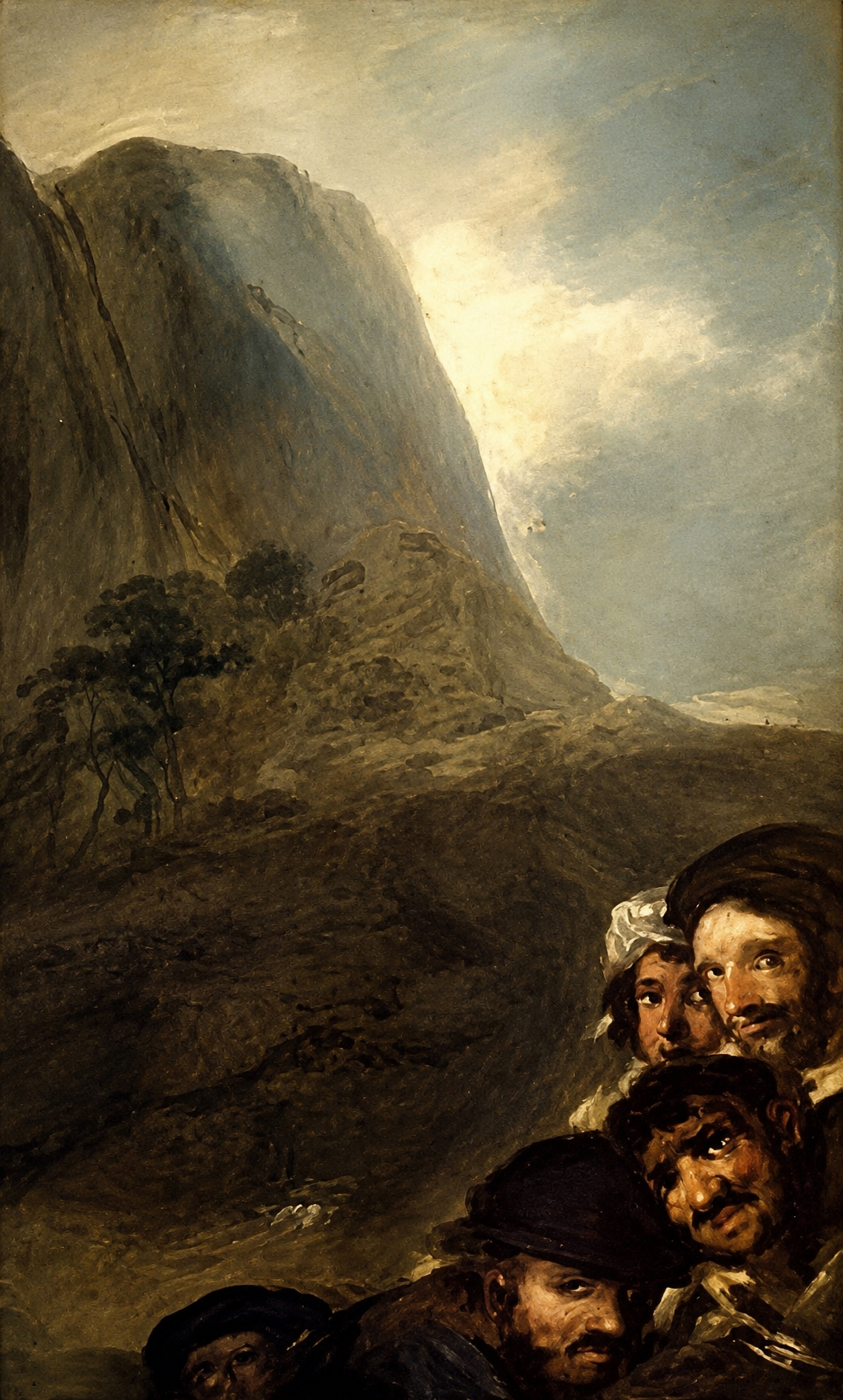
HEADS IN A LANDSCAPE
CABEZAS EN UN PAISAJE
Title: Heads in a Landscape / Cabezas en un paisaje
Artist: Francisco de Goya y Lucientes (1746–1828)
Date: c. 1820–1823
Series: Black Paintings (traditionally associated)
Medium: Oil on plaster, transferred to canvas
Dimensions: 45 × 63 cm (17.7 × 24.8 in)
Original Location: Probably Quinta del Sordo, Madrid
Current Location: Private Collection (Stanley Moss Collection, New York, USA)
Support: Canvas (transferred from plaster)
Style: Late Romanticism
Subject: A group of mysterious heads emerging from a dark landscape, suggesting themes of fear, anonymity, and the collective psychology of humanity.
Significance: The only work traditionally associated with the Black Paintings that is not housed in the Museo del Prado. Its uncertain provenance and haunting imagery have made it one of the most enigmatic paintings connected with Goya's late period.
Inventory Number: Not applicable (Private Collection)
The Missing Black Painting
Among the fifteen paintings traditionally associated with Goya's Black Paintings, Heads in a Landscape occupies a unique place. Unlike the other fourteen, it was never transferred to canvas by Salvador Martínez Cubells for the Museo del Prado. Instead, it followed a different path after leaving the walls of the Quinta del Sordo, eventually entering private hands. Today it remains outside Spain, in the collection of Stanley Moss & Company in New York.
Its history is unusually elusive. The painting was first documented in 1846 in the Palace of Vista Alegre, owned by Queen María Cristina of Borbón, widow of Ferdinand VII. From there it passed through several distinguished collections—including that of the Dukes of Montpensier and later the celebrated Contini Bonacossi collection in Italy—before arriving in New York during the twentieth century. Because it escaped the Prado's restoration campaign, it survives as a rare independent witness to Goya's final years.
Scholars generally date the work to around 1820–1823, placing it firmly within the period in which the Black Paintings were conceived. Yet Heads in a Landscape remains the most enigmatic member of the group. It lacks the explicit mythology of Saturn, the religious tension of The Pilgrimage to San Isidro, or the dramatic narrative of The Dog. Instead, it offers only a vast landscape, an overwhelming silence, and a handful of faces emerging from the lower corner of the composition. Their presence is almost incidental—yet impossible to ignore.
Perhaps that uncertainty is precisely why the painting belongs among Goya's final masterpieces. Rather than telling a story, it poses a question, inviting the viewer to enter a landscape where meaning is suggested rather than declared. In his final years, Goya increasingly abandoned narrative certainty in favor of psychological ambiguity. Heads in a Landscapemay be the purest expression of that transformation.
At first glance, Heads in a Landscape appears almost empty. The eye is drawn not to the figures, but to the immense rocky formation that dominates the composition. Bathed in a pale, uncertain light, the cliff rises with monumental indifference, reducing human presence to a nearly invisible detail. Goya reverses the traditional hierarchy of painting: the landscape is no longer the setting for human drama; humanity itself becomes an afterthought.
Only after a moment does the viewer discover the small cluster of heads emerging from the lower right corner. There are no bodies, no clear narrative, no indication of who these people are or why they have gathered. Their anonymity is deliberate. Yet their expressions are unmistakable. They stare directly toward us with an intensity that is both unsettling and deeply personal. We expect to contemplate the painting, but instead we find ourselves being observed.
This subtle reversal transforms the entire work. The vast landscape no longer feels empty; it becomes psychologically charged. The silence of the open space contrasts with the concentrated force of those faces, creating an uneasy tension between nature's permanence and human vulnerability. Goya achieves this with extraordinary economy. There is no dramatic gesture, no violent action, no theatrical symbolism. The power of the painting lies in what it refuses to explain.
Perhaps this is why Heads in a Landscape remains one of Goya's most mysterious creations. It is not merely a landscape inhabited by figures, nor simply a group portrait placed outdoors. It is a meditation on isolation, perception, and the unsettling awareness that, even in apparent solitude, we may never truly be alone.
The enduring fascination of Heads in a Landscape lies not in what it depicts, but in what it demands of its viewer. Few paintings by Goya offer so little narrative guidance, and yet so much psychological tension. There is no identifiable event, no mythological reference, no religious symbolism to anchor our interpretation. Instead, Goya leaves us alone with a question: who are these silent observers, and why are they looking at us?
One compelling interpretation is that the painting reflects Goya's growing preoccupation with human isolation during the final years of his life. Elderly, deaf, politically disillusioned, and increasingly withdrawn from public life, he had witnessed war, repression, and the collapse of old certainties. The tiny group of faces, overwhelmed by the immensity of the landscape, may embody humanity itself—fragile, temporary, and insignificant before the vastness of nature and time.
Yet Goya offers no despair. The figures remain together. They endure. Above them, the landscape is not violent but silent, illuminated by a strange and almost transcendent light. It is as though the painter had stripped away every distraction until only the essential remained: the human gaze confronting the unknown.
Perhaps this is why Heads in a Landscape feels surprisingly modern. It refuses to explain itself, inviting each generation to complete its meaning. More than two centuries later, those anonymous faces continue to stare across the canvas, reminding us that the greatest mysteries in art are often not those we observe, but those that quietly observe us in return.
Juan de Barrientos