

Bird Man
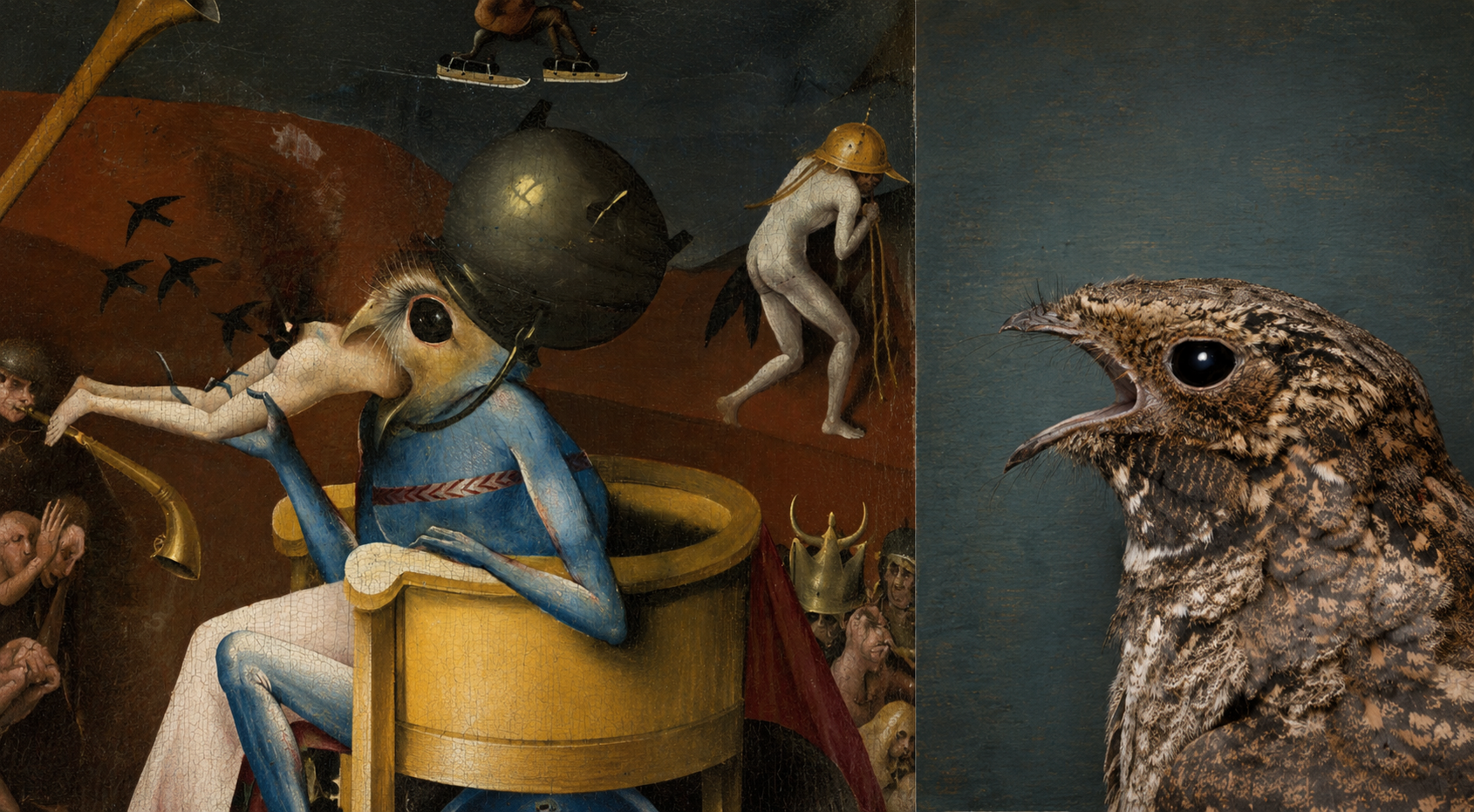
The Bird-Man of Bosch: Devourer, Judge, and the Corruption of Communion
Among all the creatures inhabiting Hieronymus Bosch’s The Garden of Earthly Delights, one possesses a uniquely disturbing presence: the so-called “Bird-Man” seated in the infernal panel of the triptych. Half bird, half monstrous sovereign, this enigmatic figure dominates the Hell scene with an authority that feels unnervingly calm.
Viewers remember him instinctively. Even among Bosch’s swarms of hybrid monsters, the Bird-Man remains singular: seated upon a throne-like structure, swallowing human bodies whole and expelling them still physically recognizable. Bosch seems to ask a deeply unsettling question: what, exactly, has happened to these unfortunate souls?
It is, in my view, one of the most psychologically unsettling images in the history of painting.
Art historians usually refer to the creature simply as the “Bird Monster,” “Bird-Headed Monster,” or “Prince of Hell.” Bosch himself almost certainly never used these names. In fact, the modern title The Garden of Earthly Delights is also posthumous. The painting has carried several names through history, including references to lust, worldly sin, and earthly vanity. Yet the Bird-Man has become so iconic that he now functions almost as the symbolic ruler of Bosch’s infernal universe.
Bosch does not paint chaos alone; he paints administration. The Bird-Man behaves less like a wild beast than like an infernal magistrate carrying out an eternal process.
Its anatomy is unusually hybrid. The long semi-curved beak, rounded head, enormous black eye, and strange whisker-like feathers around the mouth suggest something closer to nocturnal birds such as nightjars or potoos. Surely , I am not the only one to have noticed the striking similarities between Bosch’s infernal creature and the European nightjar, a nocturnal bird associated for centuries with superstition and mystery.
This observation is more important than it may first appear. Nightjars possess large dark eyes, cryptic plumage, and long facial bristles known scientifically as rictal bristles. In medieval folklore they were mysterious birds of the dusk, associated with silence, invisibility, and strange nocturnal behavior. Their old English name, “goatsucker,” emerged from the superstition that they stole milk from goats during the night. Such creatures belonged naturally to the symbolic imagination of Bosch’s age.
Bosch was not attempting zoological precision. He painted symbolic creatures. The Bird-Man is therefore best understood not as a single identifiable species, but as a fusion of nocturnal avian characteristics designed to awaken instinctive discomfort within the viewer. It feels familiar and alien simultaneously. The spectator recognizes predatory intelligence without being able to classify it completely.
This ambiguity contributes greatly to the figure’s symbolic power.
Perhaps the most profound interpretation of the Bird-Man concerns what has been described as an “inverse communion” or “anti-Eucharist.” In Christianity, the Eucharist symbolizes spiritual salvation through the sacred body of Christ. Consumption becomes redemption. The faithful receive divine grace through ritual ingestion.
Bosch corrupts this sacred structure entirely.
The Bird-Man consumes human beings not to save them, but to digest and condemn them. Instead of spiritual transformation, there is biological degradation. Instead of transcendence, there is excretion. The figure becomes a grotesque parody of divine communion: an infernal priest administering eternal corruption rather than salvation.
Such a profanation would have been deeply shocking to a late medieval audience. Bosch’s world was intensely sacramental. Religious rituals structured both social and spiritual life. To corrupt the symbolism of sacred consumption was therefore not merely grotesque; it was spiritually terrifying.
Even the throne-latrine structure reinforces the sacrilegious logic of the scene. Medieval viewers would immediately have recognized the humiliation implicit in the image. The human body, once considered capable of divine resurrection, is here reduced to waste processed through a monstrous digestive cycle.
The Bird-Man also embodies another recurring Boschian theme: the punishment hidden within desire itself. The damned entering the creature’s mouth are not attacked randomly. They seem drawn into the process almost mechanically, as though their earthly appetites have naturally evolved into infernal degradation. Bosch repeatedly suggests throughout the triptych that sin is not externally imposed punishment, but a condition that transforms itself into suffering.
This insight helps explain why Bosch still feels contemporary. His monsters are not merely decorative demons inherited from medieval manuscripts. They are visualizations of human impulses turning destructively inward.
From a Jungian perspective, the Bird-Man can be interpreted as an archetypal image emerging from the collective unconscious. Carl Jung often argued that hybrid creatures express psychic truths beyond rational language. The Bird-Man may therefore represent the devouring shadow: intelligence detached from compassion, instinct transformed into machinery, consciousness observing its own corruption.
The enormous black eye becomes especially significant in this reading. The creature does not merely eat. It watches.
Unlike many medieval demons, the Bird-Man does not appear ecstatic or enraged. Its detached observation resembles judgment itself. It is this emotional stillness that makes the figure unforgettable. Bosch creates a monster that feels spiritually awake.
Despite centuries of interpretation, the creature ultimately resists complete explanation. That resistance may be deliberate. Bosch understood that fear intensifies when forms remain unstable. The Bird-Man occupies the boundary between bird and demon, animal and judge, priest and executioner.
Five centuries later, it still watches us.
Juan de Barrientos