

Pink Architectures
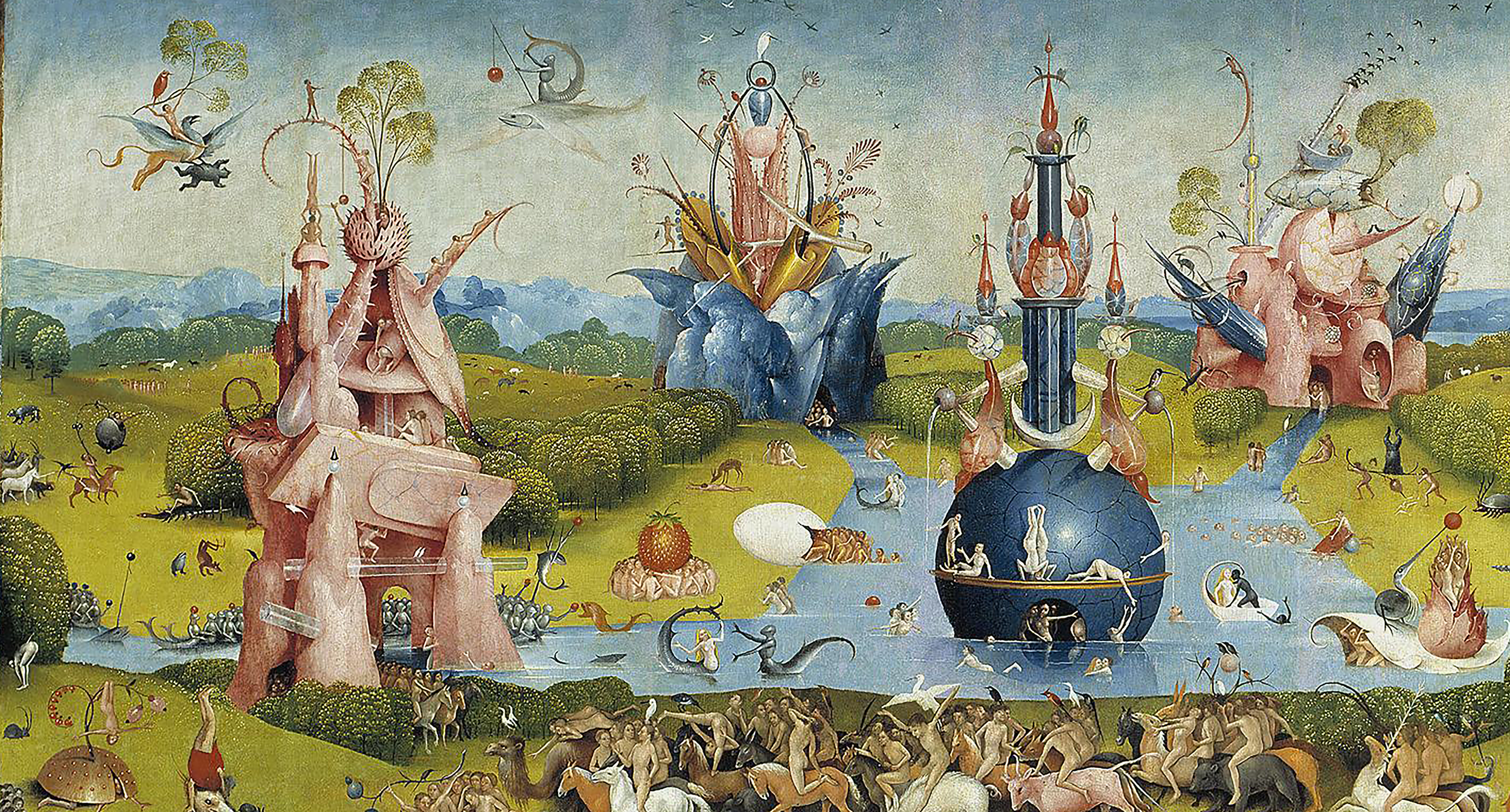
The Pink Architectures of Bosch
Mystery, Mineral Flesh, and the Curious Logic of Paradise
Among the innumerable enigmas concealed within The Garden of Earthly Delights, few are more seductive — or more resistant to interpretation — than the strange pink structures that rise throughout the panels like organisms from another order of creation. They are not churches, though they possess spires. They are not palaces, though they suggest ceremonial grandeur. Nor are they ruins, although one suspects they may already be decaying at the very moment they bloom.
One might call them architectural hallucinations, were it not for the unsettling precision with which Bosch paints them. They glisten and perspire. At once mineral and biological, crystalline and visceral, they seem suspended between geology and anatomy.
Erwin Panofsky, had he wandered through the Museo del Prado late at night with a lantern and a sufficiently pessimistic disposition, would likely have insisted that these forms belong not merely to fantasy but to a symbolic universe intelligible to the late medieval mind. Panofsky famously distrusted interpretations that reduced Bosch to a whimsical inventor of monsters. To him, Bosch was neither a surrealist before surrealism nor a medieval eccentric amusing himself with infernal caricatures. Rather, he encoded moral and theological anxieties into visual riddles.
And yet one suspects even Panofsky might have hesitated before these pink towers. They resist certainty.
The central difficulty lies in the fact that Bosch paints architecture as though it were alive. Stone dissolves into membranes; pinnacles curve like cartilage; apertures resemble wounds, mouths, or reproductive organs without ever becoming fully anatomical. The sensation is profoundly disquieting. One feels less as though entering a city than a metabolism.
Certain historians have proposed alchemical sources, and the resemblance to fifteenth-century alchemical apparatus is indeed remarkable. Manuscripts circulating through Europe depicted translucent vessels, distillation towers, glass retorts, and furnaces intended to transform matter through hidden processes. Bosch’s constructions often resemble gigantic alembics abandoned by celestial chemists.
The idea becomes more compelling when one notices that the entire triptych behaves like a process of transformation. Paradise gives way to intoxicated pleasure; pleasure collapses into mechanical punishment; desire hardens into nightmare. The painting itself begins to resemble a laboratory in which humanity becomes the unstable substance under examination.
Colour is essential. Bosch’s pink bears little resemblance to the decorative pinks of later Rococo frivolity. It is flesh-pink, shell-pink, dawn-pink, wound-pink — a colour with physiological intimacy. Even today, standing before the original panels, one senses that these surfaces should not be touched, much as one hesitates before touching certain sea creatures whose beauty implies immediate medical consequences.
Technically, Bosch achieved these luminous effects through the extraordinary oil techniques of the Netherlandish tradition: translucent glazes, lead whites, organic lakes, and layers of astonishing delicacy. The surfaces appear almost internally illuminated, as light passes through successive glaze layers before returning to the eye. One begins to understand why later admirers, from Romantic writers to Salvador Dalí, believed Bosch painted dreams with the precision of a jeweller.
Equally fascinating is Bosch’s apparent attraction to transparency. Many structures resemble blown glass. In the late fifteenth century, Venetian glass ranked among the great luxuries of Europe and was admired almost as a magical substance. Transparency itself carried symbolic force: fragility, purity, temptation, and illusion coexisted within it.
Bosch seems instinctively aware that transparent things are psychologically dangerous. We trust them because we can see through them, yet clarity can also deceive through distortion. A curved vessel alters what it contains. The eye is seduced precisely at the moment it loses certainty. Much the same could be said of Bosch’s moral universe.
It is perhaps here that the modern viewer feels closest to him. Bosch understood that human beings are drawn not merely to pleasure but to ambiguity itself.
Desire, novelty, beauty, danger, curiosity, power, and the hope of transformation all exert their force long before reason fully understands what it is seeing.
One should also remember that Bosch lived during an age intoxicated by reports of distant worlds. Exotic animals, tropical plumage, rare shells, and travellers’ tales circulated through Europe with increasing frequency. The artist may never have seen many of the creatures he painted alive, yet he absorbed fragments of reality and recombined them into persuasive impossibilities. His monsters work because they remain biologically adjacent to truth.
The same principle governs these impossible forms. They feel discovered rather than invented. One could imagine stumbling upon them somewhere beyond the edges of accepted geography, perhaps after an ill-advised maritime expedition financed by noblemen with theological interests and insufficient supervision.
Perhaps Bosch’s greatest achievement is his preservation of uncertainty. The modern world habitually demands explanations: symbols decoded, meanings stabilised, anxieties categorised. Bosch refuses such administrative tidiness. His forms hover perpetually between sacred allegory and private nightmare.
The pink constructions in The Garden of Earthly Delights remain among the finest examples of that resistance. They are buildings that behave like bodies, crystals seemingly capable of desire, ornaments poised delicately between paradise and infection — comic and terrifying at once.
Five centuries later, they continue to stand beneath the cool varnish of the Prado, elegant as orchids and almost certainly up to something.
Juan de Barrientos