

The Dog
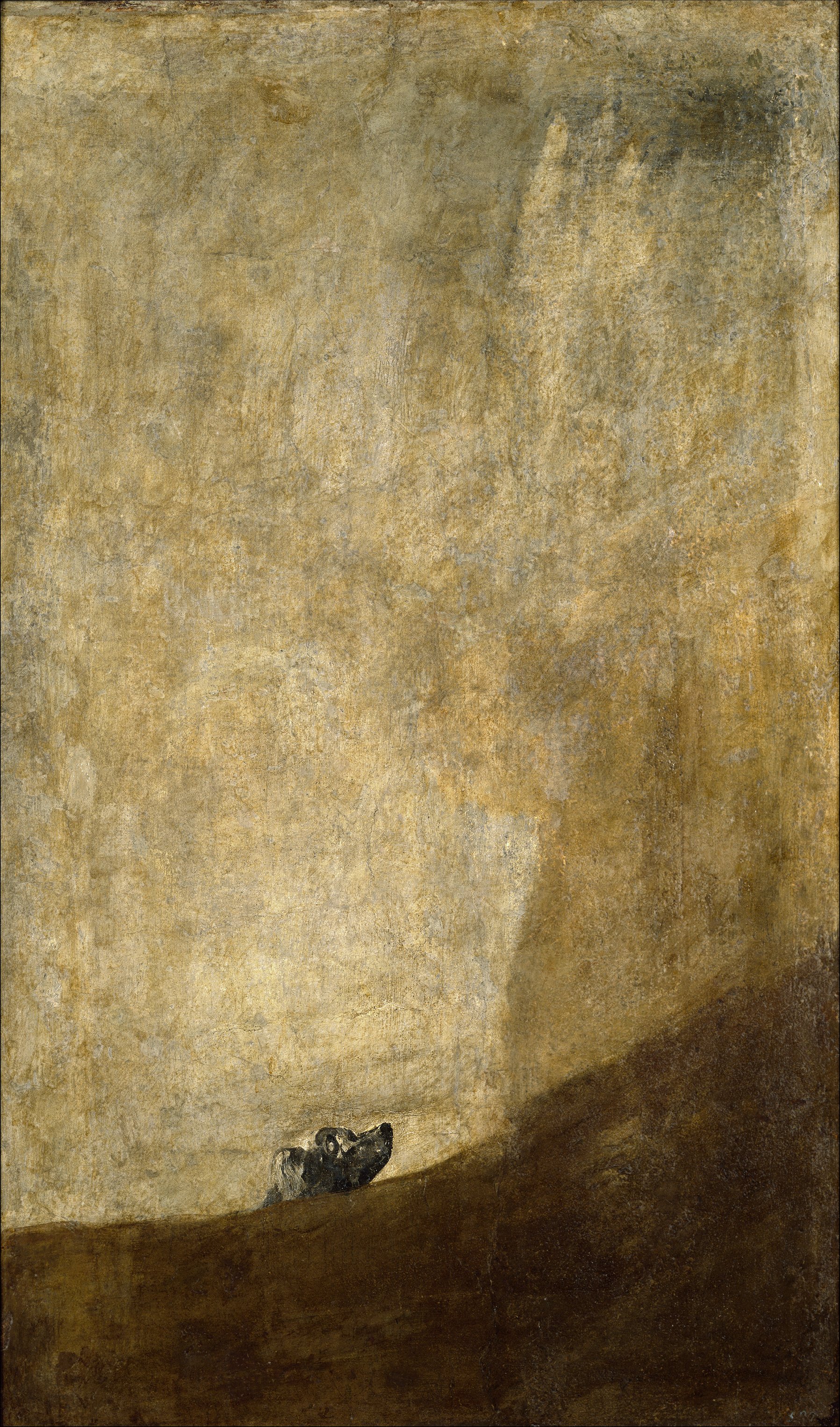
THE DOG
EL PERRO
Title: The Dog / El Perro
Artist: Francisco de Goya y Lucientes (1746–1828)
Date: c. 1820–1823
Series: The Black Paintings
Medium: Oil mural on plaster, transferred to canvas
Dimensions: 131.5 × 79.3 cm (51.8 × 31.2 in)
Original Location: Quinta del Sordo, Madrid
Current Location: Museo Nacional del Prado, Madrid, Spain
Support: Canvas (transferred from plaster, 1874–1878)
Style: Late Romanticism
Subject: The head of a solitary dog emerging from a vast ochre slope beneath an immense empty sky, evoking isolation, uncertainty, and hope.
Significance: One of Goya's most celebrated and enigmatic masterpieces, remarkable for its radical simplicity and emotional depth. Often regarded as a precursor to Modern Art, it continues to inspire widely differing interpretations while preserving its profound mystery.
Inventory Number: P000762
What Lies Above the Dog?
Goya’s The Dog and the Psychology of Absence
To me, there are paintings one admires, paintings one studies, and paintings one never entirely escapes. Francisco de Goya’s The Dog belongs to the final category. It appears deceptively simple: a small canine head emerging beneath an immense ochre field. Yet the longer one observes the work, the less stable that simplicity becomes. The image begins to generate presences.
Many viewers eventually experience the same unsettling sensation: something may exist within the upper field. A curve, a shadow, a latent profile, an unresolved form. One begins by looking at emptiness and ends by suspecting concealment.
This reaction is not merely fanciful. The surface of The Dog has provoked technical and psychological speculation for decades, precisely because the painting exists in a strangely unstable condition between image and disappearance.
One must first remember that the work we see today is not exactly what Goya painted. The Black Paintings were executed directly onto the plaster walls of the Quinta del Sordo, near Madrid, between approximately 1819 and 1823. They were private works, never intended for public exhibition. After Goya’s death, the wall paintings deteriorated severely. In the 1870s, they were laboriously transferred from plaster to canvas by Salvador Martínez Cubells.
The transfer preserved the images, but irreversibly transformed them.
Portions were lost, surfaces changed, tonal relationships shifted, and transitions interrupted. Modern scholars generally agree that The Dog, in particular, suffered considerable alteration during the transfer process. The lower region appears truncated, while the surrounding ochre field contains abrasions, repairs, and uncertain passages whose original appearance can no longer be reconstructed with confidence.
This matters because it opens a disturbing possibility: the emptiness may once have contained more.
The Prado’s classification of The Dog as “mixed media” reflects a technical reality Goya himself would likely have found almost absurd. He never conceived these works as portable paintings destined for museum walls. The Black Paintings were executed directly onto the plaster surfaces of the Quinta del Sordo, integrated physically into the architecture of the house itself.
Several were even enclosed within painted illusionistic frames rather than independent wooden ones. The paintings existed as part of an immersive domestic environment, not as isolated objects intended for gallery display.
Goya was already elderly, physically weakened, and profoundly deaf when he created them. Although assistants or labourers may have helped prepare walls, pigments, scaffolding, decorative borders, or plaster grounds, the paintings themselves bear the unmistakable psychological and technical unity of Goya’s late hand. Their later transfer from wall to canvas in the nineteenth century was therefore not merely a conservation procedure, but a radical transformation of objects never intended to leave the house at all.
Technical examinations, including radiographic and infrared studies, have revealed complex underlayers and material inconsistencies within several of the Black Paintings. In the case of The Dog, some scholars have proposed that additional forms may originally have existed in the upper register, or near the animal’s line of sight. Others remain sceptical, arguing that viewers project recognisable patterns onto ambiguous surfaces.
Human perception is notoriously eager to discover faces within ambiguity. The phenomenon known as pareidolia — the tendency to perceive meaningful forms within randomness — lies deeply embedded within human cognition. Clouds become profiles; stains become eyes; shadows acquire intention. Yet Goya’s surfaces are peculiarly susceptible to this effect because they oscillate constantly between representation and dissolution.
Certain dark curves within the ochre expanse do indeed suggest a latent facial organisation. The suggestion is extraordinarily subtle: not a face painted clearly enough to identify, but an arrangement capable of provoking subconscious recognition. One senses a profile that refuses completion.
Importantly, this does not mean that Goya secretly painted a hidden portrait above the dog. Serious scholarship requires caution here. The available technical evidence does not permit definitive claims. Nevertheless, the persistence of such perceptions among viewers remains meaningful.
Goya’s late brushwork often encourages the simultaneous emergence and collapse of form. Figures materialise from matter and retreat back into it. This spectral instability became one of the defining characteristics of the Black Paintings. The painter appears less interested in constructing solid realities than in revealing the fragile threshold at which perception itself begins.
Several modern writers have explored the existential implications of this ambiguity. Susana Calvo Capilla, for instance, examined the possibility that the dog functions as a metaphor for anguish before old age, mortality, and existential emptiness. Other critics, such as Robert Hughes and Tom Lubbock, approached the painting through themes of solitude, metaphysical silence, and psychological exposure.
Yet what remains striking is that independent viewers repeatedly arrive at similar intuitions without necessarily knowing these interpretations beforehand. The painting exerts a peculiar gravitational pull toward certain emotional conclusions.
Such reactions seem to arise not through suggestion, but from the internal structure of the painting itself. Goya built ambiguity directly into its visual language.
The great mystery is whether the apparent incompleteness of The Dog is accidental or deliberate.
Throughout the Black Paintings, Goya increasingly strips away clarity. Narrative weakens; atmosphere dominates; form dissolves into broad tonal masses. The world ceases to behave according to classical pictorial logic. Instead, consciousness itself becomes the subject.
Seen in this context, the ambiguous upper field of The Dog may not represent unfinished painting at all. It may represent deliberate indeterminacy — a void activated by perception.
This helps explain why the work feels startlingly contemporary. Long before abstraction, minimalism, or existential cinema, Goya discovered that absence can possess greater emotional intensity than detail. The eye searches the ochre field almost desperately, because the painting refuses resolution.
The dog appears to look upward toward something that may not exist.
Or perhaps toward something the viewer can no longer see.
That distinction changes the entire philosophical structure of the image. If a figure once occupied the upper space and vanished through material loss, the painting becomes tragic archaeology. If Goya intentionally erased certainty, the work becomes a meditation on consciousness confronting the unknown.
There is also a deeply Spanish quality to this ambiguity, though not in the picturesque sense foreigners often imagine. Spanish painting frequently understands darkness not merely as the absence of light, but as a metaphysical condition. Velázquez, Zurbarán, Ribera, and later Goya all exploit forms emerging from shadow with extraordinary psychological power.
Yet Goya carries the tradition into terrifyingly modern territory. Darkness no longer conceals divine revelation or theatrical spectacle. It conceals uncertainty itself.
The upper field in The Dog behaves almost like silence made visible.
One suspects this is why the painting continues to provoke such intense personal reactions. Viewers feel invited to complete the image inwardly. The work becomes collaborative in the most unsettling possible sense: the spectator supplies the missing reality.
What is it that we project into the void above the animal: fear, prayer, abandonment?
Ultimately, the enduring power of The Dog may lie precisely in the fact that it resists final explanation. Goya transforms uncertainty into structure. The painting survives in suspension: part damaged object, part deliberate enigma, part projection of the viewer’s own consciousness.
Juan de Barrientos
Notes
Official title at the Museo Nacional del Prado: Perro semihundido.
Common English titles include The Dog, Half-Submerged Dog, and occasionally The Drowning Dog.
Artist: Francisco de Goya.
Series: One of the Black Paintings (Pinturas negras), executed between approximately 1819 and 1823 in the Quinta del Sordo.
Technique: mixed media.
Prado inventory number: P00767.