

BOSCH AND ALCHEMY
Bosch and Alchemy
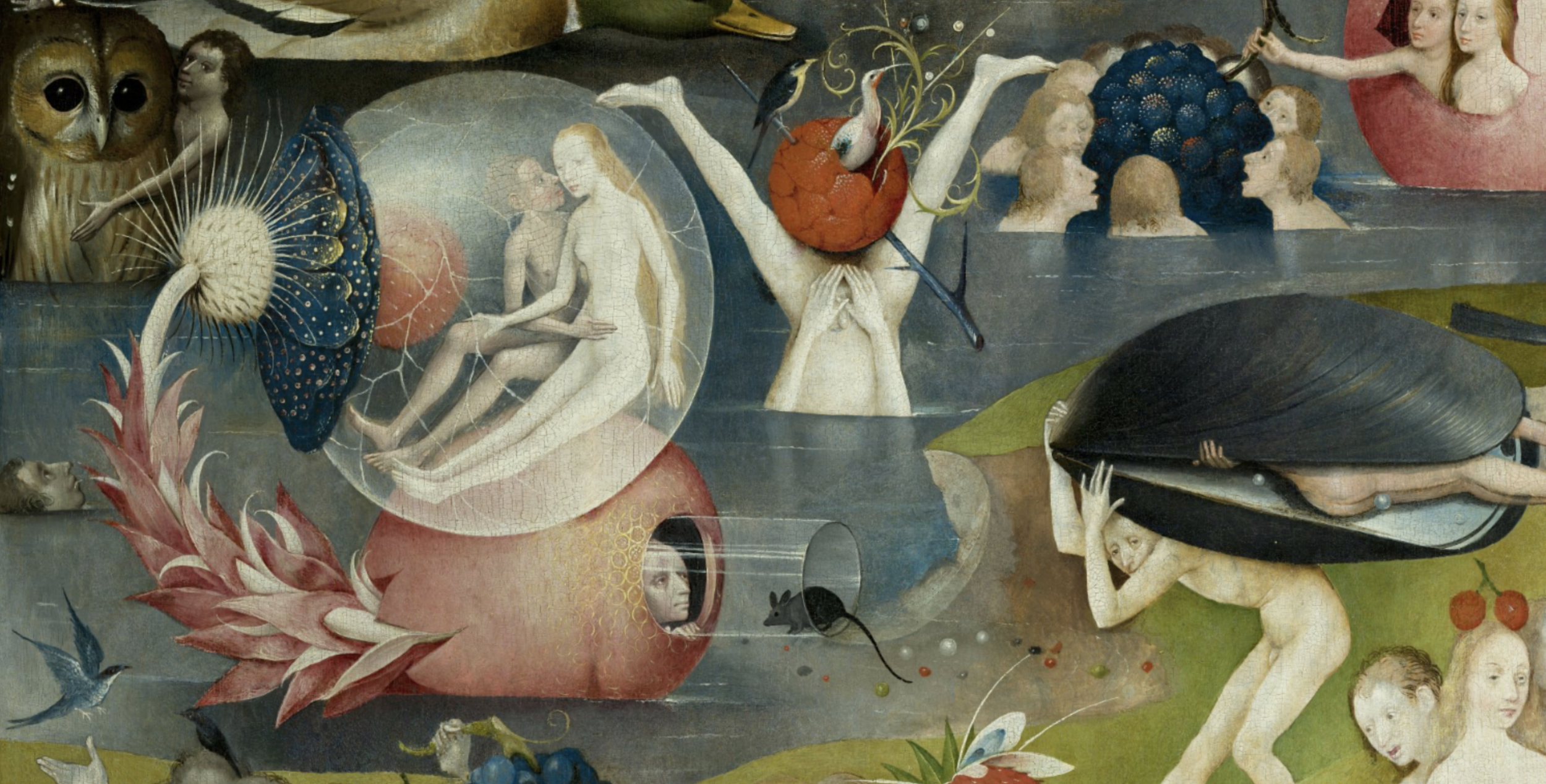
It is not difficult to imagine Hieronimus listening, by candlelight, to whispered conversations about transmutation, secret fires, and the ancient dream of transforming matter itself. While alchemists heated strange substances in glowing crucibles, Hieronimus was painting crystalline spheres, transparent tubes, and enigmatic structures that seem to belong to someone initiated into the alchemical world. The question is not whether he practiced alchemy, but how deeply its ideas of hidden knowledge and metamorphosis shaped his imagination and perception.
The connection appears almost inevitable. His paintings contain burning furnaces, strange vessels, hybrid creatures, impossible architectures, cracked eggs, and organic forms that seem to mutate continuously. These images can resemble the visual world of occult laboratories, mystical experiments, or symbolic chemistry. Yet caution, as always, is necessary. There is no solid historical evidence that Bosch himself practiced alchemy, belonged to an alchemical circle, or possessed formal hermetic knowledge. The relationship is subtler, and more interesting.
Bosch did not need to be an alchemist to inhabit an alchemical civilization.
Alchemy in the late Middle Ages was not merely the attempt to turn lead into gold. It existed somewhere between science, metallurgy, medicine, theology, philosophy, and symbolic mysticism. Alchemists studied transformation itself: purification through fire, decay, rebirth, hidden correspondences, and the possibility that corruption could become perfection. Matter was not inert. It was mysterious, active, volatile, and morally suggestive.
This language of transformation appears everywhere in Bosch.
In paintings such as The Garden of Earthly Delights and The Temptation of Saint Anthony, nothing remains stable for long. Human beings merge with animals. Bodies open like containers. Architecture behaves organically. Instruments become flesh. Creatures appear halfway between species. Bosch paints a universe in permanent mutation.
This does not prove alchemical intention. It reveals something more important: Bosch’s imagination was fascinated by forms in flux.
He lived in the wealthy and commercially sophisticated city of ’s-Hertogenbosch during a period when Europe was beginning to reconsider matter itself. Workshops, furnaces, metalworkers, glassmakers, apothecaries, dyers, brewers, and proto-chemical artisans surrounded everyday urban life. Medieval craft culture was deeply material. Heat transformed metal. Pigments changed through combustion. Glass emerged from sand and fire. Substances dissolved, thickened, fermented, evaporated, and recombined. Long before modern chemistry, urban artisans lived among visible transformations.
Bosch absorbed this atmosphere instinctively.
One reason scholars connect Bosch to alchemical imagery is his repeated use of strange containers and furnace-like structures. In several paintings, enormous vessels dominate the composition. Some resemble eggs, others sealed chambers, distillation apparatuses, or impossible glass constructions. Alchemical manuscripts frequently depicted symbolic vessels such as alembics, retorts, and enclosed chambers used in processes of transformation. Bosch’s forms are rarely precise enough to identify technically, yet they evoke the same psychological territory: matter enclosed, heated, altered, and corrupted.
The egg becomes one of Bosch’s most revealing symbols.
Bosch repeatedly paints cracked shells, hollow eggs, and enclosed spherical forms. Medieval and Renaissance alchemy often treated the egg as a symbol of generation and hidden transformation. The so-called philosophical egg represented incubation, potential life, and the mysterious development of hidden substance. Bosch’s eggs frequently feel unstable or damaged, as if creation itself has become compromised.
Yet Bosch’s world differs fundamentally from optimistic alchemical visions.
Many alchemists believed transformation could ultimately purify matter and elevate humanity. Bosch is more severe. His transformations often appear grotesque, failed, or spiritually corrupted. Human beings do not ascend toward perfection. They collapse into fragmentation. Appetite overwhelms order. Bodies become unstable because the soul itself has lost balance.
Fire plays a crucial role in this atmosphere. Alchemy depended upon controlled heat. Furnaces symbolized purification, destruction, and metamorphosis. Bosch’s infernal landscapes frequently contain burning cities, glowing interiors, and structures that resemble industrial furnaces centuries before industrialization existed. Some of his Hell scenes appear almost mechanically alive. Heat emanates from hidden interiors. Towers burn from within. Mechanical forms glow silently in darkness.
The Temptation of Saint Anthony may be the most important painting for understanding Bosch’s relationship with alchemical imagery. The work overflows with unstable architecture, bizarre machinery, hybrid organisms, and ritualistic absurdity. Certain structures have often been compared to laboratories or proto-scientific apparatuses. Others may parody human attempts to manipulate nature itself. The saint remains still while the world around him becomes a laboratory of spiritual disorder.
What matters is not whether Bosch secretly encoded alchemical formulas. That approach leads too quickly into speculative fantasy. The stronger interpretation is that Bosch recognized a deeper truth embedded within alchemical culture: matter is unstable because humanity itself is unstable.
Late medieval Europe was fascinated and frightened by transformation. Disease transformed the body. Sin transformed the soul. Fire transformed cities. War transformed kingdoms. Economic change transformed social life. The old medieval order itself was beginning to mutate beneath pressures that would eventually produce the Renaissance and the Reformation.
Bosch captures this atmosphere of instability with extraordinary intensity.
One of the greatest dangers in interpreting Bosch is the temptation to transform him into an occult prophet. Twentieth-century writers frequently exaggerated his connection to hermeticism, secret societies, and hidden mystical doctrines. Some presented Bosch almost as an initiate communicating encrypted esoteric truths. Serious historical interpretation requires restraint.
Whatever intellectual curiosities Bosch may have possessed, his imagination remained deeply rooted in the Christian vision of sin, judgment, and salvation.
Yet medieval Christianity itself was not hostile to symbolic transformation. Alchemy and religion often overlapped in surprising ways. Purification through fire, death preceding rebirth, corruption preceding renewal — these themes belonged simultaneously to theology and alchemy. Bosch understood the emotional and spiritual power of transformation, even if he did not practice alchemy literally.
This may explain why his paintings resist simple interpretation. Bosch occupies a threshold moment in European civilization. His world remains medieval, yet new forms of intellectual curiosity are beginning to emerge. Matter behaves unpredictably. Human identity appears unstable. Nature itself feels restless.
His paintings therefore resemble alchemical visions not because they encode secret formulas, but because they inhabit the same psychological landscape: a universe where everything can change form.
Bosch understood that transformation is not always salvation.
Sometimes it becomes nightmare.
Juan de Barrientos