

The Butterfly and the Thistle
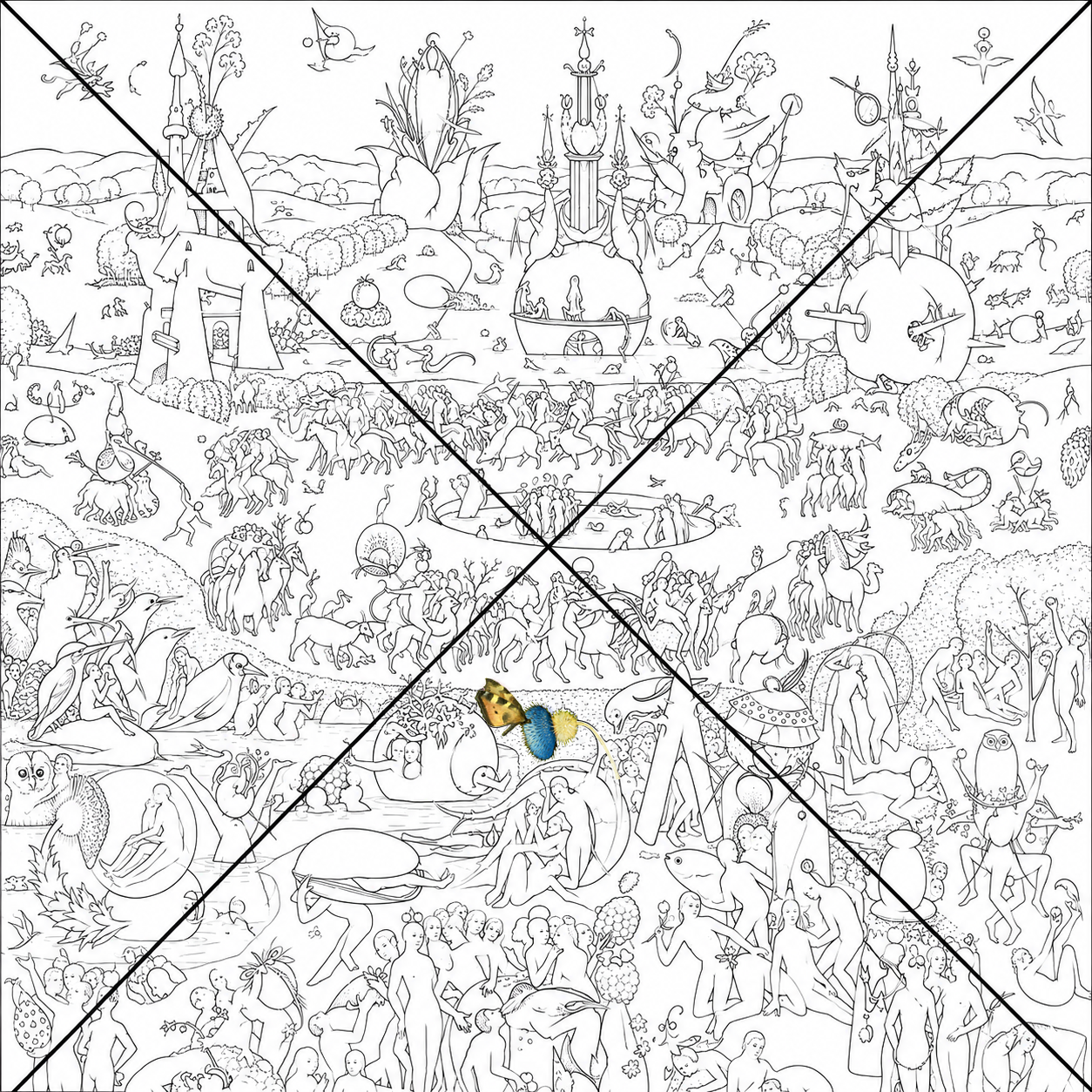
The Butterfly and the Thistle: Hidden Metamorphosis in Bosch’s Garden
Among the innumerable details concealed within Hieronymus Bosch’s The Garden of Earthly Delights, one of that may be overlooked is also quite intellectually stimulating: a small butterfly resting quietly within the central panel. Overshadowed by gigantic fruits, erotic crowds, strange animals, and the organic architectures, the insect appears almost insignificant at first glance.
Yet the longer one studies Bosch, the more perplexing small details become.
The butterfly raises an immediate question. Why would Bosch include such a recognizable European species inside one of the most symbolically charged paintings in Western art — and then almost hide it from the viewer?
The answer may lie precisely in this ambiguity.
Unlike many symbolic creatures in medieval art, Bosch’s butterfly is not visually emphasized. No figure points toward it. No compositional device isolates it dramatically. It exists almost naturally within the landscape, as though Bosch were recording an ordinary fragment of European ecology inside an unstable dream.
This restraint is deeply unusual.
Butterflies already possessed centuries of symbolic meaning by Bosch’s lifetime. In ancient Greek culture, the word psyche signified both “soul” and “butterfly.” Greek thinkers saw metamorphosis as a natural image of invisible continuity beyond death. The butterfly therefore became associated with spiritual transformation, survival, and the mysterious relationship between body and soul.
Christianity later inherited many of these associations. Medieval theologians frequently interpreted the butterfly’s emergence from the chrysalis as a metaphor for resurrection. Yet medieval Europe also regarded insects with suspicion. Nature was understood not only as divine creation, but as a domain filled with decay, temptation, mutability, and corruption.
Bosch appears to exploit this instability brilliantly.
The butterfly in the central panel does not function as a simple Christian emblem of resurrection. Instead, it behaves more like a fragment of living biology embedded within a world where transformation itself has become uncertain.
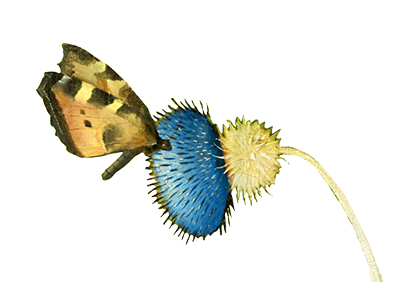
Identifying the species precisely is difficult, but the insect appears closely related to several well-known European butterflies from the Nymphalidae family. At first glance, the form resembles Aglais urticae, the Small Tortoiseshell butterfly, a widespread species found across most of Europe, including the Low Countries and Spain. The species feeds primarily on nettles, explaining the scientific term urticae, derived from the Latin urtica, meaning “nettle.”
The genus name itself opens another unexpected symbolic layer. Aglais derives from Aglaia, one of the Three Charites or Graces of Greek mythology. The three sisters represented different dimensions of beauty and human flourishing:
Aglaia symbolized radiance and splendor,
Euphrosyne joy and delight,
and Thalia abundance and flowering vitality.
The connection feels astonishingly appropriate for Bosch’s central panel, filled with sensuality, beauty, erotic abundance, and luminous human bodies. Although Bosch himself could not have known the later Linnaean classification, modern taxonomy unintentionally reconnects the butterfly with ancient ideals of pleasure, grace, and beauty.
Yet the second half of the scientific name changes the tone immediately.
Urticae refers to the nettle:
a plant associated with irritation, pain, wild growth, and neglected terrain.
Beauty becomes linked to discomfort.
This duality mirrors Bosch’s larger vision perfectly.
Yet other details suggest a more complex construction.
The large dark eyespot visible on the wing recalls Aglais io, the European Peacock butterfly, another widespread European species familiar to medieval observers. Unlike the more modest Small Tortoiseshell, the Peacock butterfly possesses striking eye-like markings capable of startling predators. When the wings open suddenly, the insect appears almost to stare back at the viewer.
This psychological quality would almost certainly have fascinated Bosch.
Throughout The Garden of Earthly Delights, Bosch repeatedly destabilizes vision itself. Eyes appear where they should not exist. Creatures merge with false faces. Organic forms imitate one another. Appearance becomes unreliable. The Peacock butterfly’s defensive eyespots therefore fit naturally into Bosch’s broader visual imagination.
At the same time, the wing structure itself does not correspond perfectly to either species.
This is important.
Bosch may not have intended a scientific representation at all. Instead, he appears to combine recognizable features from several European butterflies into a generalized symbolic insect form. The orange coloration, black upper markings, broad geometry, and eyespot motifs suggest that Bosch observed real butterflies carefully while simultaneously simplifying or recombining their anatomy artistically.
This method is entirely consistent with his larger approach to nature.
Bosch rarely invents creatures from nothing. His monsters usually emerge through distortion, fusion, exaggeration, or recombination of real biological forms. Reality mutates gradually inside his paintings.
The butterfly’s ecological surroundings may be equally revealing.
Near the insect appears a strange blue spherical plant covered in radiating spikes, resembling a stylized thistle or globe thistle. This detail may seem decorative, but medieval viewers often interpreted plants symbolically as well as biologically.
The thistle occupied a particularly ambiguous position in European culture.
Because of its thorns, the plant frequently carried associations with suffering, bodily pain, neglect, wilderness, and even Christ’s Passion. Thistles emerged in uncultivated terrain and difficult environments. They were both beautiful and defensive, attractive yet hostile to touch.
This duality mirrors Bosch’s entire central panel.
The Garden initially appears luminous, fertile, and pleasurable. Yet beneath the sensual abundance lies instability, excess, and latent violence. Beauty constantly approaches danger.
The butterfly-thistle relationship therefore becomes unexpectedly meaningful.
Certain European butterflies, especially Vanessa cardui — the Painted Lady butterfly — maintain strong ecological associations with thistles. Even the scientific name cardui derives directly from the Latin word for thistle. Bosch may not have painted a precise Vanessa cardui specimen, but he may well have understood the visual relationship between butterflies and thorny flowering plants commonly observed throughout European fields and roadsides.
Importantly, these species were not exotic.
A viewer in Bosch’s ’s-Hertogenbosch would have recognized such butterflies immediately, just as later Spanish viewers in Madrid would have recognized them after the painting entered the orbit of Philip II and eventually the Prado. The insects belonged to a shared European ecosystem stretching across the continent.
This familiarity matters enormously.
Bosch is not introducing some distant tropical marvel into the painting. He is transforming ordinary European nature into psychological symbolism.
That transformation itself becomes the true subject.
The central panel overflows with metamorphosis. Human beings merge with fruits, animals, architecture, and strange organic structures. Identity dissolves continuously. Yet the butterfly — the traditional symbol of sacred transformation — remains visually restrained.
This contradiction feels deliberate.
If Bosch wished to emphasize resurrection directly, he could easily have enlarged the insect or isolated it compositionally. Instead, the butterfly remains almost hidden inside the larger biological confusion of the panel.
The result is profoundly unsettling.
The ancient symbolism of psyche survives inside the painting, but only in fragmented form. The butterfly no longer guarantees transcendence. Instead, it exists within a universe where metamorphosis itself may no longer be trustworthy.
Even the plant nearby reinforces this tension:
beauty beside thorns,
fragility beside irritation,
seduction beside pain.
Bosch’s genius often lies not in declaring symbols openly, but in destabilizing expectations quietly. The butterfly becomes important precisely because Bosch refuses to make it fully legible.
One notices it almost accidentally.
And once seen, it becomes impossible to forget.
Juan de Barrientos