

Birds
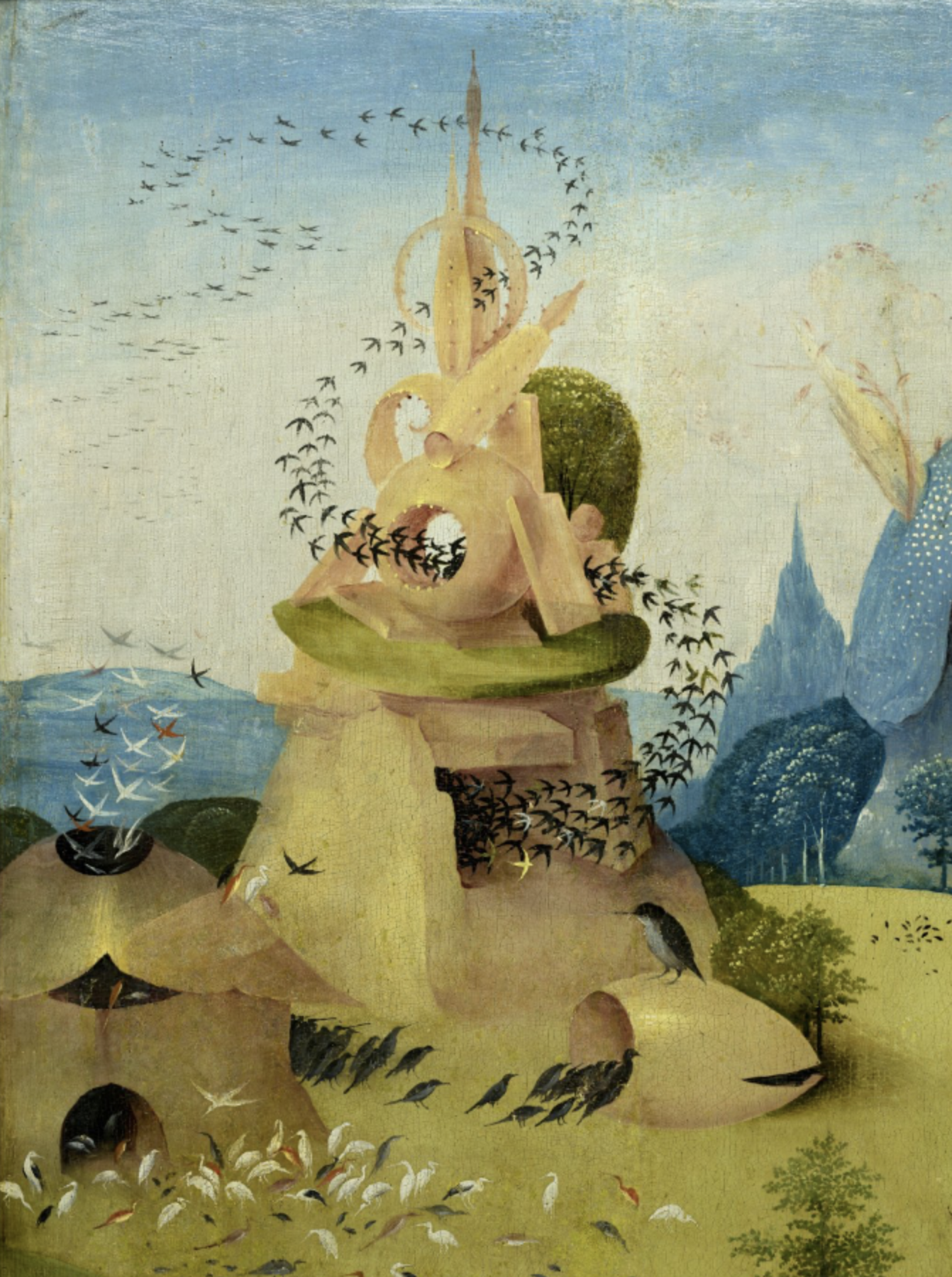
Flight, Desire, and the Symbolic Sky of Bosch.
Among the numerous strange creatures that populate Hieronymus Bosch’s The Garden of Earthly Delights, birds occupy a particularly unsettling position. They appear everywhere: perched on impossible structures, carrying fruit, swallowing human beings, spying from shadows, or gliding silently through the painting’s dreamlike spaces. Some are recognisable species, while others seem hybrid, distorted, or entirely invented. Bosch does not paint birds merely as decorative elements of nature. In his world, they become psychological presences, symbols of appetite, temptation, surveillance, vanity, sexuality, and spiritual instability.
The symbolism of birds in medieval painting was already ancient by Bosch’s lifetime. Christian manuscripts, bestiaries, sermons, and folklore had associated different species with virtues and sins for centuries. Doves symbolised purity and the Holy Spirit. Owls suggested darkness, ignorance, or hidden knowledge. Ravens were linked to death and corruption. Peacocks represented vanity and earthly pride. Bosch inherited this symbolic vocabulary, but he transformed it into something far more ambiguous and unsettling. In The Garden of Earthly Delights, birds are no longer simple moral emblems. They become actors in a mysterious theatre of human desire.
One of the most striking aspects of the triptych is the sheer density of avian life. Birds appear in all three panels: Eden, the central garden, and Hell. In Paradise, they seem relatively natural, though even there their presence already hints at instability. The world Bosch paints is beautiful but fragile, balanced delicately between innocence and catastrophe. Some scholars have identified cranes, ducks, kingfishers, woodpeckers, hoopoes, and herons among the many species represented. Bosch was astonishingly observant. He almost certainly studied real birds directly, perhaps through hunting displays, travelling merchants, illuminated manuscripts, or collections of exotic animals maintained by wealthy patrons.
Yet Bosch rarely paints birds simply as birds. Their scale constantly shifts. Tiny birds suddenly become gigantic. Human beings become smaller than berries or trapped inside shells. A bird may tower over a crowd like a god. This instability of proportion matters deeply. Medieval painters usually organised scale according to spiritual hierarchy. Bosch disrupts that order deliberately. The result is a world where desire has altered reality itself.
In the central panel, the famous garden of pleasure, birds become increasingly linked to erotic symbolism. Throughout medieval Europe, birds often carried associations with sexuality and courtship. Their songs, nesting rituals, and mating displays made them natural metaphors for seduction. Bosch intensifies these associations dramatically. Birds emerge beside nude couples, hover near oversized fruit, or participate directly in bizarre scenes of sensuality.
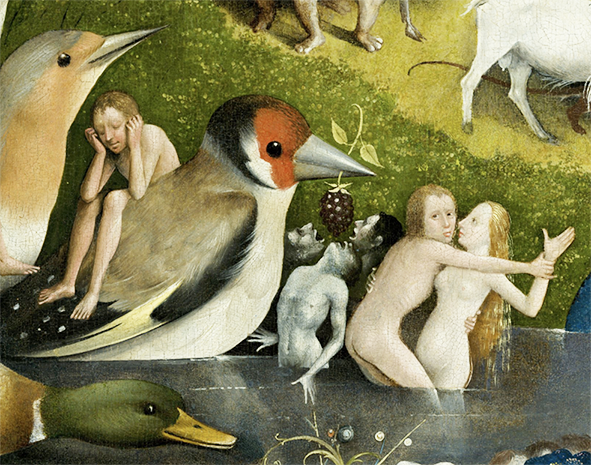
One recurring theme is consumption. Human figures feed birds, are fed by birds, or are swallowed by them. The act of eating becomes inseparable from lust. Bosch repeatedly links appetite of the body with appetite of the soul. In one extraordinary detail, a gigantic bird-like creature devours human beings while excreting them into a pit below. This image reaches its full horror in the Hell panel, where the famous “Prince of Hell” appears as a monstrous bird seated upon a throne-like toilet. The creature consumes the damned and expels them into darkness. Here Bosch transforms the elegant symbolism of flight into something grotesque and humiliating. Spiritual elevation has become digestion.
The owl deserves special attention. Bosch places owls throughout his paintings, and The Garden of Earthly Delights is no exception. To modern viewers, owls often symbolise wisdom, but medieval symbolism was far more suspicious. Because owls are nocturnal creatures that avoid daylight, they frequently represented spiritual blindness, hidden sin, deception, or heresy. Bosch repeatedly places owls in dark cavities, hollow spaces, or hidden corners, as though they are silent observers of human corruption.
Yet the owl in Bosch is never entirely simple. It also possesses an eerie intelligence. It watches. It knows. Some scholars have suggested that Bosch’s owls may hint at forbidden knowledge or spiritual ambiguity. In this sense, the bird becomes deeply unsettling because it refuses to behave like a fixed symbol. It remains suspended between wisdom and evil, awareness and corruption.
Flight itself carries profound meaning in the painting. Human beings cannot fly naturally, yet Bosch fills the triptych with images of levitation, gliding, riding animals, floating fruits, and impossible movement through air and water. Medieval spirituality often imagined the soul as aspiring upward toward heaven, but Bosch questions whether humanity truly deserves ascent. His skies are crowded, unstable, and feverish. Flying creatures move not toward divine harmony but toward confusion.
This tension becomes especially important when one considers the structure of the triptych as a whole. The left panel begins with divine creation. The centre descends into intoxication and sensual excess. The right panel collapses into torment and punishment. Birds accompany humanity throughout this journey. They witness the Fall, participate in pleasure, and dominate Hell itself. In many ways, they function almost like spiritual barometers, revealing the moral temperature of each world.
Bosch may also have been fascinated by the psychological freedom birds represent. Birds move across boundaries impossible for humans. They cross land, water, and sky effortlessly. In medieval imagination, flight often symbolised transcendence, liberation, or mystical experience. Yet Bosch turns this dream into something unstable. His birds are rarely serene. They stare, consume, spy, carry burdens, or mutate into monsters. Freedom itself becomes dangerous.
The exoticism of certain birds is equally important. During Bosch’s lifetime, Europe was becoming increasingly aware of distant lands through trade and exploration. Rare animals arriving from Africa or Asia created fascination and anxiety. Strange birds represented both wonder and the unknown. Bosch exploits this atmosphere masterfully. Some creatures in the triptych seem almost tropical or fantastical, suggesting a world expanding beyond familiar moral boundaries.
At times, Bosch even blurs the distinction between human and bird entirely. Bodies imitate beaks, heads emerge from feathers, and hybrid creatures dominate the Hell panel. These transformations reflect one of Bosch’s deepest obsessions: the collapse of stable identity. Sin does not merely corrupt behaviour; it alters the structure of reality itself. Humans become animal-like because desire has consumed reason.
And yet, despite all this darkness, the birds also contribute enormously to the painting’s strange beauty. Bosch understood movement brilliantly. Wings create rhythm across the composition. Feathers introduce flashes of colour and texture. The eye moves constantly through the painting as though following migrating forms across a dream. Without the birds, the triptych would lose much of its vitality and visual music.
Perhaps this explains why the painting remains so haunting. Bosch does not present nature as innocent decoration. He presents a living cosmos saturated with symbolic intelligence. Every creature participates in meaning. Every feather may conceal a warning.
In The Garden of Earthly Delights, birds become mirrors of humanity itself. They embody longing, appetite, curiosity, vanity, and the dream of escape. They rise into the sky, yet remain chained to instinct. Bosch seems to ask a terrifying question beneath all the colour and invention: what if humanity also longs to fly, but carries Hell within its own wings?
Juan de Barrientos