

Bosch and Owls
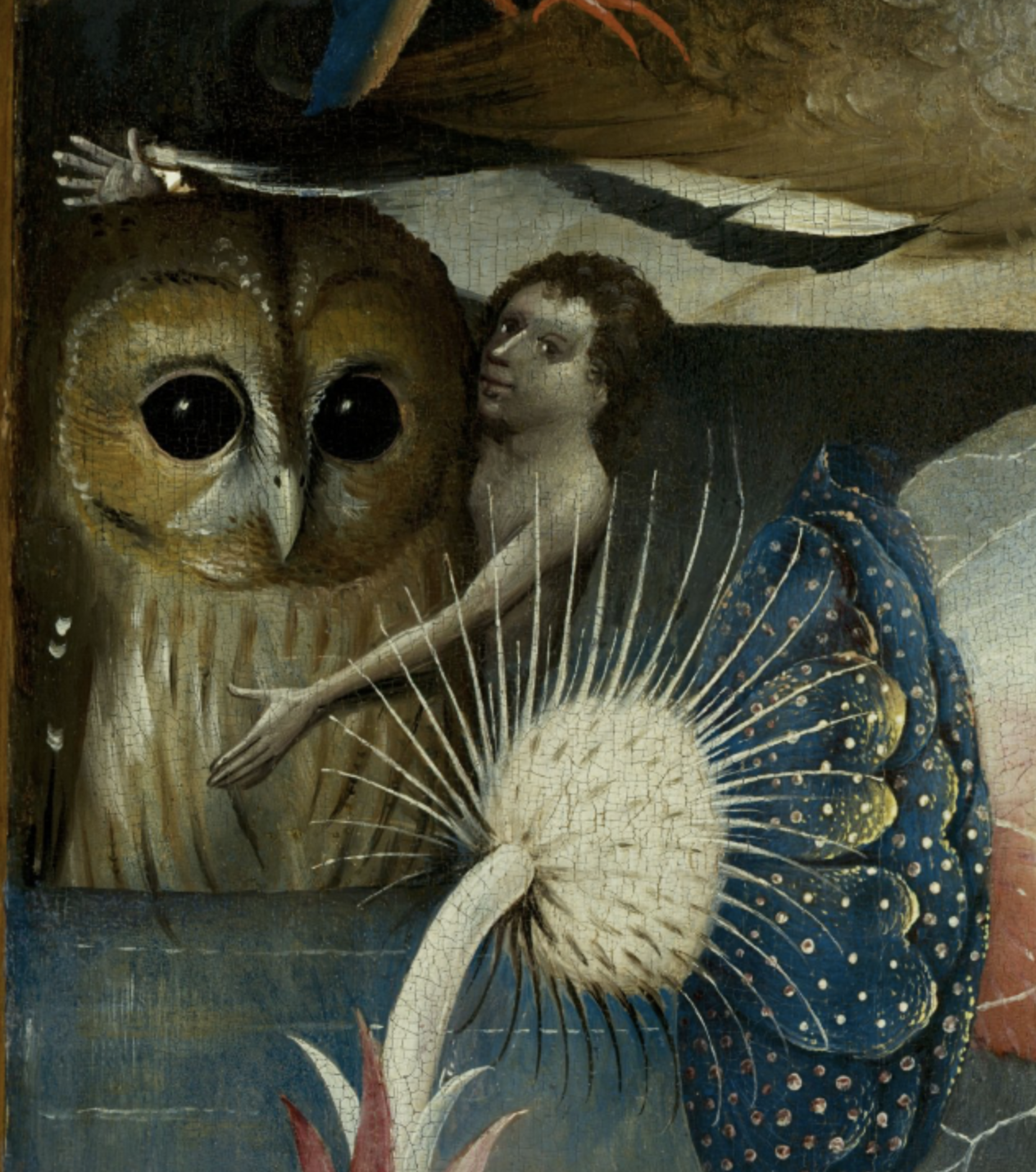
Owls in The Garden of Earthly Delights: Wisdom, Darkness, and the Eyes of Bosch
Among the numerous animals inhabiting Hieronymus Bosch’s The Garden of Earthly Delights, none appears with more symbolic insistence than the owl. Hidden inside hollow structures, staring from shadows, or emerging silently from impossible architecture, the owl becomes one of the most psychologically charged creatures in the entire triptych. Modern viewers often instinctively associate owls with wisdom, intelligence, or philosophical contemplation, inherited largely from the Classical Greek tradition of Athena. Yet Bosch’s owls belong to a darker world. In Bosch, the owl does not illuminate truth. It watches from the edge of corruption.
The Garden of Earthly Delights was painted around 1490–1500, though Bosch himself almost certainly never used that title. Over the centuries the painting acquired various names related to lust, earthly sins, or the madness of humanity. Today the title emphasizes the seductive beauty of the central panel, but Bosch’s vision is far more unstable than the modern name suggests. Paradise, pleasure, and damnation bleed into one another continuously. The owl operates precisely within these unstable borders.
Owls appear repeatedly throughout the triptych. One of the most famous examples can be found in the left panel, inside the strange pink fountain-like structure of Paradise. Even before humanity has fully entered corruption, the owl is already present. This is deeply significant. Bosch inserts the creature into Eden itself, suggesting that darkness or spiritual ambiguity may already exist within creation.
Additional owls appear in the central panel, concealed among vegetation and bizarre organic structures. They are often partially hidden, requiring careful observation. This concealment matters. Bosch’s owls are rarely triumphant symbols placed openly before the viewer. They lurk. They observe. They remain half-discovered.
In medieval Northern Europe, the symbolism of the owl differed profoundly from the modern popular image of the wise bird. Unlike the Greek owl of Athena, medieval owls often represented spiritual blindness, sin, heresy, deception, or creatures of darkness fleeing divine light. Because owls are nocturnal and emerge in silence, they became associated with hidden knowledge and morally ambiguous forms of perception.
Bosch inherited this symbolic tradition, but he transformed it into something far more psychologically complex.
In Classical Greece, the owl carried noble associations. Athena, goddess of wisdom and strategic intelligence, was closely connected with the owl, particularly the little owl common around Athens. Coins from ancient Athens frequently displayed the bird as a civic emblem. Here the owl symbolized clarity, prudence, and intellectual vigilance.
Bosch overturns this tradition almost completely.
His owls do not suggest enlightened philosophy. Instead, they evoke a gaze detached from morality. They see within darkness, but the knowledge they possess is uncertain and disturbing. Bosch seems fascinated by the possibility that perception itself may become corrupted.
This inversion becomes particularly powerful when compared to the surrounding chaos of the central panel. Human beings pursue pleasure obsessively: consuming fruit, embracing one another, riding strange animals, and engaging in endless circular movement. Yet amid this delirium, the owls remain strangely still. They do not participate. They observe.
That stillness gives them extraordinary authority.
The owl becomes less an animal than a consciousness hidden within the painting.
One of the most debated figures in the triptych is the so-called Bird-Man or Bird Monster seated in the Hell panel. Many historians have linked this infernal creature to Bosch’s owl symbolism. Although the creature does not anatomically resemble a conventional owl completely, its gigantic black eye and nocturnal appearance suggest an extension of the same symbolic world.
Recent comparisons with nocturnal birds such as nightjars and potoos have complicated the discussion further. The Bird-Man possesses long facial bristles around the beak, features more closely resembling nightjars than European owls. This is important because Bosch was not painting zoological illustrations. He painted symbolic hybrids designed to generate unease.
The result is not a species but an atmosphere.
Bosch’s birds belong to the psychology of darkness.
This psychological dimension explains why modern thinkers such as Carl Jung remain relevant to interpreting Bosch. Jung believed that certain images recur across cultures because they emerge from deep structures of the collective unconscious. Creatures of the night frequently symbolize hidden aspects of the psyche: instincts, fears, forbidden knowledge, or repressed perception.
From a Jungian perspective, Bosch’s owls may represent consciousness entering forbidden territory. The owl sees what daylight conceals. It penetrates darkness. Yet this vision comes at a price. Knowledge becomes inseparable from anxiety.
The eyes of Bosch’s owls are particularly important. Again and again, Bosch exaggerates their stare. They appear awake while humanity sleeps morally. In some cases, they almost seem aware of the viewer outside the painting itself.
This produces one of Bosch’s most unsettling effects.
The spectator is no longer merely observing the painting.
The painting observes the spectator.
Bosch understood that vision itself can be frightening. To be seen completely is terrifying. The owl therefore becomes a symbol not only of hidden evil, but of hidden awareness. It embodies the uncomfortable possibility that human beings are transparent before spiritual judgment.
Yet Bosch never allows symbolism to become mechanically simple. His owls remain ambiguous. They are dark, but they are also intelligent. They may represent evil, but they also reveal truth about human behavior. Bosch does not reduce the creature to a moral label.
This ambiguity partly explains the painting’s continuing fascination. The owls resist closure. They feel ancient, almost pre-Christian, carrying echoes of forgotten mythologies older than theology itself.
Indeed, the tension between pagan and Christian symbolism may be one reason the owl functions so powerfully in the triptych. The Greek world associated the owl with wisdom and divine intelligence. Medieval Christianity often associated it with spiritual darkness. Bosch allows both meanings to coexist uneasily.
The creature sees.
But what does it know?
Perhaps Bosch himself did not fully answer that question.
What makes the owls unforgettable is not merely their symbolic meaning, but their emotional effect. They introduce silence into chaos. While bodies move frantically across the painting, the owls remain motionless. While humanity indulges itself, the owl waits.
That waiting feels eternal.
Five centuries later, Bosch’s owls continue to stare outward from the shadows of the triptych, neither entirely demonic nor entirely wise. They belong to a threshold between knowledge and corruption, vision and blindness, revelation and nightmare.
And perhaps that uncertainty is precisely what Bosch wanted.
Juan de Barrientos