

The Panel for the Garden of earthly delights
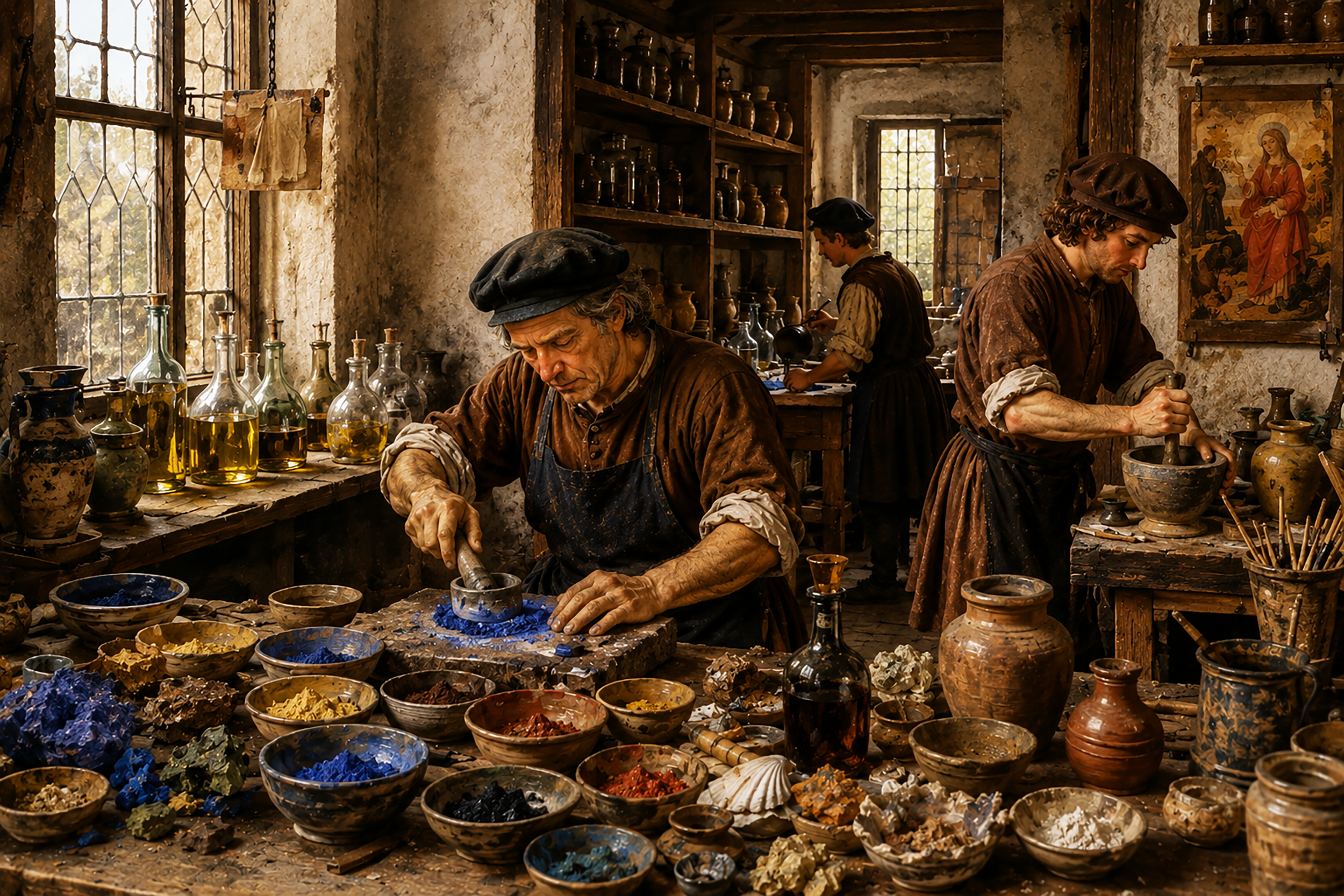
The Workshop of Hieronymus Bosch
Wood, Pigments, Grisaille, and the Cost of Wonder
Few painters in history feel as mysterious as Hieronymus Bosch. His visions appear almost supernatural: hybrid creatures, transparent spheres, impossible architecture, giant birds swallowing men, and musical instruments transformed into devices of torment. Yet behind these dreamlike inventions stood something practical — a workshop, expensive materials, skilled labor, and a disciplined technical process. Bosch was not merely a visionary. He was also an exceptional craftsman working within the sophisticated artistic world of the late fifteenth and early sixteenth centuries.
To understand The Garden of Earthly Delights, one must recognize that paintings like this were luxury objects. They required costly wood panels, imported pigments, oils, assistants, merchants, and wealthy patrons capable of financing years of labor. The strange paradise Bosch created emerged not from chaos, but from extraordinary technical control.
The Garden of Earthly Delights, today housed in Madrid’s Museo del Prado, is a triptych painted in oil on oak panels. Northern European painters of Bosch’s period usually worked on wood rather than canvas. Canvas already existed during Bosch’s lifetime, especially in Venice, yet Northern painters still preferred oak panels. Wood offered an extraordinarily smooth and stable surface ideal for Bosch’s microscopic detail and delicate glazing techniques.
Bosch used Baltic oak imported through major commercial trade routes connected to the Hanseatic world. Oak was valued because it was hard, resistant, and relatively stable over time. Preparing a panel was a slow process. The wood had to dry for years to reduce warping and cracking.
Several planks were joined together and reinforced at the back. Over the surface, painters applied layers of animal glue and chalk gesso, sanding repeatedly until the panel became smooth almost like ivory. Only then could the artist begin drawing.
The choice of wood also transformed the triptych into a massive physical object. Painted on thick oak panels and reinforced structurally from behind, The Garden of Earthly Delights likely weighs several hundred kilograms. Opening its wings would not have been a casual gesture, but an almost ceremonial act.
Modern infrared studies reveal that Bosch drew extensively beneath the paint surface. These underdrawings show an artist thinking dynamically, altering figures during the creative process. Bosch experimented directly on the panel, changing forms and improvising details as he worked. This may be one reason his paintings still feel alive: they retain traces of invention.
One of the most fascinating technical elements of Bosch’s triptych is the exterior grisaille. When the wings are closed, the viewer does not initially see the colorful world of paradise and damnation. Instead, Bosch presents a restrained monochromatic image of the Earth during Creation, painted in grey tones known as grisaille. The effect resembles sculpture rather than painting.
Grisaille served several purposes in Northern art. It demonstrated technical mastery, created dramatic contrast with the brilliant interior colors, and reinforced symbolic meaning. Opening the triptych became almost theatrical: the muted exterior suddenly exploded into living color.
The pigments themselves were extremely expensive. Bosch used azurite for blues, vermilion for reds, lead-tin yellow, malachite greens, ochres, carbon blacks, and delicate organic lakes derived from insects or plants. Ultramarine, derived from lapis lazuli imported from Afghanistan, was among the most precious substances available to painters, sometimes worth more than gold.
Oil paint itself was still relatively advanced technology in Northern Europe. Oil allowed transparency, luminosity, and microscopic detail. Bosch exploited these properties brilliantly. Tiny highlights, translucent fruits, reflective water surfaces, feathers, scales, and glass-like structures all depend upon thin oil glazes layered patiently over time.
Did Bosch work alone? Probably not entirely. Like most successful painters of his era, Bosch likely maintained a workshop with assistants and apprentices. Assistants prepared panels, mixed pigments, copied secondary details, and perhaps painted less important passages. However, scholars generally believe the central imaginative scenes were executed directly by Bosch himself.
Bosch also benefited from relative financial security. His marriage into a prosperous family appears to have elevated his social position and may have provided the stability necessary for such ambitious works. This differs greatly from the modern myth of the isolated and impoverished artistic genius.
The workshop system was standard in Renaissance Europe. Patrons paid not merely for labor, but for the intellectual authority of the master’s invention. Bosch’s name itself became valuable. Copies and imitations of his works circulated widely after his death, evidence that collectors desperately wanted “Boschian” imagery.
The Garden of Earthly Delights was probably commissioned by a wealthy noble family connected to the Burgundian-Habsburg court culture of the Low Countries. Such paintings were elite objects designed for private contemplation among educated aristocrats.
Bosch died in 1516, long before Philip II of Spain became the great collector associated with his work. Yet Philip later became one of Bosch’s greatest admirers, transferring several of his paintings to El Escorial. Philip viewed Bosch not as a painter of fantasy, but as a profoundly moral and religious artist whose terrifying visions reflected the corruption of humanity.
How much did The Garden of Earthly Delights cost? No surviving invoice gives an exact figure, but it would have been extraordinarily expensive. The materials alone were luxurious. Add years of labor, workshop assistants, imported pigments, and Bosch’s fame, and the triptych becomes comparable to a major aristocratic commission.
Bosch lived in the Dutch town of ’s-Hertogenbosch, from which his artistic name derives. His real name was Jheronimus van Aken. He belonged to a family of painters and was also a respected member of the Illustrious Brotherhood of Our Blessed Lady.
Today, visitors to ’s-Hertogenbosch can still sense something of Bosch’s world. The city preserves medieval streets, canals, Gothic towers, and the atmosphere of the northern Renaissance. A museum dedicated to Bosch and his artistic universe stands there today.
And perhaps that is the final surprise. For all the apparent madness of Bosch’s imagery, his art was rooted in discipline, material knowledge, and technical sophistication. Beneath every monster lies careful draftsmanship. Beneath every hallucination lies craftsmanship and patience. Bosch did not paint chaos accidentally. He constructed it deliberately, layer by layer, with some of the finest materials and techniques available in Renaissance Europe.
That may be why the paintings continue to disturb us. They are not random dreams. They are dreams built with precision.
Juan de Barrientos