

Bosch, how was his personality?
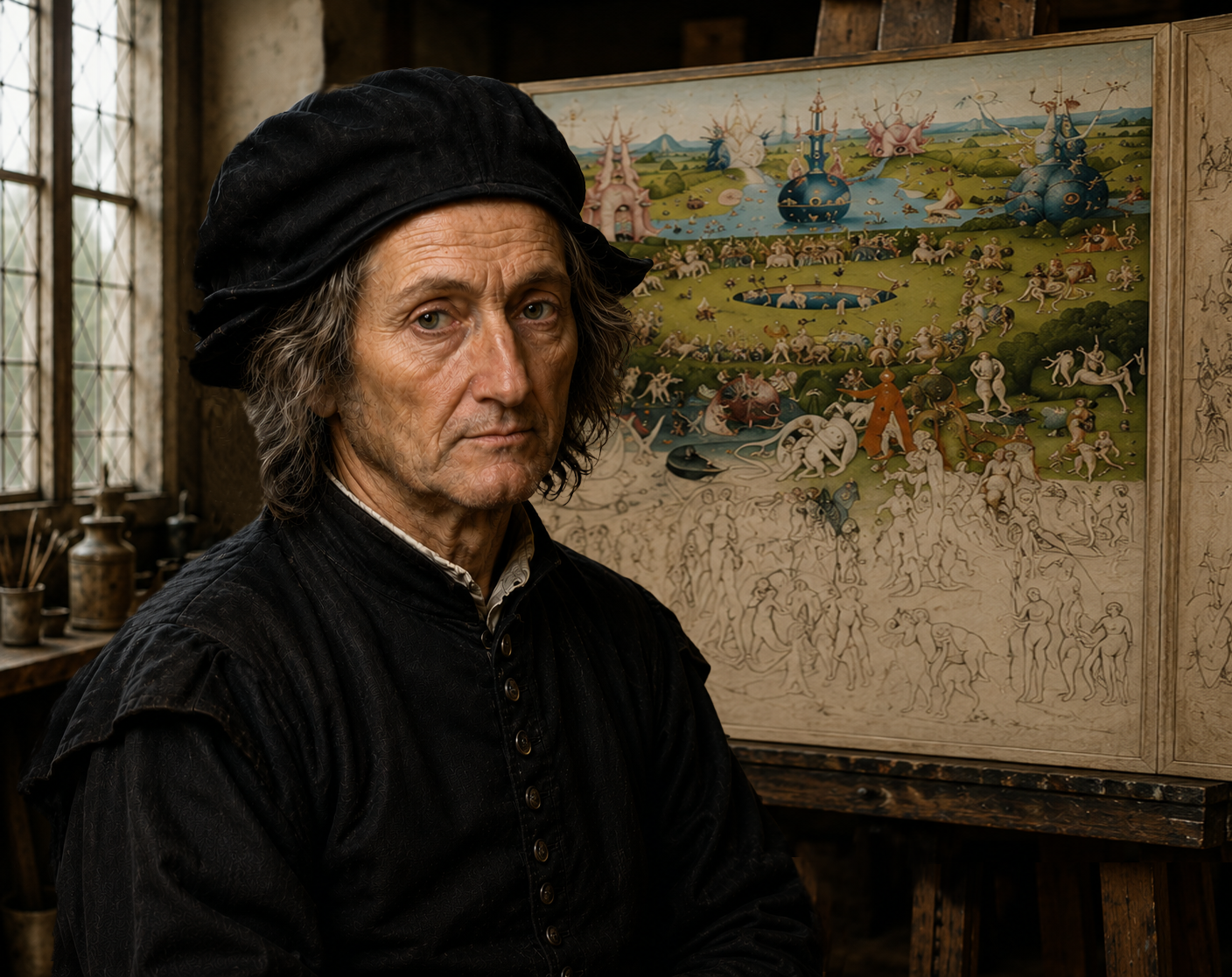
The true personality of Hieronymus Bosch remains frustratingly elusive. Unlike Michelangelo, Leonardo, or Dürer.
To my knowledge, Bosch left behind no personal writings, theoretical treatises, or revealing correspondence. We possess no diary, no confessional notebook, no intimate autobiography. Even his face survives only through uncertain portraits and copies. History preserves fragments: legal documents, guild records, confraternity memberships, commissions, inheritance traces, and scattered references from observers. The result is strangely appropriate. Bosch himself painted worlds in which identity dissolves into masks, and symbolic transformations.
And yet personality leaves traces.
Not always through direct testimony, but through rhythm, obsession, atmosphere, selection, repetition, and symbolic instinct. Paintings are not psychological X-rays, but they are rarely neutral objects either. Certain temperaments organize reality in recognizably different ways. Bosch’s imagination possesses such unusual coherence that one begins, cautiously, to sense the structure of a mind behind the images.
From a Jungian perspective, Bosch appears deeply preoccupied with what Carl Jung would later call the shadow: the hidden, repressed, instinctual dimension of human existence. Few painters before Bosch descended so insistently into psychic darkness without fully surrendering to it. His paintings are crowded with temptation, punishment, grotesque humor, erotic confusion, spiritual anxiety, and bodily vulnerability, yet they rarely collapse into nihilism. Even his infernal scenes retain structure. One senses observation rather than chaos.
Bosch does not paint like a man overwhelmed by madness. He paints like someone studying it.
The precision of his symbolic organization suggests unusual intellectual discipline. His compositions are extraordinarily controlled despite their apparent delirium. The viewer may feel disoriented, but the painter clearly was not. Bosch organizes hundreds of figures simultaneously while maintaining symbolic rhythm across vast surfaces. Such visual intelligence implies concentration, patience, and remarkable internal order.
Was Bosch introverted? Very probably.
Not in the modern sentimental sense of the isolated misunderstood genius, but in the deeper psychological sense of a person oriented toward interior perception. His paintings rarely celebrate heroic public identity. They focus instead upon hidden impulses, collective behavior, moral instability, and private transformation. Bosch appears fascinated by what human beings become when masks weaken.
This sensitivity often accompanies observant personalities rather than socially dominant ones.
Yet Bosch was clearly not socially marginal. Here modern myth becomes misleading. He belonged to the Illustrious Brotherhood of Our Lady, moved within respected civic circles, married advantageously into wealth, maintained a successful workshop, and participated in elite religious culture. Such facts suggest someone capable of navigating sophisticated social environments competently.
One suspects controlled reserve rather than eccentric theatricality.
Perhaps Bosch belonged to that difficult category of personality both socially functional and inwardly detached: the attentive observer present inside society while simultaneously studying it from a slight psychological distance.
His humor also reveals much.
Bosch possesses one of the strangest comic sensibilities in Western art. Today´s viewers sometimes overlook this because the paintings feel so ominous, but many details contain unmistakable absurdity. Musical instruments become torture devices. Monsters wear funnels. Bodies emerge from fruit. Birds swallow humanity mechanically while seated upon chamber pots. The imagination operating here is not merely fearful; it is darkly amused.
Humor of this kind usually emerges not from hysteria, but from intelligence sharpened by observation.
One imagines Bosch noticing vanity, greed, lust, performance, and self-deception with extraordinary attentiveness. The paintings often feel less like fantasies invented arbitrarily than exaggerations extracted from real human behavior.
Was he well educated? Probably more than many older accounts assumed.
Bosch may not have possessed the classical humanist education of certain Italian Renaissance intellectuals, yet his symbolic sophistication strongly suggests broad familiarity with theology, devotional literature, popular folklore, liturgical imagery, bestiaries, proverbs, and religious drama. Medieval intelligence did not necessarily express itself through scholarly essays. Symbolic literacy functioned differently. Bosch belonged to a world saturated with visual theology.
He almost certainly absorbed enormous amounts of information through sermons, ritual, processions, manuscripts, ecclesiastical discussions, confraternity culture, and urban spectacle.
And he remembered everything.
Memory itself seems central to Bosch’s personality. His paintings behave almost like vast symbolic storage systems in which fragments accumulate without losing coherence. The mind behind them appears associative, visually retentive, and unusually sensitive to symbolic transformation.
Jung might have described Bosch as possessing strong intuitive perception. Such personalities often detect patterns beneath ordinary appearances and experience reality less as fixed surface than as layered symbolic field. Bosch repeatedly transforms ordinary objects into psychological signs: knives become threats, fruit becomes temptation, architecture becomes organism, music becomes punishment.
The external world never remains merely external.
At the same time, Bosch’s paintings reveal surprisingly little narcissism. This absence is striking. Many artists project themselves aggressively into their work through heroic signatures, autobiographical symbolism, or displays of intellectual vanity. Bosch rarely does. His paintings observe humanity collectively rather than dramatizing personal genius.
This restraint may reflect religious humility.
Or perhaps something more psychologically interesting: a personality fundamentally more fascinated by systems than by self-display.
There is also a curious emotional temperature in Bosch’s work. Despite all the violence, the paintings rarely feel emotionally hysterical. They feel coldly lucid. Even suffering appears observed with almost clinical calm. The Bird-Man of Hell does not rage; it administers. Demons function like bureaucrats. Punishment unfolds mechanically.
Such imagery suggests a mind acutely sensitive to structure beneath emotional surface.
Jung frequently warned modern audiences against dismissing symbolic imagination as primitive irrationality. For Jung, symbolic images often express profound psychological truths inaccessible to ordinary language. Bosch seems intuitively aware of this centuries earlier. He paints not illustrations of doctrine alone, but psychic conditions.
Desire becomes architecture.
Fear becomes landscape.
Consciousness becomes environment.
One wonders whether Bosch experienced vivid dreams. It is tempting to imagine so, though evidence remains absent. More important is the fact that his paintings possess dream logic without dream confusion. Symbols mutate fluidly while retaining emotional precision. This balance between imagination and control may reveal the deepest aspect of Bosch’s personality.
He appears neither naïvely mystical nor conventionally rational.
Instead, one senses a mind unusually capable of inhabiting symbolic ambiguity without losing intellectual stability.
Was he elegant? In a certain sense, yes.
Not elegant like an Italian courtier, but intellectually elegant. Bosch avoids excess for its own sake despite popular misconception. His paintings are dense, yet carefully structured. Even grotesque imagery is distributed rhythmically. The eye moves through calculated intervals of tension, silence, humor, horror, and stillness.
This requires refinement.
Perhaps the most revealing aspect of Bosch’s personality is his relationship with judgment. Many religious artists condemn humanity aggressively. Bosch rarely feels self-righteous. His paintings expose folly relentlessly, yet they also imply deep familiarity with human weakness. One detects disappointment more than hatred.
This nuance matters psychologically.
People obsessed purely with moral superiority rarely produce such complex images. Bosch’s humanity remains compromised because he understood compromise intimately.
In the end, Bosch resists reduction to modern categories. He was not merely a medieval moralist, proto-surrealist, mystic, pessimist, or visionary eccentric. He appears instead as something rarer: an extraordinarily observant intelligence living at the threshold between medieval symbolism and psychological modernity.
A man capable of looking steadily into the darker regions of the human imagination without entirely surrendering either faith or reason.
And perhaps that difficult balance explains why his paintings still feel so alive.
Juan de Barrientos