

The Key in the Hell panel
The Key in Hell: A Metaphysical Artifact in Bosch's Garden of Earthly Delights
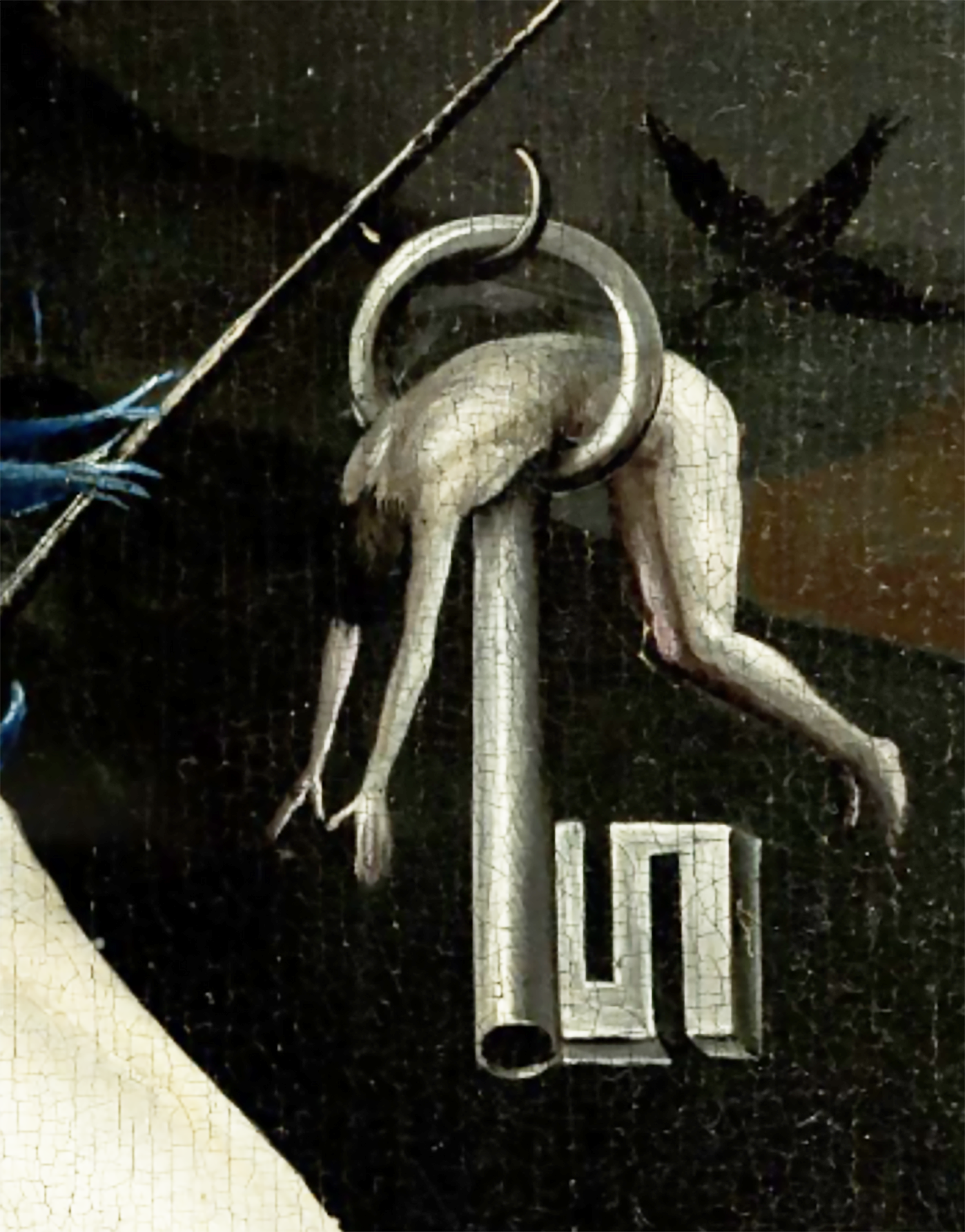
Among Bosch's inventions in the Hell panel, I am especially intrigued by the key; a human figure appears to be hanging, or is he trying to pass through? Overshadowed by the Birdman, the giant musical instruments, and the burning city in the distance, this small detail could easily be overlooked, but I do not think Bosch would enlarge an object without purpose.
Indeed, in the Garden, it is quite important to pay attention to specific figures individually; otherwise, comprehension is not possible. Bosch's triptych is not merely a large painting but a collection of interconnected visual ideas. Many of its details can be studied almost as independent images. The key belongs to this category.
Several scholars have already proposed interpretations of this object. Dirk Bax suggested a sexual meaning. Charles de Tolnay connected it to clerical desire and the violation of celibacy. Jacques Combe interpreted it as a reference to the Key of Knowledge mentioned in Scripture. Other researchers have associated it with the Petrine keys, symbols of spiritual authority and access to the Kingdom of Heaven.
These interpretations establish an important fact: the object was not intended as a simple tool or decorative accessory. It was understood as a symbol.
Jacques Combe's interpretation deserves particular attention. Rather than emphasizing sexuality or clerical criticism, Combe associated the object with the biblical Key of Knowledge. His interpretation points toward Luke 11:52:
Vae vobis legis peritis, quia tulistis clavem scientiae; ipsi non introistis, et eos qui introibant prohibuistis.
"Woe unto you, lawyers! for ye have taken away the key of knowledge: ye entered not in yourselves, and them that were entering in ye hindered."
Modern English renders the passage:
"You did not enter yourselves, and you prevented those who were trying to enter."
The relevance of this text to Bosch's image is striking. The suspended figure appears neither fully admitted nor fully excluded.
A closer examination of the surrounding composition reveals additional elements that deserve attention. Beneath the key lies a large animal skull, apparently equine rather than bovine. Its elongated form dominates the lower portion of the scene. Unlike a living animal, the skull introduces an unmistakable association with death and decay.
Equally important is the hooded blue figure seated upon the skull. Holding a long pole or spear, the figure creates one of the strongest visual lines in the composition. The diagonal shaft extends across the scene and appears to direct the viewer's eye toward the suspended man and the key.
Behind the suspended figure appears a dark winged silhouette. At this scale it is difficult to determine whether Bosch intended a bird, a hybrid creature, or another symbolic form. It may even be a raven or crow-like bird.
The composition therefore revolves around four principal elements: the key, the suspended figure, the great animal skull, and the blue spear-bearing figure.
The key represented by Bosch is not a realistic key. It possesses an unusually large circular opening. Its lower section follows a winding path. Most importantly, it appears to function simultaneously as an object and as a space.
Ordinarily, a key exists to open a door. In Bosch's image, however, the distinction begins to disappear. The key seems to contain its own opening. It becomes not merely an instrument of access but a place of passage.
At first glance, the human figure appears to hang from the circular opening. Gravity is clearly acting upon the body. Yet the viewer is left uncertain whether the figure is emerging, trapped, suspended, or passing through.
Bosch often places his figures in transitional states. The figure associated with the key appears suspended between conditions.
The key may be understood as a symbolic passage.
The figure appears caught within that passage.
The skull introduces mortality.
The blue figure introduces agency.
Together they form a visual drama centred on access, obstruction, and uncertainty.
The lower section of the key twists and bends. The eye is forced to follow a crooked route. The shape evokes not a direct path but a distorted one.
If so, the object ceases to function merely as a key. It becomes simultaneously key, doorway, and path.
The traditional interpretations centered on Petrine symbolism remain relevant. Yet Bosch appears to take that familiar symbol and subject it to a radical transformation.
The key no longer grants access. It no longer opens. It no longer liberates. Instead, it traps.
The image may therefore represent a frustrated spiritual passage.
The possibility of a symbolic concern with access and spiritual destiny becomes even more intriguing when considered alongside Bosch's own name. The artist signed his works as Jheronimus Bosch, adopting the name of his city rather than his family surname, van Aken. Jheronimus derives from the Greek Hieronymos, meaning 'one who bears a sacred name.'
For this reason, the most intriguing interpretation may be that Bosch transformed the traditional key into a metaphysical artifact.
The figure does not appear victorious. Nor does he appear fully condemned in the conventional sense. Instead, he seems caught in a state of struggle.
The key in Hell is not merely a key. It is a metaphysical artifact, suspended between authority and failure, passage and imprisonment, promise and deception.
Juan de Barrientos