

Devotio Moderna
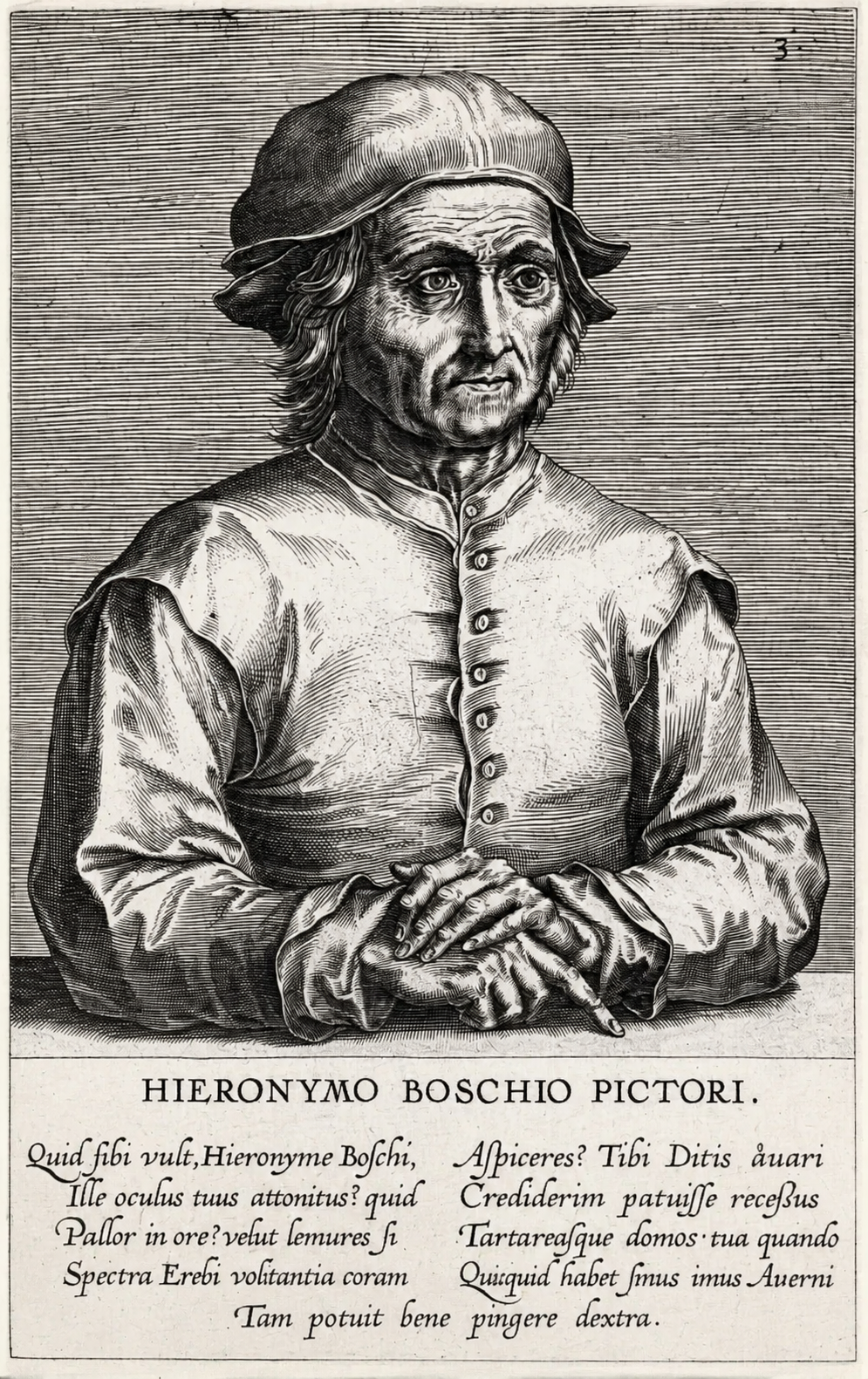
Bosch, Geert Groote, and the Devotio Moderna
The terrifying inwardness of Hieronymus Bosch’s paintings reflects the devotional culture of the Devotio Moderna, where salvation increasingly became a matter of interior struggle. Bosch did not emerge from a primitive or irrational medieval world populated merely by superstition and fear. He emerged from one of the most spiritually introspective environments in late medieval Europe — a civilization becoming intensely concerned with conscience, temptation, inward corruption, and the hidden instability of the human soul.
At the center of this transformation stood Geert Groote.
Born in the fourteenth century in Deventer, Groote was not a revolutionary in the later Protestant sense, but a Catholic reformer deeply disturbed by what he perceived as spiritual superficiality within Christian society. Educated, intellectually sophisticated, and originally connected to elite urban life, Groote eventually underwent a profound spiritual conversion. He began criticizing vanity, clerical luxury, moral negligence, and empty religiosity. Yet his goal was not to destroy the Church. It was to renew Christianity from within.
Groote believed religion had become excessively external. Ritual, ceremony, and institutional authority remained important, but true Christianity increasingly required inward transformation. The believer was expected not merely to obey publicly, but to examine conscience continuously, discipline desire, and cultivate humility internally.
From these ideas emerged the movement known as the Devotio Moderna — “Modern Devotion.” The movement remained fully Catholic and deeply orthodox, yet it transformed religious consciousness throughout the Low Countries and parts of Germany.
The Devotio Moderna encouraged meditation, devotional reading, self-examination, emotional identification with Christ, and moral vigilance. The soul itself became battlefield.
This atmosphere is indispensable for understanding Bosch.
The late medieval Netherlands was one of Europe’s most urbanized and intellectually active regions. Trade expanded rapidly. Manuscript culture flourished. After the invention of movable-type printing by Johannes Gutenberg in the mid-fifteenth century, books and devotional texts circulated with unprecedented speed.
Communities inspired by Geert Groote, especially the Brothers of the Common Life, copied manuscripts, educated students, and helped spread devotional culture throughout Northern Europe. One of the movement’s most influential figures, Thomas à Kempis, wrote The Imitation of Christ, one of the most widely read Christian books in European history.
Bosch almost certainly lived within this atmosphere of inward Christianity.
He belonged to the respected Illustrious Brotherhood of Our Blessed Lady in ’s-Hertogenbosch and almost certainly possessed practical literacy himself. His paintings reveal extraordinary symbolic discipline, theological awareness, and conceptual intelligence. Bosch was not an irrational visionary painting random hallucinations. His imagination was structured, reflective, and morally coherent.
The Devotio Moderna helps explain why Bosch’s paintings feel psychologically intense in ways unusual for earlier medieval art.
Temptation appears fluid. Desire expands gradually. Pleasure transforms almost imperceptibly into punishment. Beauty mutates into grotesque distortion. Human beings drift toward corruption while scarcely noticing the movement occurring within themselves.
This is not merely moral allegory. It is spiritual psychology.
The central panel of The Garden of Earthly Delights embodies this inward instability with extraordinary force. Thousands of naked bodies circulate endlessly among fruit, animals, pools, and erotic encounters. Yet despite the visual abundance, the scene feels spiritually hollow. There is almost no prayer, no liturgy, no transcendence, and no stable metaphysical center.
From the perspective of the Devotio Moderna, this would represent profound spiritual catastrophe. The movement feared precisely this condition: a soul so immersed in sensory life that it gradually lost orientation toward God.
Bosch visualizes distraction itself becoming metaphysical danger.
Even paradise in Bosch feels unstable. In the left panel of The Garden of Earthly Delights, Christ stands beside Adam and Eve before the Fall fully unfolds. Yet strange animals already inhabit the landscape. Creation itself appears fragile, vulnerable to distortion.
The Devotio Moderna transformed Christianity in Northern Europe into something intensely introspective. Believers were encouraged to fear not merely external evil, but the hidden instability within themselves.
Bosch gave visual form to this new spiritual consciousness.
His paintings remain terrifying precisely because they suggest corruption does not always arrive dramatically. It emerges gradually through distraction, vanity, appetite, self-forgetting, and inward drift. Humanity separates itself from spiritual order almost imperceptibly.
He did not paint merely medieval fear. He painted the terrifying possibility that human beings may lose metaphysical orientation from within while continuing to believe themselves perfectly awake.
Juan de Barrientos