

The Apprentice
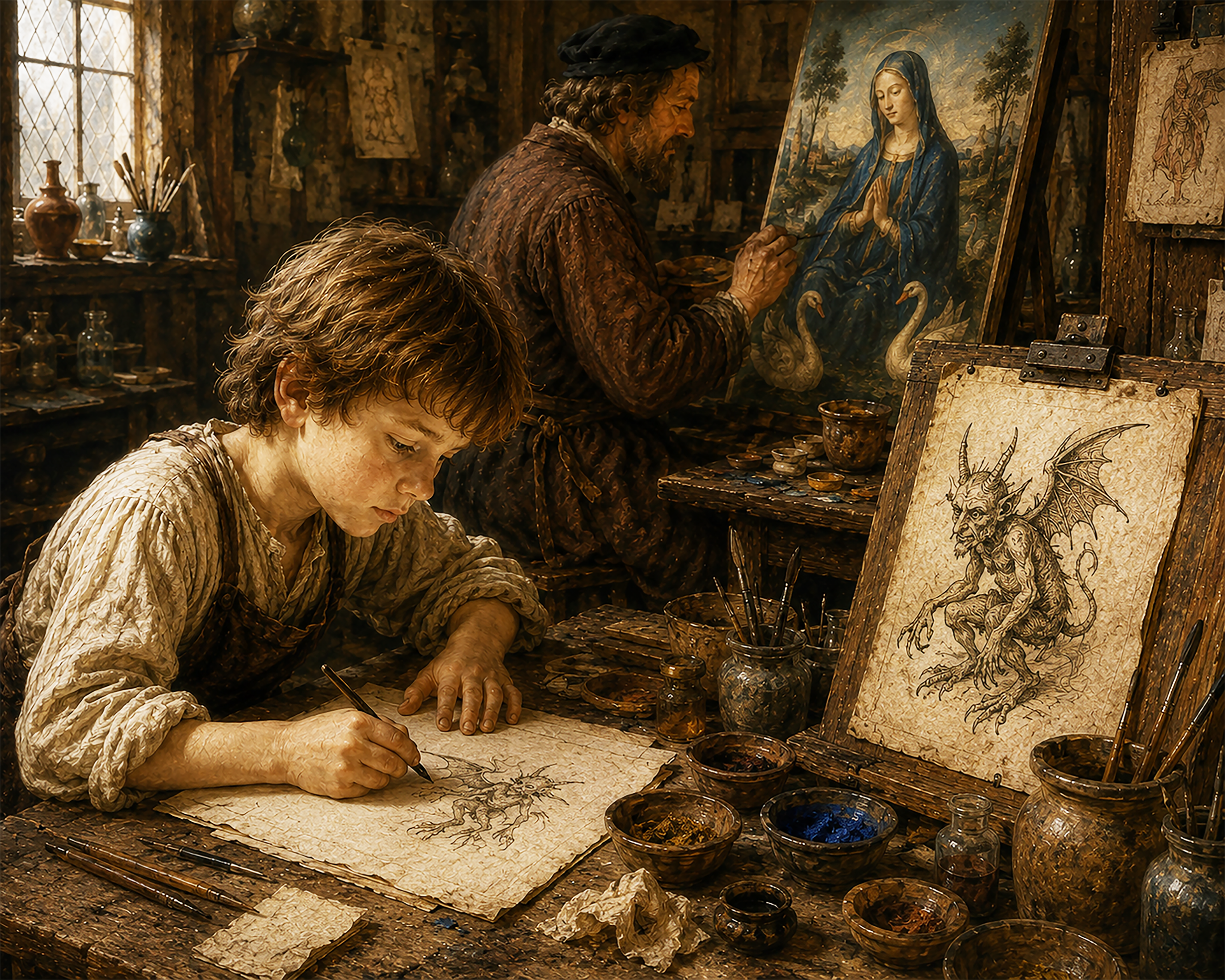
We know little about the childhood of Jheronimus Bosch.
This statement appears repeatedly throughout Bosch scholarship. We do not know the precise date of his birth. We do not know what he looked like as a child. We do not know which family member first taught him to draw. We do not know the exact day he became an apprentice.
Yet perhaps the last question assumes something that may never have existed. In a family workshop, there was often no clear moment when childhood ended and apprenticeship began.
Bosch was born into a family of painters. His grandfather was a painter. His father was a painter. Several of his uncles were painters. Art was not a profession discovered later in life. It formed part of the atmosphere into which he was born. Long before he learned to hold a brush, he may already have been surrounded by pigments, wooden panels, drawings, commissions, tools, and conversations about images.
When we speak of apprenticeship, we often imagine a formal beginning. A boy reaches a certain age. Papers are signed. A master accepts him as a student. Such arrangements certainly existed. Yet life inside a family workshop could be different. Learning often began through proximity rather than ceremony.
One can easily imagine a young Jheronimus, perhaps seven or eight years old, moving quietly through the workshop while older relatives worked around him. He might sweep the floor. He might carry water. He might collect scraps of wood. He might watch in silence as a panel was prepared for painting. No one would have described these activities as artistic training. Yet they formed part of an education that no written contract could record.
I have always been particularly fond of fairy tales, and one of my favourites is The Sorcerer's Apprentice. Most readers know the story through Goethe's famous poem of 1797, later made famous again through Disney's Fantasia. Yet the tale itself is far older. Versions of the story can be traced back to antiquity. At its heart stands a simple image: a young apprentice observing powers he does not yet fully understand. The comparison is not historical. Nevertheless, the tale captures something essential about apprenticeship itself. The apprentice stands at the edge of knowledge, watching, imitating, listening, and gradually understanding the importance of learning. Gradually, the mysteries of the workshop begin to reveal themselves.
A fifteenth-century painting workshop possessed its own form of magic. Powders became colours. Animal skins became glue. Pieces of timber became sacred images. Blank surfaces gradually filled with figures, animals, landscapes, and stories. To a child, these transformations must have seemed extraordinary. The workshop was not merely a place of labour. It was a place where materials appeared to change their nature before one's eyes.
Perhaps the future creator of The Garden first experienced painting not as an art but as a mystery. We know that drawing formed the foundation of artistic training. Before invention came observation. Before imagination came discipline. A child might begin by copying simple forms: straight lines, curves, leaves, folds of cloth, hands, animals, and faces. The exercises were repetitive. The goal was not originality but accuracy. There is a beautiful paradox here.
The creator of some of the most imaginative images in Western art may have begun by drawing the same simple forms hundreds of times.
Paper existed during Bosch's lifetime and was becoming increasingly available throughout Europe. Yet it was still valuable. Young apprentices often practised on inexpensive sheets, reused materials, or discarded workshop sketches. Many early exercises were never intended to survive. Indeed, the first drawings Bosch ever made may have disappeared before he reached adulthood.
The same is true of countless other traces of his childhood. We do not know which birds, animals, plants, or tales captured his attention. What we do know is that he grew up in a city filled with visual stimuli. Merchants arrived from distant regions. Pilgrims passed through the town. Religious processions filled the streets. Animals were bought and sold in markets. The world entered the city in countless forms. A child possessing unusual powers of observation would have found no shortage of material.
This point deserves emphasis because the strange inventions of Bosch did not emerge from a vacuum. The owl, the fish, the horse, the bird, the tree, the reptile, and the human face all existed before they were transformed within Bosch's visual universe. The extraordinary often begins with the ordinary. Perhaps this is why the image of the apprentice remains so compelling.
When we stand before The Garden, we naturally think about the master. We think about genius, invention, symbolism, and meaning. Have we ever asked ourselves what that child was like? Yet every master was once a child. Every accomplished hand was once uncertain; every confident line was once hesitant. Before Bosch became Bosch, he was a boy moving through a family workshop, surrounded by sights, sounds, and materials whose significance he could only partly understand. Knowledge entered gradually. Surely, this process took time.
Juan de Barrientos