

The Garden Architectures, part I
The Garden's Architectures – Part I
Five Centuries of Looking at Bosch
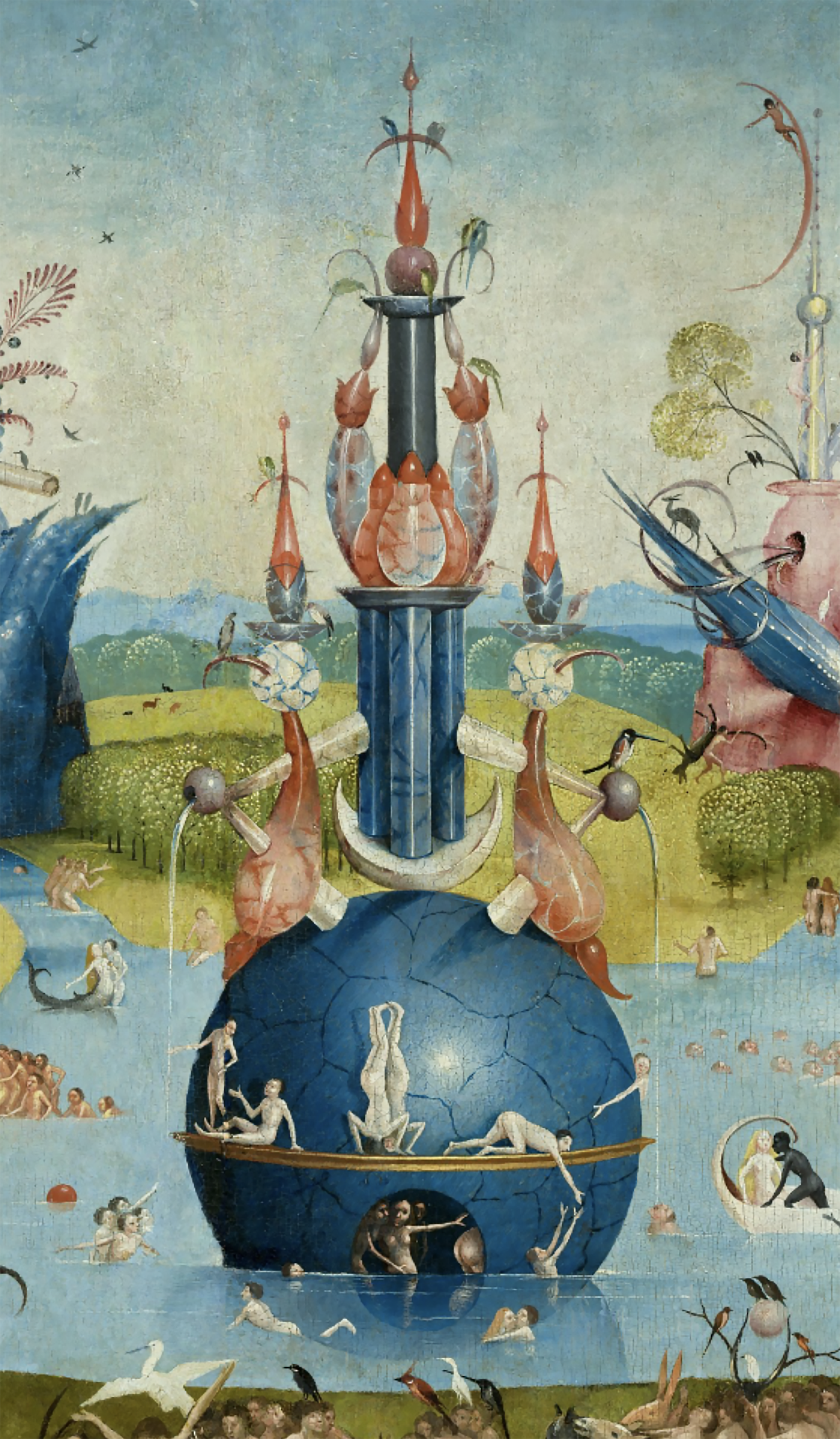
As an architect, I find Bosch's extraordinary structures among the most fascinating elements of the triptych. Over the years, I have developed my own observations, questions and hypotheses about them, some of which have appeared in previous essays. Yet before travelling further down that path, it is important to listen carefully to a conversation that has continued for more than five centuries.
Many distinguished scholars have devoted years, and sometimes entire careers, to the study of these enigmatic forms. Their conclusions often differ, sometimes dramatically, yet each has contributed something valuable to our understanding of Bosch's masterpiece. Whether one ultimately agrees with their interpretations or not, it would be unwise to ignore their observations.
Hidden Prado essays are usually concise. This one will be an exception. Attempts to explain Bosch's remarkable structures span more than five centuries and involve some of the most influential figures in Bosch scholarship. Rather than compress that conversation into a single article, I have chosen to divide it into two parts.
The purpose of this essay is not to determine which interpretation is correct. Rather, it is to examine how different generations of observers have approached the same visual problem. The blue fountain that dominates the left panel and the extraordinary constructions that appear throughout the central panel have inspired a remarkable variety of explanations. They have been studied through theology, symbolism, folklore, psychology, cultural history, visual theory and the broader traditions of Northern European art. Together, these approaches form one of the most fascinating conversations in Bosch studies.
The structures themselves require little introduction. Anyone who stands before The Garden notices them almost immediately. The great blue fountain rises above Paradise like an impossible monument, while curious pink forms emerge throughout the central panel among crowds of figures, fruits, animals and pools. Bosch clearly intended them to be protagonists. They occupy prominent positions within the composition and play an important role in organising the landscape. Yet understanding them has proven far more difficult than simply noticing them.
That difficulty helps explain their enduring appeal. Bosch scholarship contains many disagreements, but few subjects have generated such a wide range of interpretations. To some observers, these forms are primarily symbolic; to others, they are visionary inventions. Certain writers have searched for precise meanings, while others have warned against excessive certainty. Each generation has brought new questions, methods and assumptions to the problem. The history of these structures therefore reveals more than changing interpretations of a painting. It also reveals changing ways of looking at Bosch himself.
The First Observers
Bosch died in 1516. The Garden of Earthly Delights had already begun the long journey that would eventually transform it into one of the most studied paintings in the world.
The earliest observers approached the triptych very differently from those of us who study it today. They did not possess the analytical tools of art history, nor did they necessarily separate individual motifs for independent examination. The painting was viewed as a whole, and its moral message attracted far more attention than its countless details. As a result, the earliest surviving descriptions tell us relatively little about the structures themselves.
Inventories and collection records acknowledge the painting's extraordinary imagery, but rarely pause to explain specific forms. The focus remains on the overall effect. The triptych appears primarily as a moral and religious work whose many details contribute to a broader narrative concerning humanity, temptation and divine judgement.
This should not surprise us. The discipline of art history did not yet exist in its modern form. Collectors, patrons and chroniclers approached paintings differently. They were generally less interested in decoding individual visual elements than in understanding the overall message conveyed by the work.
The remarkable constructions therefore remained both visible and unexplained. Although they were clearly noticed, they attracted relatively little independent analysis. For several centuries, that situation changed surprisingly little.
Before Art History
During the seventeenth and eighteenth centuries, Bosch's reputation fluctuated. Admirers praised the richness of his imagination, while others regarded his imagery as eccentric or bizarre. Yet even as opinions changed, systematic attempts to explain these structures remained relatively rare.
Part of the reason may be that Bosch occupied an unusual position within European art. Artists such as Raphael, Leonardo or Titian could be discussed through questions of composition, perspective and classical beauty. Bosch presented a different challenge. His paintings were populated by forms that seemed to resist ordinary categories. Viewers admired them, remembered them and occasionally struggled to explain them. The strange buildings belonged firmly within this group of perplexing inventions.
Although recognised as extraordinary, they were not yet subjected to the sustained investigation that would emerge later. For several centuries, the structures remained visible, admired and frequently reproduced, yet they attracted surprisingly little detailed analysis. Their presence was acknowledged; their meaning remained largely unexplored.
The Romantic Discovery of Bosch
The nineteenth century transformed the situation. Europe developed a growing fascination with imagination, dreams, mystery and the irrational. Writers, artists and intellectuals became increasingly interested in figures who appeared to stand outside conventional artistic traditions. Bosch suddenly looked different. Rather than being viewed primarily as a moralising painter of the late Middle Ages, he began to be seen as a visionary. Various commentators regarded him as a precursor of fantasy, symbolism or other forms of imaginative art that would emerge long after his death.
This shift had important consequences for the structures of The Garden of Earthly Delights. They were no longer regarded simply as strange details within a religious painting but increasingly as evidence of Bosch's extraordinary imagination. The emphasis moved away from moral instruction and towards creative invention. Collectors, writers and scholars admired Bosch's ability to create worlds unlike anything produced by his contemporaries, and the unusual buildings attracted attention because they appeared to belong to those worlds.
Yet the growing admiration for Bosch did not resolve the mystery of the structures. The nineteenth century succeeded in elevating his reputation, but the fundamental questions remained unanswered. What exactly were these forms? Why had Bosch placed them so prominently within the composition? What role did they play within the larger meaning of the triptych? The twentieth century would attempt to answer these questions with unprecedented ambition.
Wilhelm Fraenger and the Transformation of the Debate
No figure occupies a more important position in this story than Wilhelm Fraenger. Born in Germany in 1890, Fraenger was trained in art history but cultivated interests that extended well beyond conventional academic boundaries. Fascinated by symbolism, spirituality, cultural history and alternative intellectual traditions, he approached The Garden of Earthly Delights from a markedly different perspective than many earlier scholars. Rather than viewing Bosch primarily as a moralist, he searched for deeper symbolic structures beneath the visible surface of the image.
Fraenger believed that Bosch's paintings reflected intellectual and spiritual traditions that previous generations had not fully recognised. Unusual details were therefore not treated as imaginative inventions alone, but as meaningful components within a larger symbolic system. For readers encountering Bosch in the middle of the twentieth century, this approach was immensely attractive. Suddenly, the strange structures appeared capable of explanation, and elements that had long resisted interpretation could be examined as part of a coherent network of meanings.
The extraordinary forms of the triptych no longer appeared merely decorative or imaginative. Under Fraenger's interpretation, towers, fountains and other unusual elements could be understood as parts of a deeper symbolic system waiting to be deciphered. Whether one agrees with his conclusions or not, it is difficult to overstate his influence. He fundamentally altered the terms of the debate. Before Fraenger, many observers admired Bosch's imagination; after Fraenger, increasing attention was directed towards the possibility of hidden meanings embedded within the painting. What had previously been regarded as visual curiosities became subjects of serious intellectual inquiry.
Fraenger's books inspired generations of readers and encouraged scholars as well as enthusiasts to look beneath the surface of Bosch's imagery. For many, the triptych became a landscape of possibilities in which seemingly minor details might carry significance beyond their immediate appearance. At the same time, his work raised important methodological questions. Could such elaborate interpretations be supported by historical evidence? How much symbolism could reasonably be attributed to a single image, and where should the boundary between interpretation and speculation be drawn? These questions would become increasingly important as Bosch scholarship matured during the second half of the twentieth century. Even those who strongly disagreed with Fraenger's conclusions often acknowledged the importance of the issues he had brought into the discussion and the seriousness with which he approached Bosch's work.
That achievement alone guaranteed Fraenger a lasting place within Bosch scholarship. Decades after his death, researchers continue to debate his conclusions, reassess his methods and revisit the questions he first brought to prominence. Opinions remain sharply divided, yet his influence is undeniable. Whether regarded as a visionary interpreter, an excessively ambitious theorist or something in between, Fraenger permanently altered the way scholars approached The Garden of Earthly Delights. The history of attempts to explain Bosch's extraordinary structures cannot be written without him, for it was Fraenger who transformed a collection of curious forms into one of the central intellectual debates of Bosch studies.
A Conversation Changes Direction
By the middle of the twentieth century, the discussion surrounding Bosch's extraordinary structures had entered a new phase. The centuries of relative silence were over. What had once been admired primarily as a curious feature of the triptych had become the subject of serious scholarly debate. Researchers increasingly disagreed not only about the answers, but also about the methods required to reach those answers. Much of this transformation can be traced to Fraenger, whose work encouraged readers to search for deeper layers of meaning beneath the visible surface of Bosch's imagery.
Yet Fraenger's influence also provoked a response. As the twentieth century progressed, a new generation of scholars began to question some of his assumptions, challenge his methods and propose alternative approaches to the problem. Their contributions would reshape Bosch studies for decades to come. Fraenger changed the conversation. The scholars who followed changed it again. The history of Bosch's structures therefore became more than a search for answers; it became a debate about how such answers should be sought. That debate continues today, and it is to those later voices that we shall turn in the second part of this essay.
Juan de Barrientos