

The Gardens Architectures Part II
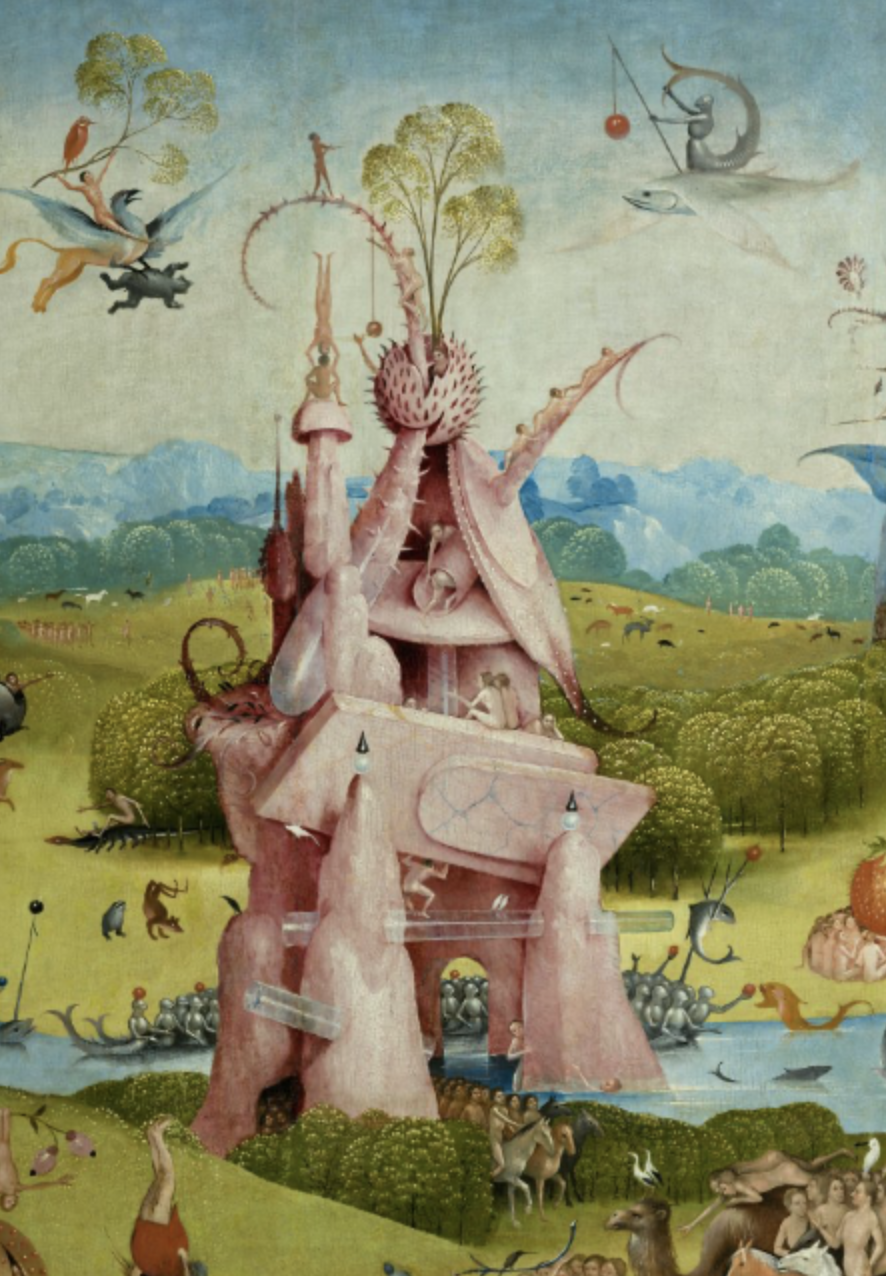
The Garden's Architectures – Part II
The Scholars Respond
At the conclusion of the first part of this essay, we left Bosch scholarship at a turning point. For centuries, the extraordinary structures of The Garden had attracted admiration, curiosity and speculation. Then Wilhelm Fraenger arrived and altered the scale of the discussion. Whether one agreed with him or not, he encouraged readers to search for deeper layers of meaning beneath Bosch's imagery. Fraenger changed the conversation; the scholars who followed changed it again.
What followed during the second half of the twentieth century was not the rejection of Fraenger, but something more interesting. A new generation of scholars began asking different questions. Some challenged his conclusions. Others challenged his methods. Most importantly, many began searching for ways to understand Bosch that relied less upon grand explanatory systems and more upon historical evidence, cultural context and close visual observation.
Ernst Gombrich and the Limits of Interpretation
Among the most influential voices of the twentieth century was Ernst Gombrich. Born in Vienna in 1909 and later associated with the Warburg Institute in London, Gombrich helped shape the discipline of art history for generations. Although Bosch was only one of many subjects that interested him, his approach to interpretation had significant consequences for Bosch studies. Gombrich possessed a healthy scepticism toward overly elaborate explanations. He understood that images could contain symbolism, but he also recognised a danger familiar to every historian: the temptation to explain too much.
This caution proved particularly relevant in the case of Bosch. The strange structures of the triptych invite interpretation almost automatically. Their unusual appearance encourages speculation, and faced with such imagery scholars naturally wish to discover a key capable of unlocking the entire puzzle. Gombrich reminded researchers that not every mystery necessarily conceals a code. Sometimes an image remains partly mysterious because its creator intended it to be so. Sometimes uncertainty reflects the limits of our evidence rather than the inadequacy of our imagination.
This may sound obvious, yet it represented a significant corrective within Bosch scholarship. At a time when increasingly elaborate interpretations were being proposed, Gombrich encouraged a return to discipline and restraint. His contribution was not to solve the mystery of Bosch's constructions, but to remind future scholars that some questions demand caution before they demand answers. If Fraenger expanded the possibilities of interpretation, scholars such as Gombrich helped define its limits. Yet the story did not end with questions of interpretation alone. During the second half of the twentieth century, Bosch scholarship increasingly turned toward history, culture and context.
A Broader Historical Context
As the twentieth century progressed, Bosch increasingly became the subject of serious academic investigation. Researchers explored archival documents, studied the religious climate of the Burgundian Netherlands, examined devotional practices, popular traditions, literary sources and social history, all in an effort to understand Bosch's world more clearly. This broader approach gradually altered the discussion surrounding the structures. Rather than asking exclusively what a particular form symbolised, scholars increasingly asked how it functioned within the intellectual and cultural environment of the late fifteenth century. The conversation expanded beyond symbolism, and questions of historical context became equally important.
Paul Vandenbroeck and Cultural History
One of the most interesting contributors to this broader approach was the Belgian scholar Paul Vandenbroeck. Rather than searching primarily for hidden doctrines or esoteric traditions, he examined the cultural world from which Bosch emerged, treating popular beliefs, customs and visual traditions as essential tools for interpretation. Applied to the structures of The Garden, this perspective encouraged scholars to think less about isolated symbols and more about their place within a wider medieval imagination. Whether one accepts every conclusion or not, Vandenbroeck demonstrated an important principle: understanding an image often requires understanding the society that produced it.
Hans Belting and the Power of Images
Another important voice emerged from a different direction. Hans Belting, one of the most respected art historians of the late twentieth century, became interested not only in artworks themselves but also in the ways images function within human experience. His work encourages us to consider a simple but important possibility: what if the significance of Bosch's structures lies not solely in what they mean, but also in what they do? Many discussions of Bosch begin with the assumption that every unusual form must correspond to a specific concept. Belting's broader approach reminds us that images can operate in more complex ways. They attract attention, create atmosphere, shape perception and influence how viewers experience an entire visual environment. Seen from this perspective, the structures participate in the construction of Bosch's world, and their importance may depend as much upon their visual presence as upon any single symbolic definition. For some readers this approach feels less dramatic than the search for hidden codes; for others it comes closer to the experience of standing before the painting itself.
Reindert Falkenburg and the Active Viewer
Among contemporary scholars, few have contributed more to our understanding of Bosch than Reindert Falkenburg. His work places particular emphasis upon the relationship between the image and the observer, an approach that proves especially valuable when considering the structures of The Garden of Earthly Delights. Rather than treating interpretation as a simple process of extracting information from a painting, Falkenburg reminds us that viewing is an active experience in which the image guides attention, the viewer responds, questions emerge and meanings gradually unfold. From this perspective, Bosch's structures perform an important function regardless of whether they possess a single definitive explanation. They provoke observation, encourage reflection and resist immediate understanding. In other words, they keep the viewer engaged. For anyone who has spent hours studying The Garden of Earthly Delights, this observation feels surprisingly familiar. The structures continue to attract attention precisely because they resist comfortable classification.
Science Enters the Conversation
The conversation did not stop with traditional art history. During recent decades, scientific investigation has transformed our understanding of Bosch's paintings. Infrared reflectography, pigment analysis, dendrochronology and other technical methods, together with projects such as the Bosch Research and Conservation Project, have revealed aspects of Bosch's working methods and materials that previous generations could never have examined. These discoveries have not solved the mystery of the structures, nor was that ever their purpose. Their contribution has been different, but equally valuable. They provide a firmer foundation upon which interpretation can proceed, allowing speculation to be tested against stronger evidence. The conversation continues, but it now does so with tools that Bosch scholars of earlier generations could scarcely have imagined.
What the Debate Teaches Us
After surveying more than a century of scholarship, one observation becomes difficult to ignore: the structures continue to resist consensus. This should not be interpreted as failure. On the contrary, it reveals something important about both Bosch and the history of art. Different scholars approached the same visual problem using different intellectual tools. Fraenger searched for symbolic systems, Gombrich emphasised caution, Vandenbroeck explored cultural context, Belting examined the power of images and Falkenburg focused upon the active role of the viewer. Each illuminated part of the problem, yet none eliminated the mystery entirely. Perhaps this is precisely why the conversation remains alive. Had the structures possessed an obvious explanation, the debate would have ended long ago. Instead, each generation discovers new reasons to return to them.
The Conversation Continues
As an architect, I suspect these structures will continue to attract my attention for many years to come. They remain among the most remarkable visual inventions within the triptych, and I suspect I shall return to them many times in the future. Yet one lesson emerges clearly from studying the history of their interpretation: no serious investigation begins in isolation. Before offering our own observations, it is worth listening to those who have spent decades studying the same problem. Their conclusions may differ, their methods may conflict and their assumptions may not always coincide with our own. Nevertheless, each contributes to a conversation that has now continued for more than five centuries. The history of these structures is therefore more than a history of interpretation. It is the story of generations of thoughtful observers attempting to understand one of the most extraordinary images in Western art. The buildings remain, the questions remain, and perhaps that is part of their enduring power.
Juan de Barrientos