

The Garden, Provenance
The Journey of a Masterpiece: How The Garden of Earthly Delights Reached Spain
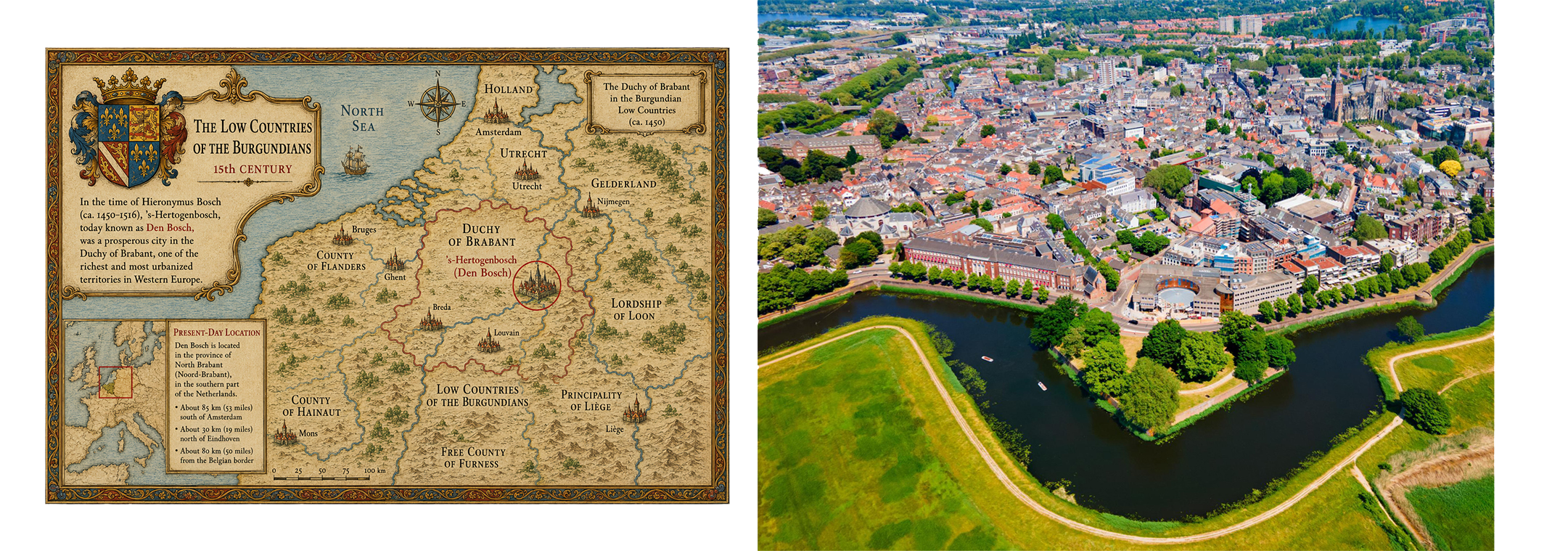
Hieronymus Bosch’s Garden of Earthly Delights was painted in 's-Hertogenbosch.Jheronimus was born in a city located roughly between Amsterdam and present-day Belgium, in one of the wealthiest, most urbanized, and most dynamic regions of fifteenth-century Europe.
In the Garden, if every human, animal, bird, fish, monster, hybrid, and demon is counted, Bosch may have created one of the most densely populated ecosystems in the history of painting. The Garden of Earthly Delights does not merely depict a crowd. It depicts a world.
Long before it became one of the treasures of the Prado Museum, the triptych passed through the collections of princes, rebels, military leaders, and royal officials. Its journey across the sixteenth century offers a fascinating glimpse into the political and cultural history of Europe. The earliest documented owner of the painting was Count Engelbert II of Nassau, one of the most powerful noblemen of the Burgundian Netherlands. By the middle of the sixteenth century, the triptych was hanging in the Nassau Palace in Brussels, where visitors recorded seeing the extraordinary work. The painting was already regarded as an object worthy of attention, admired for its imagination and complexity.
The next stage of the story brought the work into the possession of William of Orange, known to history as William the Silent. As Prince of Orange and leader of the Dutch Revolt, William became one of the principal opponents of Spanish rule in the Low Countries. During the political and military turmoil that followed, many of his possessions were confiscated by the Spanish Crown.
In 1568, the Duke of Alba, Fernando Álvarez de Toledo, acting on behalf of Philip II, seized properties associated with William of Orange. Among the confiscated possessions was Bosch’s remarkable triptych. The painting therefore entered the orbit of one of the most powerful aristocratic families in Spain.
At some point after the confiscation, the work came into the possession of Don Fernando de Toledo, the Duke of Alba’s natural son. Don Fernando was no minor figure. He served as Grand Prior of Castile in the Order of Saint John, held important military commands, acted as Viceroy of Catalonia, and moved within the highest circles of the Spanish monarchy. Wealthy, influential, and deeply connected to both religious and political institutions, he represented the elite culture of late sixteenth-century Spain.
The precise date on which Don Fernando acquired the painting remains uncertain. Historians do not yet know whether it passed directly to him soon after the confiscation or whether it remained for a time under the control of his father. What is certain is that by the time of Don Fernando’s death in 1591, the Garden of Earthly Delights formed part of his collection.
This period of ownership is particularly intriguing. The painting was not hidden away as an embarrassing curiosity, nor was it condemned as a dangerous work. Instead, it appears to have remained within the collection of a highly placed nobleman and religious official. For years, perhaps decades, it was likely viewed by members of the Spanish aristocracy, military leaders, clerics, and visitors connected to the court.
Following Don Fernando’s death, his possessions were auctioned. In 1591 Philip II purchased the triptych from the sale. The king’s interest in Bosch is well documented. He collected numerous works by the painter and regarded them with exceptional esteem. This fact alone deserves reflection. Philip II was one of the most devout Catholic rulers of the age, yet he actively sought out Bosch’s paintings and preserved them within one of the most important religious foundations of his kingdom.
Two years later, in 1593, the painting was transferred to the Monastery of El Escorial. There it remained for centuries, becoming part of Spain’s royal artistic heritage. Eventually, in the nineteenth century, it entered the collection of the Prado Museum, where it continues to attract scholars, artists, and visitors from around the world.
The succession of owners tells us something important about the painting itself. The Garden of Earthly Delights was not treated as a marginal object. It moved through the hands of some of the most powerful individuals of its age. Noble families preserved it. Political leaders claimed it. Religious figures owned it. A king deliberately acquired it.
The painting’s passage from Nassau to Orange, from Orange to the House of Alba, from Don Fernando de Toledo to Philip II, and finally to El Escorial reflects more than a chain of ownership. It reveals a continuous recognition of the work’s importance. Whatever Bosch intended, generations of influential viewers considered the painting worthy of preservation, study, and admiration.
That remarkable journey remains part of the mystery of the Garden itself.
Juan de Barrientos