

Theatrical Experience
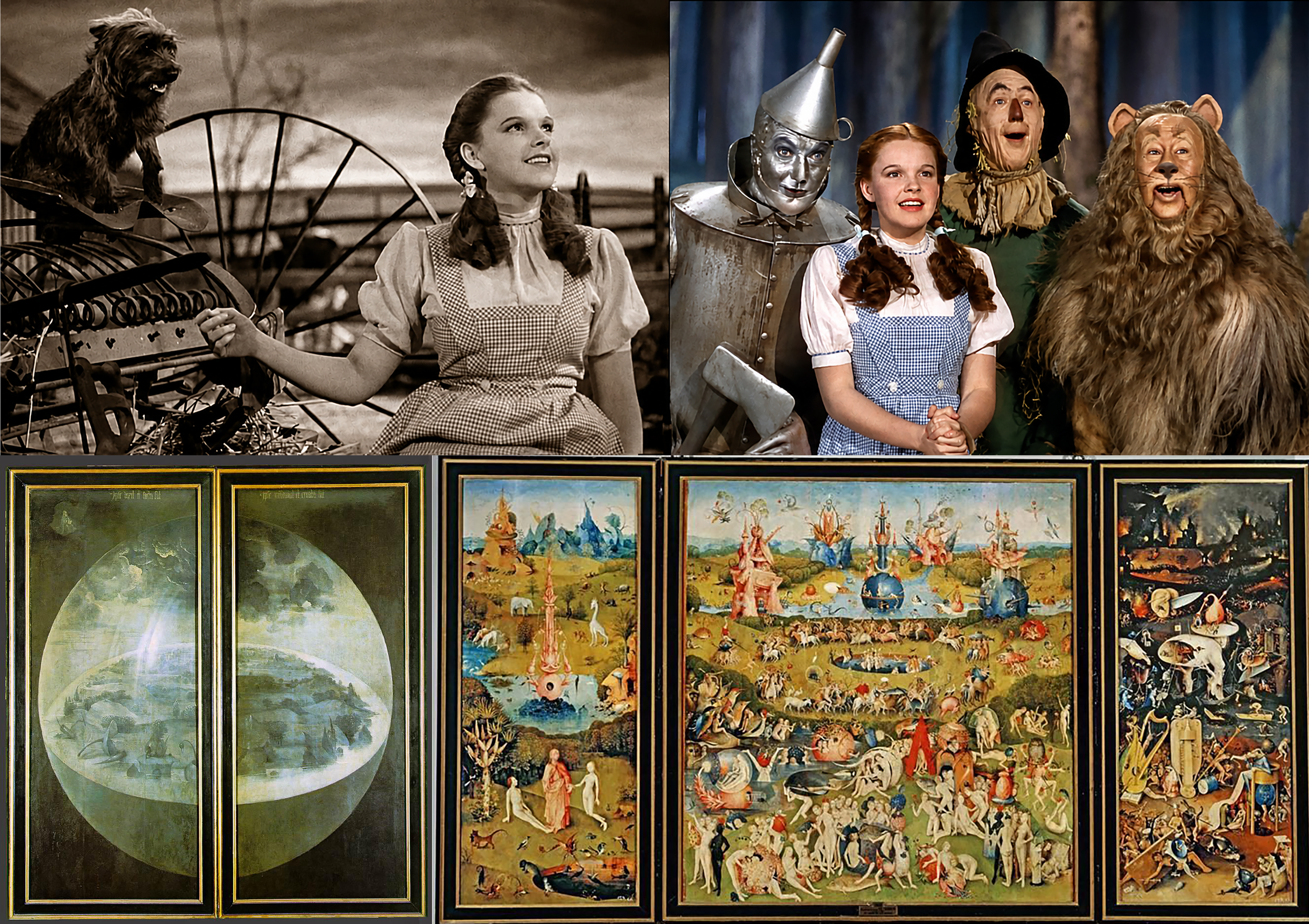
The Garden of Earthly Delights as Installation and Theatrical Experience.
Viewers often encounter The Garden of Earthly Delights already open inside the Museo del Prado. The famous central panorama immediately dominates the eye: impossible creatures, naked figures, gigantic fruits, infernal structures, strange animals, pools, birds, and microscopic scenes unfolding simultaneously across nearly four meters of painted surface. Yet this museum presentation may conceal one of the most important aspects of Bosch’s masterpiece. The triptych was not simply designed to exist as an image. It was designed to be revealed.
Closed, the exterior panels present a restrained grisaille vision of the world during Creation. The earth appears enclosed within a transparent sphere floating in darkness beneath the small figure of God. Compared with the interior, the exterior is austere, almost silent. Bosch deliberately suppresses color in order to create a sense of cosmic suspension.
Then the wings open.
The visual transformation must have been extraordinary.
The physical characteristics of the triptych force us to think beyond painting alone. Opened, the structure measures almost four meters across and according to my calculations weighs between 250 and 300 kgs, between 551 and 661 pounds.
Such an object could not have been casually handled or simply suspended like a modern framed canvas.
It is my belief that originally, a special room might have existed in order to see and appreciate the painting in daylight.
If Engelbert II of Nassau was indeed the commissioner, as many scholars suspect, he possessed both the resources and the social status necessary to dedicate a room specifically to the display of such an extraordinary object.
This remains a reasoned historical reconstruction rather than documented fact, yet the physical demands of the object strongly suggest controlled architectural conditions. Bosch’s painting contains immense quantities of microscopic detail impossible to appreciate properly under weak candlelight. Late medieval candles produced unstable and limited illumination. The extraordinary visual complexity of the triptych instead seems to demand sustained daylight viewing.
This immediately increases the importance of the room itself.
One begins to imagine a carefully selected aristocratic chamber in the Low Countries perhaps with large windows, controlled daylight, sufficient viewing distance, and enough architectural space to accommodate the opening wings. The painting may not merely have decorated the room. It may have transformed it.
The triptych was most probably commissioned for the sophisticated courtly environment Engelbert II of Nassau-Breda. Within such noble circles, ceremonial presentation and controlled revelation played an important social role. Collections of rare objects, tapestries, relics, illuminated manuscripts, and exotic artifacts were often displayed selectively to distinguished visitors.
The Garden of Earthly Delights fits naturally into this culture of revelation.
Its exterior panels already establish anticipation. The viewer first encounters a mysterious monochromatic world. Then, at the appropriate moment, the wings open and color explodes outward into the room itself.
This effect may well have been intentional.
Bosch appears deeply conscious of psychological rhythm: concealment followed by revelation, restraint followed by excess. The closed grisaille compresses visual experience. The interior releases it with overwhelming force.
The spectator crosses from silence into sensory abundance.
The physical opening of the wings becomes part of the meaning of the work itself.
One further possibility deserves consideration. Given the enormous size and weight of the triptych, it is plausible that household attendants or servants participated in its ceremonial unveiling. This too remains a weighted historical assumption rather than documented fact, yet it fits remarkably well with the material reality of the object and the ceremonial culture of aristocratic courts.
One can easily imagine noble guests entering the room and first encountering the work in its closed state. Then, at the proper moment, two attendants might simultaneously open both wings in perfect symmetry. Such synchronization would have intensified the theatrical force of the revelation enormously.
As the wings opened, the monochromatic world of Creation would gradually give way to something entirely different. Then suddenly an entire universe would emerge from within the silent globe: water and flesh, birds and fruits, pleasure and punishment, crystalline structures and infernal fire.
At the conclusion of the viewing, the attendants may have closed the wings once more, returning Bosch’s immense symbolic universe to monochromatic silence.
This possibility is fascinating because it restores the physical and temporal dimension of the triptych — something almost entirely lost in modern reproductions.
Books, screens, and posters flatten the work into a permanently exposed image. Bosch’s original viewers likely experienced something much slower, more ceremonial, and psychologically controlled.
The work behaved almost like a visual machine.
This theatrical dimension also explains why Bosch invested such effort into the exterior grisaille panels. Many triptychs of the period possess relatively simple exteriors because they remained closed during ordinary liturgical periods. Bosch, however, painted the exterior with exceptional care. The closed state clearly mattered.
The triptych therefore functions simultaneously as painting, architecture, installation, and ritual object.
The more one studies its hinges, scale, movement, and sequential revelation, the less it resembles a conventional static image. Bosch understood that concealment intensifies revelation. The psychological tension created by the closed panels amplifies the force of the interior enormously.
Modern readers may find an unexpected comparison interesting, in The Wizard of Oz, audiences experience the transition from the monochromatic world of Kansas to the dazzling colours of Oz. The power of the scene lies not simply in colour, but in transformation. One reality disappears and another suddenly takes its place. Bosch's triptych may have produced a comparable effect. The viewer first encountered a silent grey world enclosed within the sphere of Creation. Then the wings opened, and an entirely different universe appeared.
Very few artworks of the late medieval or early Renaissance world achieve this level of immersive control over the viewer’s perception.
The Garden was not merely observed.
It was experienced.
Juan de Barrientos