

The materials and tools that Jheronimus used
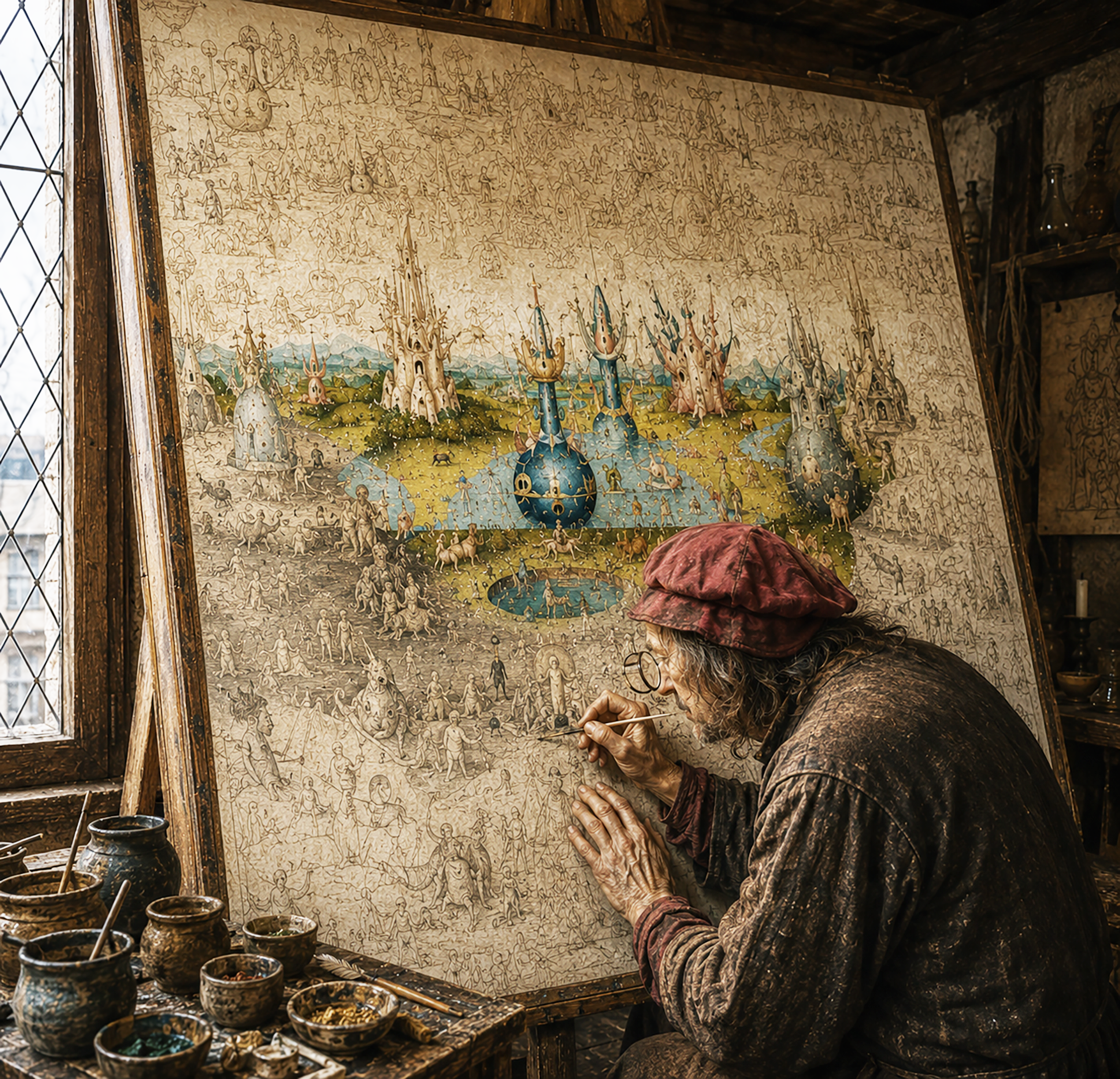
The Tools of Wonder: Bosch's Workshop and the Making of a Vision
Let us understand how a painting was executed in the sixteenth century. Every detail had to be created using the tools and techniques available at the time.
Before we discuss Bosch's ideas, symbols, or intentions, it is worth considering something more humble. What did he hold in his hands?
The road to The Garden of Earthly Delights did not begin with fantastic creatures or philosophical concepts. It began with a table of oak, a sharpened quill, a handful of pigments, a few brushes, and the daily discipline of a craftsman.
The support itself required considerable preparation. Bosch did not paint on canvas. Like most Netherlandish painters of his time, he worked primarily on carefully prepared oak panels. The wood was selected, seasoned, assembled, and coated with layers of preparation before a single figure could be drawn. The surface was commonly covered with a white ground composed of chalk or finely ground calcium carbonate mixed with animal glue. This preparation created a smooth, luminous surface capable of reflecting light through subsequent layers of paint.
That white ground played a crucial role in the final appearance of the painting. Spectators often focus on the pigments, but the brilliance of Netherlandish painting depends equally upon the light reflected from beneath them. In a sense, the luminosity of Bosch's colours begins not with blue or red pigments, but with a layer of white chalk hidden beneath everything else.
Once the panel had been prepared, Bosch could begin to draw.
He did not possess the modern pencil. The familiar graphite pencil would not become widely available until after his lifetime. Instead, he likely used charcoal, black chalk, metalpoint, or brush and ink to establish his preliminary designs. The surviving drawings associated with Bosch reveal an artist of remarkable confidence. The lines are fluid, economical, and expressive. They suggest a mind capable of visualising complex forms long before they reached the painted surface.
The drawing stage may have occupied many days or weeks. Hundreds of figures had to be positioned. Landscapes had to be organised. Relationships between forms needed to be established. The apparent spontaneity of the finished work conceals a considerable amount of planning.
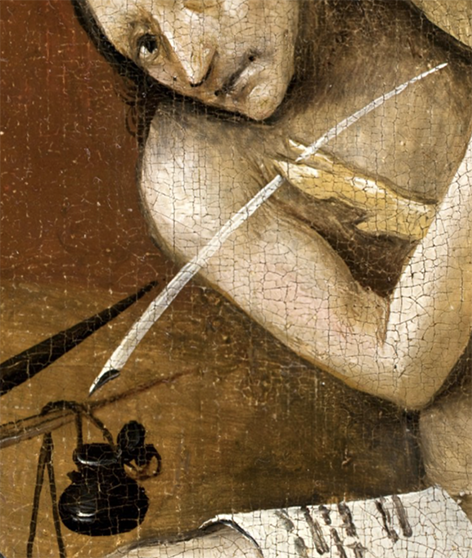
Bosch shows the instruments used in his time
The instrument most frequently used during this phase was probably a quill pen. These pens were commonly made from goose feathers, though swan and crow feathers were also employed. The artist cut and shaped the nib himself using a small knife. When the tip became worn, it was sharpened again. Every line visible in Bosch's drawings originated from a feather that had first been transformed into a tool by the artist's own hands.
The knife itself was among the most important objects in the workshop. It sharpened quills, scraped errors, prepared materials, and assisted in countless practical tasks. Although rarely celebrated in discussions of art history, the knife was as essential to the painter as the brush.
Only after drawing could painting begin.
The pigments available to Bosch were relatively limited compared with those available to artists today. Yet their quality was often extraordinary. Blues were commonly derived from azurite. Greens could be produced from copper-based pigments such as malachite. Earth pigments supplied yellows, reds, and browns. Carbon blacks provided deep shadows. Many colours originated as minerals extracted from the ground, crushed into powder, and transformed into paint.
The workshop therefore contained a curious collection of substances: stones reduced to dust, coloured earths, oils, glues, and liquids stored in ceramic vessels. To us, these materials might appear primitive. Yet they formed the basis of some of the most sophisticated paintings ever created.
The brushes used by Bosch were equally modest. They bore little resemblance to many modern brushes. Some were made from squirrel hair, marten hair, or other fine animal fibres. Particularly delicate brushes could be astonishingly small. Certain historical examples were fashioned by inserting hairs into the hollow shaft of a bird feather and securing them with thread.
Such brushes were capable of extraordinary precision. When we examine the tiny figures scattered throughout The Garden of Earthly Delights, it becomes difficult to imagine the patience required to paint them. Many details are only a few millimetres in size. Yet each had to be painted deliberately, often under natural light, by a hand guided with immense control.
That natural light shaped the rhythm of the workshop.
Bosch lived centuries before electric illumination. He painted by daylight. Large windows were therefore among the most important features of a painter's studio. Northern light was especially prized because it remained relatively stable throughout the day. The quality of available light determined when work could begin and when it had to stop.
In winter, productive hours were limited. Clouds, rain, and seasonal darkness all affected the pace of work. The artist can continue painting deep into the night beneath powerful lamps today. Bosch could not. His schedule was governed by the sun.
This fact is easy to overlook. Yet it reminds us that the creation of a masterpiece was not simply an intellectual exercise. It was also a physical negotiation with time, weather, fatigue, and light.
The process itself unfolded gradually. Areas of drawing were followed by modelling, underpainting, colour, and transparent glazes. Some passages remained unfinished while others approached completion. For months, perhaps years, Bosch would not have seen the finished painting that we admire today. Instead, he would have seen a constantly changing object: part drawing, part grisaille, part colour, part possibility.
Perhaps this is the most fascinating aspect of all.
We encounter The Garden of Earthly Delights as a completed masterpiece. Bosch only experienced it that way after years of work. During most of its creation, the painting existed only in fragments. Certain sections were complete while others remained little more than lines upon a prepared panel. The work emerged slowly, detail by detail, layer by layer, day after day.
The contrast is striking. One of the most imaginative images in Western art was created using remarkably simple tools: a panel of oak, a layer of chalk, a feather, a knife, a few brushes, and pigments derived from stone and earth.
The complexity of Bosch's vision can sometimes make us forget the simplicity of its means. Yet perhaps that is precisely what makes the achievement so extraordinary. The wonders of The Garden of Earthly Delights did not appear through magic. They emerged through patience, craftsmanship, and thousands of careful decisions made by a man seated beside a window, working by natural light, with a brush in his hand.
Juan de Barrientos